
Introduction
Your garden is not just a patch of land. It is a potential lifeline for wildlife in a world where natural habitats are shrinking every day. Learning how to support biodiversity in home garden spaces provides one of the most practical and immediate actions any individual can take in response to the global biodiversity crisis.
You do not need a large garden, specialist knowledge, or a significant budget. The 12 changes in this guide can be implemented in any outdoor space — from a small balcony to a large rural plot — and each one makes a genuine, measurable difference to local wildlife populations.
Understanding how to support biodiversity in home garden efforts takes only a small shift in perspective: from seeing your garden as a display space to seeing it as a fragment of habitat in an ecosystem that desperately needs reconnection.
Why Gardens Matter for Biodiversity
Gardens collectively cover an enormous area. In the UK alone, private gardens cover approximately 4,330 square kilometers—larger than all the country’s national nature reserves combined. In India, urban gardens, farmhouses, temple grounds, and school campuses add up to millions of hectares of land that could either support or suppress local biodiversity.
When managed with wildlife in mind, gardens become stepping stones in the landscape—patches of suitable habitat that allow insects, birds, reptiles, amphibians, and small mammals to move between larger natural areas. Learning how to support biodiversity in home garden environments can provide this, therefore, and is not just about your plot. It is about connecting the wider ecological network.
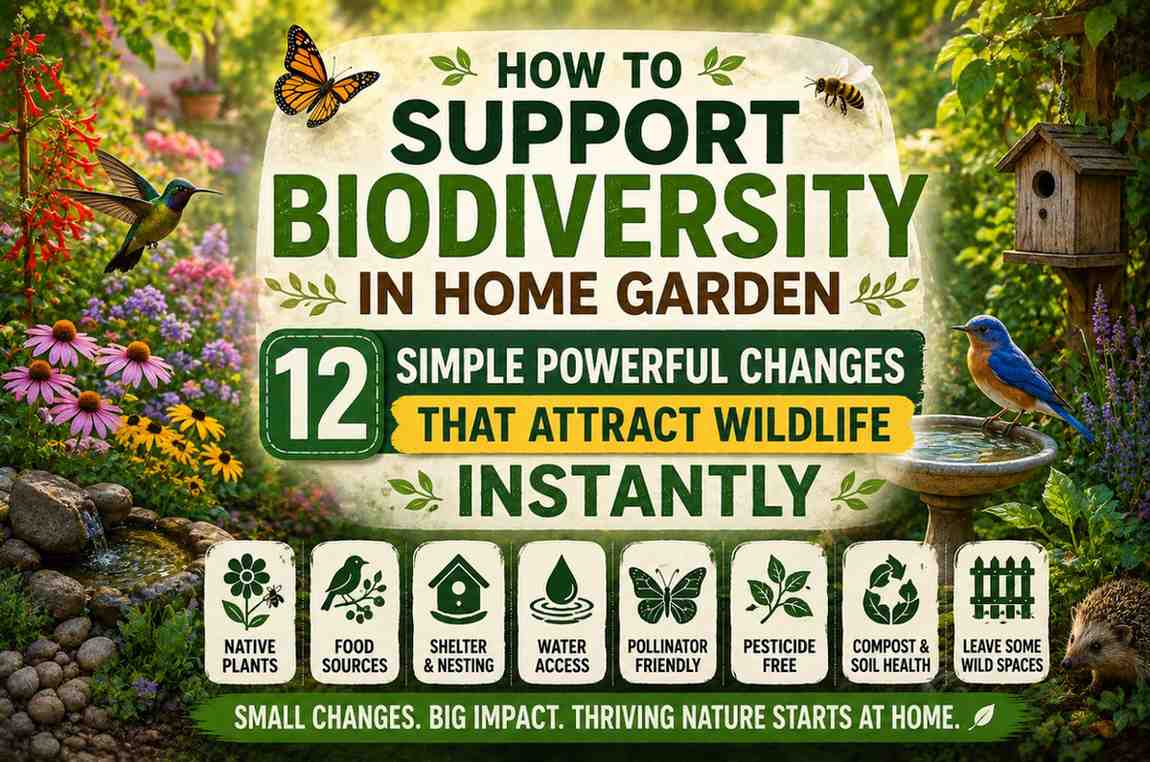
12 Powerful Changes to Support Biodiversity in Your Garden
Change 1: Plant Native Species
The single most effective way of discovering how to support biodiversity in home garden spaces can be achieved by replacing exotic ornamentals with native plant species. Native plants have co-evolved with local insects over thousands of years. They provide nectar, pollen, leaves, and seeds in the right forms, at the right times, for the wildlife that evolved alongside them.
A garden dominated by exotic species—however beautiful—is essentially a desert for most native insects. A garden full of native wildflowers, shrubs, and trees is a feast.
Change 2: Let Part of Your Lawn Grow Wild
Perfectly manicured lawns are ecological wastelands. Allowing even a section of your lawn to grow longer provides habitat for crickets, beetles, spiders, voles, hedgehogs, and dozens of wildflower species. Wild patches also provide nesting cover for ground-nesting insects, including many solitary bee species.
This is perhaps the simplest answer to how to support biodiversity in home garden environments—do less, not more.
Change 3: Install a Wildlife Pond
Water is one of the most important resources any garden can provide for wildlife. A pond — even a small one in a half-barrel or a dug-out depression — creates habitat for frogs, toads, newts, dragonflies, water beetles, and numerous invertebrates. It also provides drinking and bathing water for birds and mammals.
A wildlife pond does not need a pump or filter. Still, shallow water with gently sloping edges and native aquatic plants is far better for wildlife than a formal, manicured water feature.
Change 4: Build a Compost Heap
A compost heap is far more than a recycling facility. It is a miniature ecosystem—a warm, moist, food-rich habitat that supports slow worms, hedgehogs, grass snakes, beetles, and an extraordinary diversity of soil microorganisms. The compost it produces also enriches your soil, reducing the need for chemical fertilizers. This is one of the most overlooked answers to how to support biodiversity in home gardens practitioners ask about.
Change 5: Stop Using Pesticides and Herbicides
Garden pesticides kill indiscriminately. Insecticides kill the pest species you target — and the beneficial insects, predatory beetles, ground beetles, hoverflies, and lacewings that would otherwise provide natural pest control. Herbicides eliminate the wildflowers that sustain pollinators.
The most impactful thing many gardeners can do when they ask how to support biodiversity in home garden environments is simply to stop poisoning them.
Change 6: Create Habitat Piles
Piles of logs, stones, and leaf litter provide essential overwintering habitat for hedgehogs, toads, beetles, and dozens of invertebrate species. A well-positioned log pile is one of the highest-biodiversity habitats you can create in a garden with essentially zero effort or cost.
Stack logs in a shaded spot and leave them to slowly decay over years. The deadwood ecosystem they support will reward you with a remarkable diversity of fungi, beetles, and the birds that feed on them.
Change 7: Install Nesting Boxes for Birds and Bats
The loss of mature trees with natural cavities has reduced nesting sites for many hole-nesting birds — blue tits, great tits, nuthatches, treecreepers, and owls. Bat boxes address the equivalent crisis for bats, which are heavily constrained by the loss of old buildings and mature trees with suitable roost spaces.
Choosing the right box type and positioning it correctly—typically in a sheltered, north-to-southeast-facing direction, 3–5 meters high—is a key part of learning how to support biodiversity in home. Garden spaces provide for nesting wildlife.
Change 8: Leave Seed Heads and Dead Stems Over Winter
The autumn tidying instinct destroys enormous amounts of wildlife habitat. Hollow stems provide overwintering sites for solitary bees. Seed heads provide food for finches, tits, and sparrows through the leanest months of the year. Dead flowerheads support overwintering invertebrates and their eggs.
Resisting the urge to cut back every autumn is a simple but surprisingly impactful part of how to support biodiversity in home. Garden managers can implement it immediately.
Change 9: Grow a Hedgerow Instead of a Fence
Hedgerows are among the richest habitats in the agricultural landscape. A mixed native hedgerow of hawthorn, blackthorn, hazel, dog rose, and elder provides nesting cover for birds, food for insects and small mammals, and connectivity for hedgehogs and other ground-dwelling wildlife.
Replacing a solid fence with a hedge — or simply planting a hedge in front of it — transforms a barrier into a wildlife corridor.
Change 10: Reduce Hard Surfacing
Paved and concreted surfaces shed rainwater, overheat during summer, and provide nothing for wildlife. Replacing areas of hard surfacing with permeable gravel, gravel planted with creeping native plants, or lawn allows water infiltration, reduces the heat island effect, and creates ground-level habitat.
Permeable surfaces are also better for your garden’s drainage and for reducing flash flood risk downstream — a practical benefit alongside the biodiversity gain.
Change 11: Create a Solitary Bee Hotel
While honeybees are colonial, over 90% of the world’s 20,000 bee species are solitary—they do not live in hives. Solitary bees are highly efficient pollinators, but they need suitable nesting sites: hollow plant stems, holes in wood, or bare soil. A bee hotel provides these sites.
Install your bee hotel in a sunny, sheltered south-facing position, at least one meter above the ground. This is one of the most frequently recommended answers to how to support biodiversity in home gardens gardeners ask for and one of the most immediately rewarding.
Change 12: Connect With Your Neighbours
Your garden’s biodiversity impact is multiplied many times over when neighboring gardens adopt similar practices. A hedgehog corridor of connected gardens, a street-wide wildflower verge, or a neighborhood wildlife pond network creates landscape-scale connectivity from individual plot-level action.
Talk to your neighbors, share seeds and plants, and consider joining local biodiversity recording projects to track the wildlife your garden network supports. This collective dimension is one of the most important and undervalued aspects of how to support biodiversity: in-home gardens communities can coordinate.
The Bigger Picture
Every one of these 12 changes connects your garden to the wider crisis in global biodiversity. Understanding how to support biodiversity in home garden spaces starts with recognizing that the boundary of your plot is not a boundary for wildlife—it is a temporary resting point in a landscape that needs all the help it can get.
Individual action matters. But it matters most when it is part of a collective movement—of policy change, corporate accountability, and the reconnection of fragmented landscapes at scale. (See Biodiversity Loss Causes and Effects 2026.) (See Nature Positive Business Strategies 2026.)
Conclusion: Start Today
You do not need to implement all 12 changes at once. Start with one — a log pile, a patch of long grass, a bag of native wildflower seeds. Each change you make answers the question of how to support biodiversity in home garden environments, one square meter at a time.
The cumulative effect of millions of gardeners making these choices is not symbolic. It is ecological. It is measurable. And it is happening right now in gardens and allotments and balconies and school grounds across the world.
Last updated: May 2026 | Related: What Is Biodiversity and Why Is It Important | Biodiversity Loss Causes and Effects 2026




 creator@ecometric.site