Introduction
Nature-positive business strategies in 2026 are no longer an edge-case sustainability initiative. They are becoming a mainstream corporate imperative—driven by new disclosure requirements, investor pressure, supply chain risk, and a growing recognition that businesses cannot thrive in a world of collapsing ecosystems.
In 2026, the question is no longer whether companies should measure their biodiversity impact. For an increasing number of businesses—and for the regulatory environment they operate in—the question is how, how fast, and how credibly.
This article explains what nature-positive business strategies 2026 actually mean, what the leading frameworks and tools look like, and how eight companies across different sectors are pioneering approaches that may define the corporate standard for the next decade.
What Does “Nature Positive” Actually Mean?
Nature positive is a goal for the global economy to halt and reverse nature loss by 2030, measured from a 2020 baseline, and to achieve full recovery by 2050. It was adopted as a high-level framing concept at the Kunming-Montreal Global Biodiversity Framework negotiations and has since been embraced by a growing coalition of businesses, governments, and financial institutions.
At its core, nature-positive business strategies 2026 require companies to do three things: measure their impact on biodiversity and nature, reduce that impact through operational and supply chain changes, and restore nature through direct investment and offsetting for unavoidable impacts.
The nature-positive business strategies 2026 framework is explicit that “no net loss” of biodiversity is not sufficient. The goal is measurable positive outcomes—a net gain in biodiversity, not merely the avoidance of net loss.
The Key Frameworks Driving Nature-Positive Business in 2026
TNFD: Taskforce on Nature-related Financial Disclosures
The Taskforce on Nature-related Financial Disclosures (TNFD) published its final reporting recommendations in 2023 and has since seen rapid adoption by major corporations and financial institutions. The TNFD framework provides standardized guidance for companies to assess, disclose, and manage their nature-related dependencies, impacts, risks, and opportunities.
By 2026, the TNFD framework has become a centerpiece of nature-positive business strategies in 2026, with over 400 major companies having committed to TNFD-aligned reporting. Regulatory bodies in the EU and several other jurisdictions are moving towards mandatory nature disclosure requirements that will bring TNFD into compliance obligations.
Science Based Targets for Nature (SBTN)
The Science Based Targets Network (SBTN) has developed a methodology for setting nature targets that are aligned with what the science says is required to halt and reverse biodiversity loss. Like science-based climate targets, SBTN targets anchor corporate action to measurable ecological outcomes rather than arbitrary corporate preferences.
The SBTN methodology is a key tool in the nature-positive business strategies 2026 toolkit, providing companies with a credible, externally validated basis for setting and measuring progress against biodiversity goals.
Natural Capital Accounting
Natural capital accounting integrates the economic value of ecosystem services—clean water, pollination, carbon storage, and coastal protection—into corporate and national accounts. Tools like the Integrated Biodiversity Assessment Tool (IBAT) and the ENCORE platform help companies identify which aspects of their operations depend on and affect specific ecosystem services.
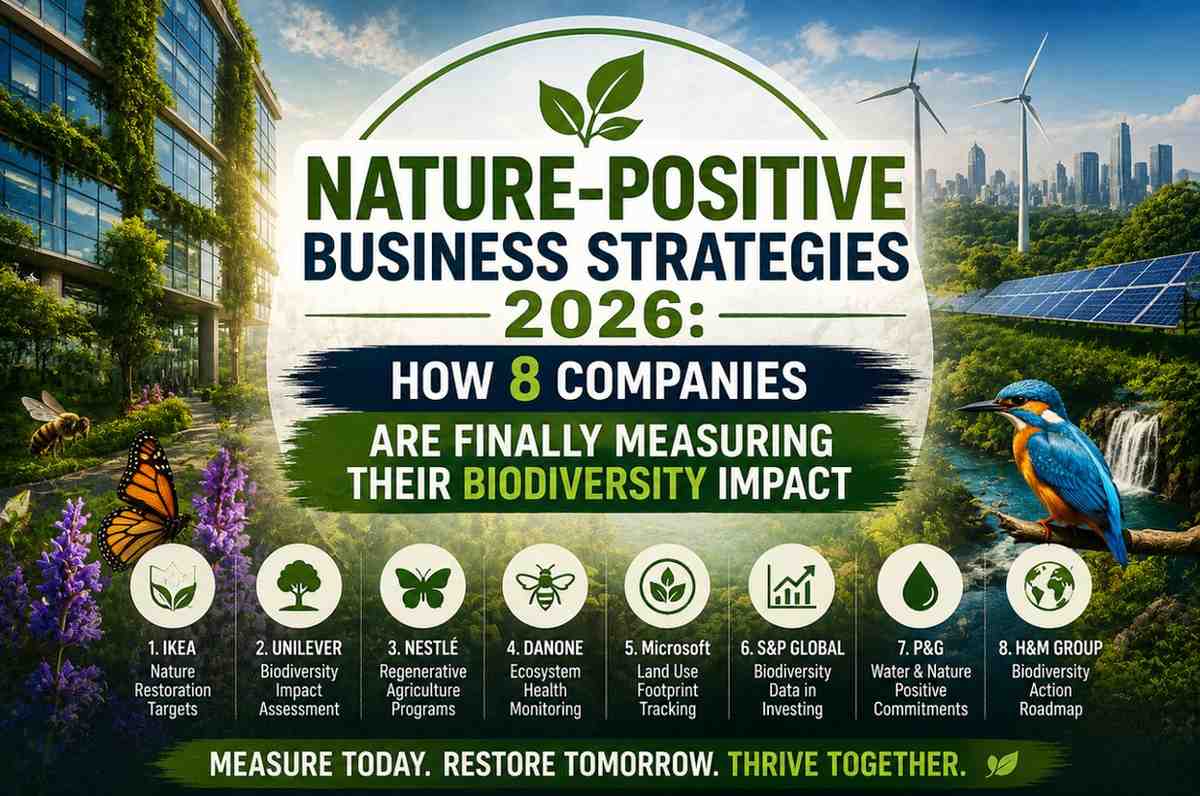
8 Companies Leading Nature-Positive Business Strategies in 2026
1. Unilever
Unilever has committed to achieving a nature-positive supply chain by 2030, with particular focus on deforestation-free sourcing of palm oil, soy, cocoa, and tea. The company’s nature-positive business strategies 2026 approach includes TNFD-aligned disclosure, nature-positive commitments in its forest-risk commodity supply chains, and investment in landscape-level conservation programs.
Unilever’s Regenerative Agriculture Code now covers over 20 sourcing countries, setting standards for soil health, biodiversity, and water stewardship that go substantially beyond conventional sustainability certification.
2. AXA Group
AXA was one of the first major financial institutions to make a formal nature-positive business strategies 2026 commitment, announcing its intention to align all investment portfolios with nature-positive outcomes through a combination of exclusion policies, engagement with investee companies, and positive investment in nature-based solutions.
AXA’s approach demonstrates how financial sector engagement can leverage biodiversity improvements far beyond the company’s direct operational footprint.
3. Nestlé
Nestlé’s commitment to regenerative agriculture and forest-positive supply chains is one of the most comprehensive nature-positive business strategies and 2026 programs in the food sector. The company has mapped its key biodiversity impact pathways—primarily through agricultural sourcing—and is implementing supplier programs to restore and maintain biodiversity in key sourcing landscapes.
Nestlé was among the first food companies to publish TNFD-aligned nature-related disclosure, covering its exposure to nature-related risks in its most critical sourcing landscapes.
4. Infosys (India)
India’s own Infosys is an interesting nature positive business strategies 2026 case study because technology companies — whose direct operational footprint is relatively modest — are discovering that their significant indirect impacts through supply chains and hardware procurement require nature-related assessment and action.
Infosys has committed to net-zero emissions and water positivity and is now integrating biodiversity considerations into its campus management, supply chain standards, and community investment programs. Its campuses across India are being redesigned as biodiversity corridors, incorporating native plantings, wildlife water sources, and reduced night lighting.
5. Holcim
The construction materials sector is among the highest-impact in terms of direct land use, quarrying, and habitat destruction. Holcim, one of the world’s largest cement and aggregates companies, has developed a nature-positive business strategies 2026 program that sets specific biodiversity targets for every site it operates.
Holcim’s quarry rehabilitation program has been independently verified to have delivered net biodiversity gains at over 80% of its rehabilitated sites—converting exhausted quarries into wetlands, grasslands, and woodland habitats with high ecological value.
6. HSBC
HSBC’s commitment to aligning its financial portfolios with nature-positive outcomes represents a major signal from the banking sector. The bank has committed to no new financing for primary deforestation activities, to disclosing its exposure to forest-risk commodities, and to developing nature-related targets across its lending and investment portfolios by 2026.
Nature-positive business strategies in 2026 in the financial sector are particularly powerful because they shape the investment environment for the entire economy—determining which industries find it easy to access capital and which do not.
7. Patagonia
Patagonia’s approach to nature-positive business strategies in 2026 is distinctive because biodiversity and ecological health are not treated as a compliance requirement or a stakeholder communication challenge. They are the central purpose of the business. The company donates 1% of sales to environmental causes, funds grassroots biodiversity restoration projects, and maintains rigorous supply chain standards.
Patagonia’s conversion from a private company to a purpose trust—with ownership effectively transferred to environmental causes—is an extreme but instructive example of how ownership structure can align business incentives with nature-positive outcomes.
8. Tata Group (India)
India’s Tata Group represents the growing engagement of major Indian conglomerates with nature-positive business strategies in 2026 across diverse sectors, including steel, automotive, hospitality, and consumer goods.
Tata’s nature-related commitments include biodiversity management plans at its major industrial sites, engagement with indigenous communities in its operational landscapes, and investment in ecological restoration on degraded lands adjacent to its facilities. The group’s scale and reach across the Indian economy make its engagement with nature’s positive principles particularly significant for biodiversity outcomes in India specifically.
The Challenges Still Facing Corporate Biodiversity Action
Nature-positive business strategies in 2026 face several significant challenges that limit their effectiveness even where genuine commitment exists.
Measurement complexity is perhaps the biggest. Unlike carbon, which can be expressed in a single unit (tonnes of CO₂e), biodiversity has no equivalent universal metric. Different metrics are appropriate for different ecosystem types, different impact pathways, and different geographic scales.
Supply chain opacity means that most of the biodiversity impact of large companies happens far from their direct operations — in the farms, forests, and mines that supply their raw materials. Achieving visibility and accountability across complex global supply chains remains technically and practically challenging.
The greenwashing risk is real. The credibility of nature-positive business strategies 2026 depends on standardized, independently verified reporting against consistent baselines and targets. Without this, corporate nature claims risk becoming marketing exercises rather than genuine ecological commitments.
Conclusion: Business Is Finally Waking Up
Nature-positive business strategies 2026 represent a genuine and significant shift in the relationship between business and biodiversity. For decades, business’s relationship with nature was essentially extractive—taking what was needed and externalizing the ecological costs.
The frameworks, tools, and corporate examples profiled here show that a different relationship is not only possible but economically rational. Companies that depend on nature-derived raw materials, stable climate, clean water, and healthy ecosystems have every incentive to protect and restore the natural systems they depend on.
The momentum behind nature-positive business strategies 2026 is real. Whether it is sufficient to halt and reverse biodiversity loss within the timelines science demands is the defining question of corporate environmental engagement in this decade.
Last updated: May 2026 | Related: COP17 Biodiversity Goals 2026 Armenia | Biodiversity Loss Causes and Effects 2026



 creator@ecometric.site