
Introduction
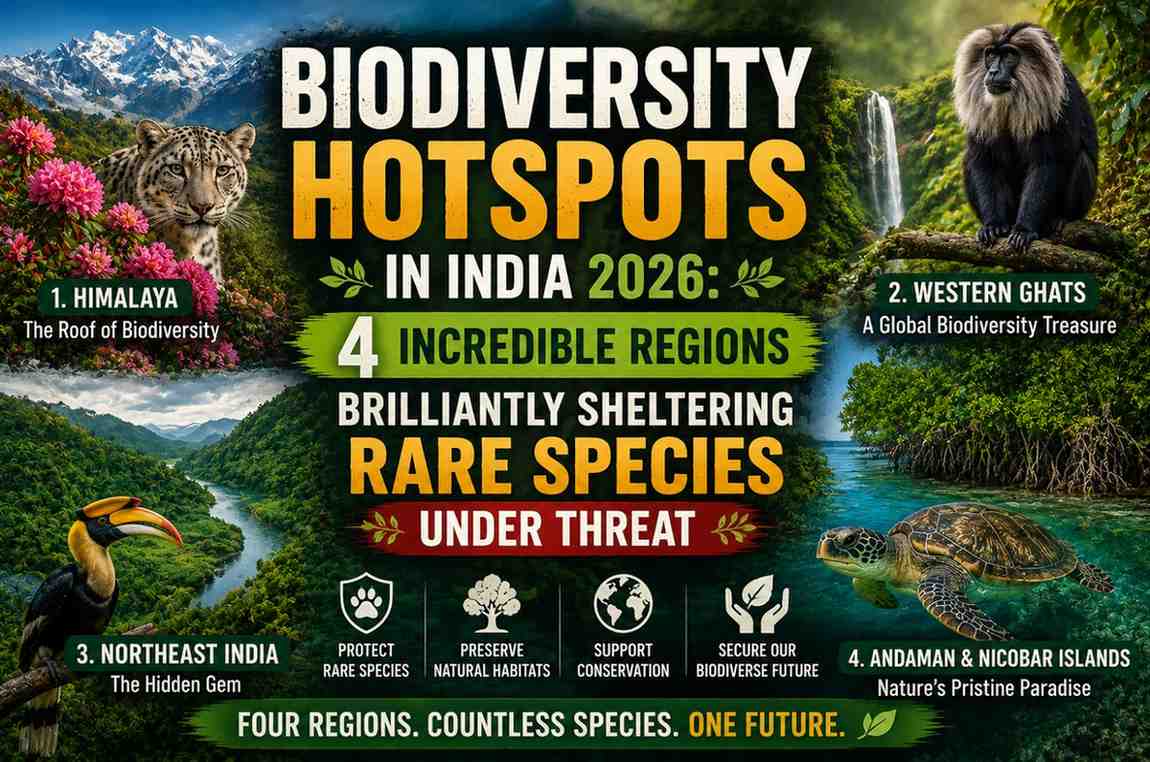
India is one of the most ecologically extraordinary countries on Earth. It is home to four of the world’s 36 recognized biodiversity hotspots, which together harbor thousands of species found nowhere else in the world. Understanding the biodiversity hotspots in India in 2026—both in terms of what they contain and what threatens them—is essential for anyone who cares about the future of life on our planet.
A biodiversity hotspot is defined as a region containing at least 1,500 endemic vascular plant species (found nowhere else) that has lost at least 70% of its original natural vegetation. These two criteria together identify places that are simultaneously extraordinarily rich in life and under extreme pressure.
India’s four hotspots — the Western Ghats, the Eastern Himalayas, the Sundaland region (in the Andaman and Nicobar Islands), and the Indo-Burma region — each tell a different story of biological wonder and conservation urgency.
Why Biodiversity Hotspots in India 2026 Deserve Global Attention
The biodiversity hotspots in the 2026 Indian context are a global conservation priority, not merely a national one. The species sheltered in these four regions represent millions of years of evolutionary history, ecological services of incalculable value, and genetic resources that humanity has barely begun to understand or catalogue.
According to the Wildlife Institute of India, these hotspots collectively support more than 45,000 plant species, over 15,000 animal species, and an extraordinary diversity of fungi, microorganisms, and invertebrates that form the invisible foundation of ecosystem function.
Hotspot 1: The Western Ghats
What Makes It Irreplaceable
The Western Ghats run for approximately 1,600 kilometers along the western edge of peninsular India, from Gujarat in the north to the southern tip of Kerala. Older than the Himalayas by tens of millions of years, the Ghats are one of the world’s oldest mountain ranges—and one of the most biologically rich.
The Western Ghats are the most celebrated of the biodiversity hotspots in India’s 2026 assessments, hosting over 5,000 flowering plant species, of which 1,700 are endemic. The region contains approximately 139 mammal species, 508 bird species, 179 amphibian species (over 80% endemic), and 288 freshwater fish species.
Flagship species include the lion-tailed macaque, the Nilgiri tahr, the Malabar giant squirrel, the Indian giant flying squirrel, and dozens of freshwater fish and amphibian species found in no other river system on Earth.
The Threats It Faces
Despite UNESCO World Heritage Site designation for many of its core zones, the Western Ghats face severe pressure. The key threats confronting this first of India’s biodiversity hotspots in 2026 include plantation encroachment (particularly coffee, tea, and rubber); illegal quarrying; dam construction on protected rivers; invasive weed species like Lantana and Eupatorium; and the growing infrastructure of roads, power lines, and resort development.
The Gadgil Committee report — suppressed by political pressure but thoroughly vindicated by subsequent events — recommended placing the entire ecologically sensitive zone under strict protection. Its partial implementation has left critical areas vulnerable.
Hotspot 2: The Eastern Himalayas
What Makes It Irreplaceable
The Eastern Himalayas encompass the Indian states of Arunachal Pradesh, Sikkim, parts of West Bengal (the Darjeeling hills), and Assam—as well as parts of Nepal, Bhutan, and southern Tibet. This is the second of the biodiversity hotspots in India, 2026, that global conservationists monitor most closely.
This region contains one of the most extraordinary altitudinal gradients on Earth, from subtropical forest floors to permanent ice and snow at over 8,000 meters. Each zone harbors a distinct community of species, many of them endemic to specific elevation bands.
The Eastern Himalayas contain over 163 globally threatened species, including the red panda, snow leopard, takin, Bengal tiger, Asian elephant, and clouded leopard. The region has over 10,000 plant species and some of the world’s finest orchid, rhododendron, and bamboo diversity.
The Threats It Faces
The Eastern Himalayas face threats from hydroelectric dam construction, encroachment at forest margins, illegal trade in plants and animals, and accelerating climate change that is causing glacial retreat and shifting the ranges of mountain-adapted species.
Road construction for strategic and economic connectivity purposes has opened previously inaccessible areas to hunting and logging, compounding pressures on the biodiversity hotspots in India. 2026 conservationists are fighting to protect here.
Hotspot 3: The Andaman and Nicobar Islands (Sundaland Extension)
What Makes It Irreplaceable
India’s Andaman and Nicobar Islands sit at the northern edge of the Sundaland biodiversity hotspot, the third entry in any survey of the biodiversity hotspots in the 2026 Indian landscape. The archipelago of 572 islands contains some of the best-preserved tropical rainforests in the Indian Ocean region.
The islands are home to extraordinarily high levels of endemism. The Andaman and Nicobar Islands have over 650 endemic plant species, 12 endemic bird species, and dozens of endemic reptiles and invertebrates. They are also home to several tribal groups, including the Sentinelese, Jarawa, and Great Andamanese, who have the right to determine their own relationship with the outside world.
The Threats It Faces
Development pressure, particularly from tourism infrastructure, road building, and the expansion of human settlements, poses growing risks to these biodiversity hotspots in India’s 2026 island ecosystems. Climate change is raising sea levels and intensifying cyclones, threatening low-lying forest habitats.
Invasive species introduced by human activity—cats, rats, and feral pigs—are devastating endemic bird and reptile populations on islands where they evolved with no terrestrial predators.
Hotspot 4: The Indo-Burma Region
What Makes It Irreplaceable
The Indo-Burma hotspot covers northeastern India (including Manipur, Nagaland, Mizoram, and parts of Assam and Meghalaya), along with Myanmar, Thailand, Vietnam, Cambodia, and Laos. It is one of the world’s most species-rich but least studied among the biodiversity hotspots in India’s 2026 documented zones.
The Indian portion contains extraordinary forest biodiversity, including the last strongholds of the hoolock gibbon, the clouded leopard, and the Blyth’s tragopan. The region’s rivers are home to endemic fish and freshwater turtles under extreme pressure from overharvesting.
The Threats It Faces
The Indo-Burma region, one of India’s biodiversity hotspots, faces particularly intense pressure in the 2026 landscape from slash-and-burn agriculture, illegal wildlife trade flowing through the region’s porous borders, and the rapid expansion of road infrastructure associated with India’s Act East Policy.
What Conservation Is Doing to Protect India’s Hotspots
India’s conservation response to the pressure on its biodiversity hotspots in India 2026 context includes an expanding network of national parks and wildlife sanctuaries, community forest rights under the Forest Rights Act, and growing investment in corridor connectivity between fragmented protected areas.
The National Biodiversity Authority (http://nbaindia.org) plays a central role in coordinating biodiversity conservation policy, and the Biological Diversity Act provides a legal framework for protecting biological resources and associated traditional knowledge.
Wildlife corridors—strips of forest connecting isolated protected areas—are increasingly recognized as critical infrastructure for maintaining viable populations of large mammals across fragmented landscapes.
Biodiversity Hotspots in India 2026 – FAQs
1. What are biodiversity hotspots in India?
Biodiversity hotspots are regions with rich endemic species and severe habitat loss, requiring urgent conservation to protect unique plants and wildlife.
2. How many biodiversity hotspots are there in India?
India has four biodiversity hotspots: the Himalayas, Western Ghats, Indo-Burma region, and Sundaland including the Nicobar Islands.
3. Why are biodiversity hotspots important?
Biodiversity hotspots protect endangered species, maintain ecological balance, support climate stability, and preserve valuable natural resources for future generations.
4. Which is the most famous biodiversity hotspot in India?
The Western Ghats is India’s most famous biodiversity hotspot because of its exceptional endemic species, forests, and UNESCO World Heritage recognition.
5. What are the main threats to biodiversity hotspots in India?
Deforestation, climate change, pollution, urbanization, mining, and illegal wildlife trade are major threats affecting India’s biodiversity hotspots.
Conclusion: Four Hotspots, One Urgent Mission
The biodiversity hotspots in India 2026 are not just conservation areas. They are the ecological heart of the subcontinent, the reservoirs of species and genetic diversity that underpin India’s agriculture, water security, and climate resilience.
Protecting them is not a luxury. It is a precondition for India’s sustainable development. And investing in their protection today is vastly cheaper than attempting to restore them after collapse—an outcome that, for many of the species they shelter, would be permanent.
Last updated: May 2026 | Related: Most Endangered Species India 2026 | Biodiversity Loss Causes and Effects 2026



 creator@ecometric.site