Introduction
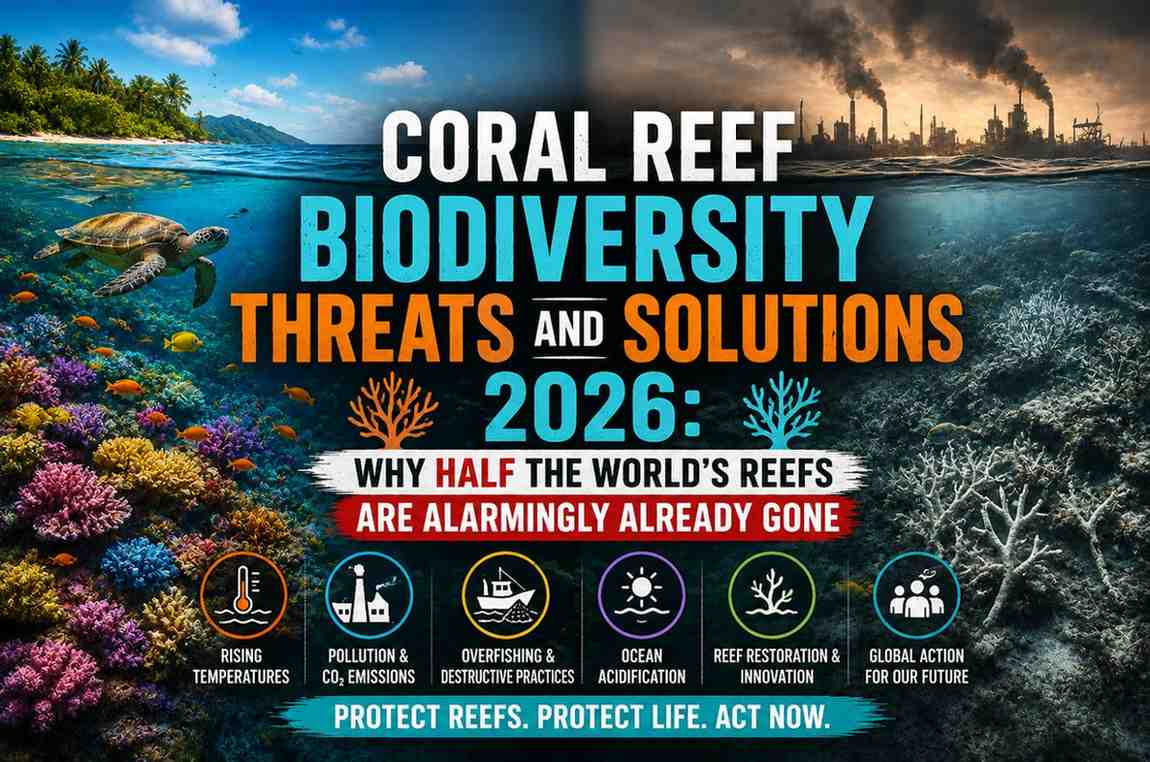
The coral reef biodiversity threats and solutions 2026 data paints a picture that is both devastating and urgently important. Coral reefs occupy less than 1% of the ocean floor, yet they are home to approximately 25% of all marine species. They protect coastlines from erosion and storm damage. They support the fisheries that feed over 500 million people. And they are collapsing.
By 2026, scientists estimate that between 50% and 60% of the world’s coral reefs have been severely degraded or lost entirely. Understanding the coral reef biodiversity threats and solutions 2026 science offers is not just a marine biology concern—it is a food security crisis, a coastal protection emergency, and a biodiversity catastrophe unfolding in slow motion before our eyes.
What Makes Coral Reefs So Extraordinarily Biodiverse?
Coral reefs are built by tiny animals called coral polyps, which secrete calcium carbonate skeletons and host symbiotic algae called zooxanthellae. These algae photosynthesise and provide up to 90% of the coral’s energy needs.
The three-dimensional structure created by decades and centuries of coral growth provides habitat for an extraordinary diversity of fish, invertebrates, and other organisms. The Coral Reef Biodiversity Threats and Solutions 2026 literature consistently notes that coral reefs are sometimes called the tropical rainforests of the sea—a comparison that captures their extraordinary species richness and their extraordinary vulnerability.
The Primary Coral Reef Biodiversity Threats in 2026
Threat 1: Ocean Warming and Mass Bleaching Events
The most severe of all coral reef biodiversity threats and solutions 2026 research focuses on is ocean warming. When sea surface temperatures rise 1–2°C above the seasonal maximum, corals expel their zooxanthellae in a stress response called bleaching. The coral turns white. Without its algae, it starves and dies within weeks to months.
Mass bleaching events were once rare, decade-scale occurrences. Since 2016, the Great Barrier Reef has experienced four mass bleaching events. In 2024, a global bleaching event — the fourth in recorded history — affected reefs in all three major ocean basins. The Coral Reef Alliance estimates that at 1.5°C of global warming, 70–90% of reefs will bleach annually, leaving insufficient recovery time between events.
Threat 2: Ocean Acidification
The ocean has absorbed approximately 30% of all human CO2 emissions, making it approximately 30% more acidic than it was before the industrial era. This acidification is dissolving the calcium carbonate structures that coral reefs are built from and making it harder for corals, oysters, sea urchins, and other reef species to build new skeletons and shells.
Ocean acidification is among the most insidious of the coral reef biodiversity threats and solutions 2026 ocean scientists are grappling with because it is invisible, slow-acting, and very difficult to reverse on human timescales.
Threat 3: Destructive Fishing Practices
Blast fishing — using explosives to stun and kill fish — physically destroys the reef structure that takes centuries to grow. Cyanide fishing — using sodium cyanide to stun fish for the aquarium trade — kills the coral polyps directly.
Bottom trawling, which involves dragging heavy weighted nets across the seafloor, devastates deep-water coral communities that were growing for hundreds or thousands of years. These practices represent direct, immediate, and physical components of the coral reef biodiversity threats and solutions 2026 crisis that are, in principle, much easier to address than climate change.
Threat 4: Nutrient Pollution and Algal Overgrowth
Agricultural runoff carries nitrogen and phosphorus into coastal waters, fertilizing the algae that compete with corals for space on the reef. On healthy reefs, herbivorous fish and invertebrates graze the algae and keep it in check. But when reef fish populations are depleted by overfishing, algae can take over the reef entirely.
The interaction between nutrient pollution and overfishing is one of the most important and complex mechanisms among coral reef biodiversity threats and solutions 2026 reef managers are working to address.
Threat 5: Sedimentation
Land clearing, construction, and poor agricultural practices erode soil into rivers that carry it to the coast. Sediment clouds the water, reducing the light that zooxanthellae need to photosynthesise. It also smothers coral recruits, preventing the establishment of new coral growth.
Threat 6: Tropical Cyclone Intensification
Climate change is making tropical cyclones more intense—carrying more rainfall and stronger winds. A severe cyclone can strip coral reefs of much of their living tissue in a single event, setting back reef development by years or decades.
Groundbreaking Solutions to the Coral Reef Biodiversity Crisis in 2026
For every entry in the Catalogue of Coral Reef Biodiversity Threats and Solutions 2026, there are scientists, conservationists, and communities working on responses.
Solution 1: Coral-Assisted Evolution
Researchers at the Australian Institute of Marine Science and the Coral Reef Alliance are actively developing corals with greater thermal tolerance through selective breeding, assisted gene flow, and direct genetic modification. These heat-tolerant strains are being tested for deployment in reef restoration programs.
The coral reef biodiversity threats and solutions 2026 field has seen dramatic acceleration in assisted evolution research, with the first large-scale field trials of thermally tolerant coral strains now underway.
Solution 2: Coral Gardening and Active Reef Restoration
Coral gardening involves growing coral fragments in underwater nurseries and transplanting them to degraded reef areas. Tens of thousands of coral fragments can be produced from a single donor colony through fragmentation. Projects in the Caribbean, Southeast Asia, East Africa, and the Indian Ocean are successfully restoring reef cover through this approach.
Solution 3: Marine Protected Areas and No-Take Zones
Reducing local stressors—fishing pressure, tourism impact, and coastal runoff—dramatically increases a reef’s resilience to climate-related bleaching events. Well-designed and effectively enforced marine protected areas consistently show higher coral cover, greater fish biomass, and faster recovery from bleaching than unprotected reefs.
Expanding marine protected area coverage is one of the most cost-effective responses among all coral reef biodiversity threats and solutions 2026 policy options available.
Solution 4: Watershed Management
Controlling the nutrient and sediment runoff that degrades coastal water quality requires action far upstream from the reef — on farms, in forests, and in urban drainage systems. Integrated watershed management that protects forest cover and reduces agricultural runoff is proving highly effective at improving reef health.
Solution 5: Community-Based Management
Many of the world’s healthiest remaining reefs are managed by coastal communities with deep cultural connections to marine resources. Community-based marine management regimes, which give local communities rights over and responsibilities for their local reef ecosystems, consistently outperform state-managed or open-access systems on biodiversity outcomes.
India’s Coral Reefs in 2026
India has approximately 2,375 square kilometers of coral reefs, concentrated in the Gulf of Mannar, Lakshadweep, the Andaman and Nicobar Islands, and the Gulf of Kutch. The coral reef biodiversity threats and solutions 2026 challenge for India is particularly acute in the Gulf of Mannar, where bleaching events, destructive fishing, and sedimentation have severely degraded reefs that were once among the most diverse in the Indian Ocean.
The Lakshadweep reefs have fared better, protected partly by their remoteness and partly by community-based management practices rooted in the islanders’ historical dependence on marine resources. (See: Biodiversity Hotspots in India 2026)
Coral Reef Biodiversity Threats and Solutions – FAQs
1. What are the biggest threats to coral reef biodiversity?
Climate change, ocean warming, pollution, overfishing, and coral bleaching are the biggest threats causing damage to coral reef ecosystems worldwide.
2. How does climate change affect coral reefs?
Climate change increases ocean temperatures, causing coral bleaching, weaker reef structures, reduced marine biodiversity, and higher risks of coral death.
3. What is coral bleaching?
Coral bleaching happens when stressed corals expel algae living inside them, turning white and losing their main food and energy source.
4. Why are coral reefs important for biodiversity?
Coral reefs support thousands of marine species, provide food and shelter, protect coastlines, and help maintain healthy ocean ecosystems.
5. How does pollution damage coral reefs?
Plastic waste, chemicals, sewage, and agricultural runoff pollute oceans, reduce water quality, and harm coral reef ecosystems and marine life.
Conclusion: The Window Is Narrow, But It Is Still Open
The Coral Reef Biodiversity Threats and Solutions 2026 picture is sobering, but it is not hopeless. Reefs that are protected from local stressors have repeatedly demonstrated the ability to recover from bleaching events when given sufficient time. Coral-assisted evolution is producing strains that can survive temperatures that would have killed their predecessors.
The fundamental truth of the coral reef biodiversity threats and solutions 2026 crisis is this: climate change is the ultimate threat, and without rapid and dramatic emissions reductions, no amount of restoration will be sufficient to preserve the world’s reef systems. But local action—protecting reefs from fishing, runoff, and physical damage—buys time for climate action to have effect.
Both are necessary. Neither is sufficient alone. Together, they represent humanity’s only realistic path to a future with living coral reefs.
Last updated: May 2026 | Related: How Does Climate Change Affect Biodiversity | What Is Biodiversity and Why Is It Important



 creator@ecometric.site