
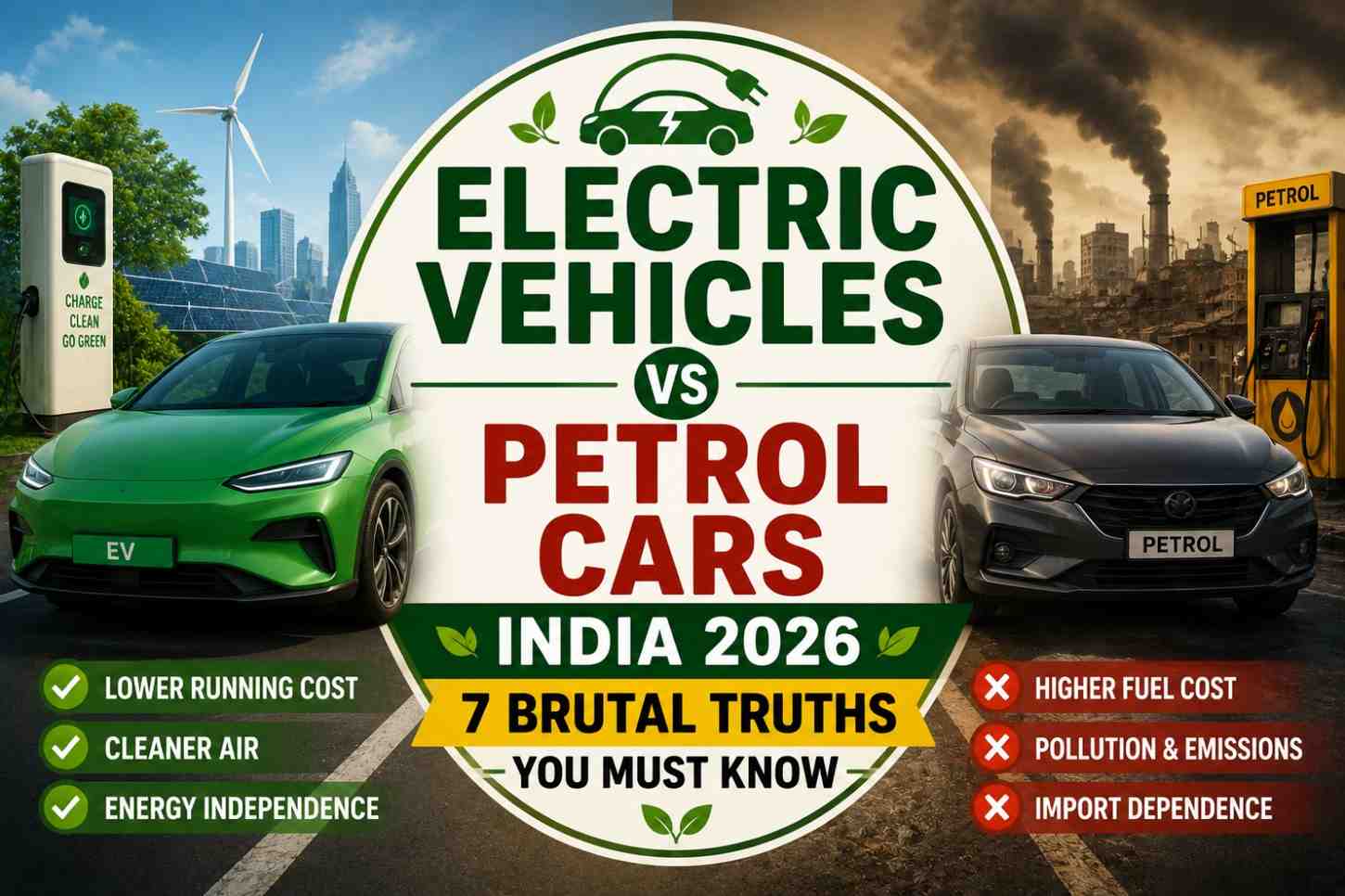
The debate over electric vehicles vs petrol cars India 2026 has moved from theoretical to intensely practical. India now has one of the fastest-growing EV markets in the world. Charging infrastructure has expanded dramatically. Battery costs have fallen. Government incentives remain robust. And yet, petrol cars still dominate the roads.
So which is actually better for you right now — in India, in 2026, with Indian roads, Indian budgets, and Indian driving habits? This guide cuts through the marketing noise and gives you the honest numbers on electric vehicles vs petrol cars India 2026, covering total cost of ownership, real-world range, charging realities, and environmental impact.
The Big Shift: Where India’s EV Market Stands in 2026
India’s EV sales crossed 2 million units in 2025–26, with two-wheelers leading the charge and four-wheelers growing rapidly. Tata Motors, MG Motor, Hyundai, and Mahindra now offer a diverse range of electric cars priced from ₹10 lakh to ₹30+ lakh. Meanwhile, Ola Electric, Ather, and Bajaj dominate the electric two-wheeler space.
The government’s FAME III scheme has pumped significant subsidies into EV adoption, reducing purchase prices further. State governments offer additional incentives — reduced road tax, waived registration fees — in Maharashtra, Delhi, Gujarat, and others.
But do EVs actually make sense in 2026? Let us go head-to-head.
Electric Vehicles vs Petrol Cars India 2026: The 7 Key Comparisons
1. Purchase Price
Petrol advantage — for now.
A well-equipped petrol hatchback (Maruti Swift, Hyundai Grand i10 Nios) costs ₹7–₹10 lakh. The most affordable electric car, the Tata Tiago EV, starts at approximately ₹8.5 lakh post subsidy — competitive, but with a smaller body and limited range compared to similarly priced petrol alternatives.
In the ₹15–₹20 lakh segment, EVs become far more competitive. The Tata Nexon EV and MG ZS EV offer comparable (or better) features to their petrol counterparts at similar price points.
Verdict: Petrol is cheaper at entry level. EVs are price-competitive at mid-segment and above.
2. Running Cost: The Game Changer
This is where the electric vehicles vs petrol cars India 2026 calculation dramatically shifts in EV favour.
- Petrol car: At ₹105–₹115/litre and 15–17 km/l efficiency, running cost ≈ ₹6.50–₹7.50 per km
- Electric car: At ₹8–₹10/kWh grid electricity and 6–7 km/kWh efficiency, running cost ≈ ₹1.20–₹1.70 per km
That is 4–5x cheaper per kilometre to run an EV. For someone driving 30 km/day (typical urban Indian commuter), that means:
- Petrol annual fuel cost: ₹71,000–₹82,000
- EV annual charging cost: ₹13,000–₹19,000
- Annual saving: ₹52,000–₹65,000
In 3–4 years, this difference can offset the price premium of an EV entirely.
3. Maintenance Cost
Clear EV advantage.
Electric vehicles have dramatically fewer moving parts than internal combustion engines. No oil changes, no complex gearboxes, no exhaust systems, no timing belts. Indian EV owners consistently report 50–70% lower annual maintenance costs compared to petrol equivalents.
A petrol car typically costs ₹8,000–₹15,000 per service visit (depending on model). An EV’s annual maintenance — primarily brake fluid, cabin air filter, and tyre rotations — typically costs ₹2,000–₹5,000.
4. Real-World Range and Charging: The Honest Picture
Petrol still wins on range anxiety — but the gap is closing.
Top-selling Indian EVs in 2026 offer:
- Tata Nexon EV Long Range: ~400 km (ARAI), ~280–320 km real-world
- Hyundai Ioniq 5: ~600 km (ARAI), ~420–480 km real-world
- Tata Tiago EV: ~250 km (ARAI), ~180–210 km real-world
India’s public fast-charging network has expanded significantly. The government’s BharatCharger initiative and private networks from Tata Power, Statiq, and Ather Grid now cover all national highways and most tier-1 and tier-2 cities. A 30-minute DC fast charge typically provides 150–200 km of range.
The honest reality: If you drive under 80 km/day and can charge at home overnight (which most Indian apartment and house dwellers can), range anxiety is essentially non-existent. If you regularly drive intercity routes or live in a tier-3 city with limited public charging, a petrol car may still be more convenient in 2026.
5. Environmental Impact: What the Numbers Actually Say
Here the electric vehicles vs petrol cars India 2026 debate requires nuance.
India’s electricity grid is still heavily coal-dependent — approximately 55–60% of electricity comes from coal-fired power plants. This means an EV in India does not run on zero emissions. It runs on grid-average emissions, which are lower than petrol but not zero.
However, studies consistently show that even on India’s current grid, EVs produce 30–40% lower lifetime carbon emissions than equivalent petrol cars, accounting for manufacturing, charging, and disposal. As India’s renewable energy share grows (targeting 50% by 2030), this advantage will increase dramatically.
The environmental verdict: EVs are better today. They will be significantly better in five years. For the full lifecycle emissions analysis, see the International Energy Agency’s EV outlook{rel=”dofollow”}.
6. Battery Life, Resale Value, and the Unknown
Petrol currently has an advantage on resale value certainty.
EV battery warranties in India typically cover 8 years or 160,000 km. Modern lithium iron phosphate (LFP) batteries used by Tata show excellent longevity in real-world Indian conditions. However, the used EV market in India is still maturing, and resale values remain uncertain — particularly for older battery chemistries.
Petrol cars have predictable depreciation curves that both buyers and sellers understand. EV depreciation, especially for first-generation models, has been steep.
Verdict: If you keep your car 7–10 years, the EV math works strongly in your favour. If you change cars every 3–4 years, petrol resale value may be more predictable.
7. Insurance, Tax, and Hidden Costs
EVs have a moderate advantage.
- Electric vehicles attract lower road tax in most Indian states (0–5% vs 12–15% for petrol)
- Registration fees are waived or reduced in Delhi, Maharashtra, and Gujarat
- Insurance premiums for EVs are currently 5–15% higher than petrol equivalents due to higher vehicle value and battery replacement risk — though this gap is narrowing as insurers gain experience
Home charging installation (a standard wall socket or dedicated charger) costs ₹5,000–₹25,000 depending on setup — a one-time cost that many petrol car owners overlook in their EV calculations.
Total Cost of Ownership: A 5-Year Comparison
Using a Tata Nexon EV vs Tata Nexon Petrol (comparable segment) as example:
| Cost Component | Nexon Petrol | Nexon EV |
|---|---|---|
| Purchase price | ₹9.5 lakh | ₹15.5 lakh |
| 5-year fuel/charging | ₹3.7 lakh | ₹0.9 lakh |
| 5-year maintenance | ₹0.75 lakh | ₹0.25 lakh |
| Insurance (5 years) | ₹1.5 lakh | ₹1.8 lakh |
| Total 5-year cost | ₹15.45 lakh | ₹18.45 lakh |
At 5 years, petrol still has a slight edge. At 7 years (and with home charging at lower rates, or solar-charged), the EV becomes clearly cheaper overall. And with India’s petrol prices having risen 8–12% annually, the crossover point moves earlier with each passing year.
Who Should Buy an EV Right Now?
Buy an EV if:
- You drive 40–100 km/day within city limits
- You can charge at home overnight
- You plan to keep the car for 6+ years
- You are buying in the ₹13 lakh+ segment
- You want to reduce fuel dependency and environmental impact
Stick with petrol if:
- You frequently drive long intercity routes with uncertain charging access
- You live in a tier-3 or tier-4 city with minimal charging infrastructure
- You need a car under ₹8 lakh
- You change vehicles every 3–4 years
The Verdict: Electric Vehicles vs Petrol Cars India 2026
For the majority of urban Indian car buyers in 2026, electric vehicles represent the smarter long-term financial and environmental choice. The purchase premium is real, but running cost savings are substantial, maintenance is simpler, and the environmental benefit is clear and growing.
The remaining gap is charging infrastructure in smaller cities and the limited affordable EV segment below ₹10 lakh. Both gaps are narrowing rapidly. By 2028, the electric vehicles vs petrol cars India question may have a near-unanimous answer.
For now: if you can make EVs work for your life, the numbers support making the switch.
Related reading: How to Reduce Carbon Footprint in Daily Life India | Green Home Design Ideas India 2026 | Best Eco-Friendly Products for Home India 2026




 creator@ecometric.site