
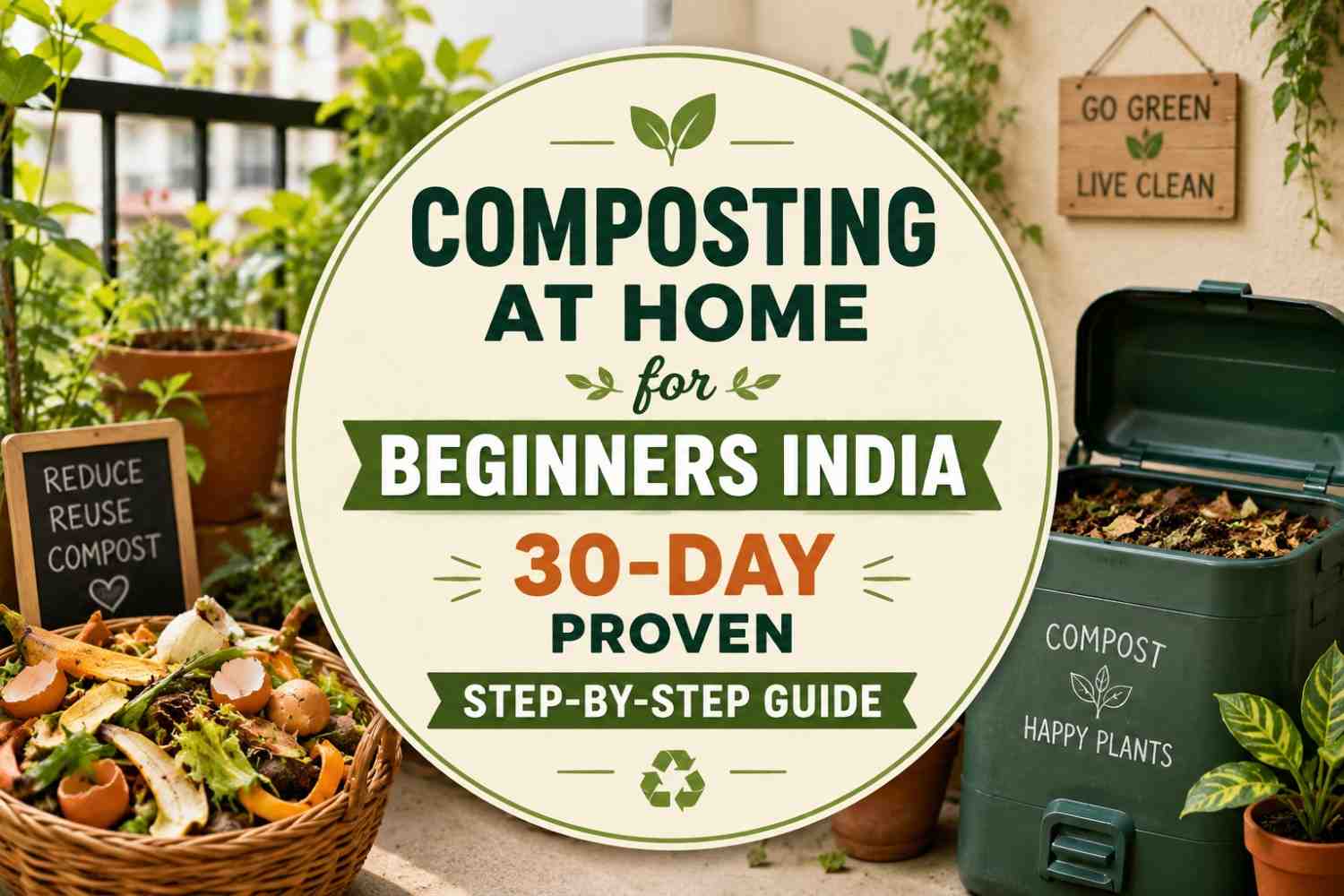
Composting at home for beginners in India is one of the most impactful, satisfying, and genuinely simple environmental actions available to every Indian household. Every day, Indian kitchens generate kilograms of vegetable peels, fruit scraps, tea leaves, and cooked food — the majority of which goes directly into plastic garbage bags destined for landfills. In just 30 days, you can transform that waste stream into rich, usable compost — sometimes called “black gold” by farmers and gardeners — and eliminate a significant portion of your household’s landfill contribution permanently.
This complete guide to composting at home for beginners in India covers everything you need: what composting is, why it matters, what equipment you need (spoiler: very little), what you can and cannot compost, and a day-by-day guide to your first successful compost batch. Whether you live in a Bengaluru apartment, a Mumbai chawl, or a house in a smaller town, composting can work for you.
Why Composting Matters in India
India generates over 62 million tonnes of municipal solid waste annually, and organic matter—food scraps, vegetable waste—constitutes approximately 50–60% of that total. When organic waste is sent to landfill, it decomposes without oxygen, generating methane—a greenhouse gas approximately 25 times more potent than CO₂.
When the same organic matter is composted aerobically (with oxygen), it generates minimal greenhouse gas emissions and produces a valuable soil amendment that:
- Returns nutrients to soil naturally, reducing need for chemical fertilisers
- Improves soil structure, water retention, and drainage
- Supports soil microorganism health and biodiversity
- Reduces the need for irrigation by improving soil’s moisture-holding capacity
For Indian households with gardens, balconies, or even a few potted plants, compost is liquid gold. For those without, finished compost can be donated to community gardens or urban farming initiatives or even sold—a small but real income stream.
Composting at home for beginners in India is not just environmentally sound. It is also extremely practical.
What You Need to Start Composting in India
The good news: you need very little. Here is the starter kit:
Option 1: The Terracotta Pot Method (Recommended for Beginners)
The most beloved and Indian-appropriate composting method uses two or three terracotta pots (matkas) with drainage holes in the base. Terracotta pots are affordable (₹50–₹150 each), beautiful, porous (which aids aeration), and available at every local market.
You will need:
- 2–3 terracotta pots with drainage holes (10–15 litre capacity each)
- 1 bag of dried leaves, sawdust, or dry coconut husk (carbon material)
- A small stick for stirring/turning
- A tray or plate under each pot to catch liquid (valuable as liquid fertilizer—dilute 1:10 with water)
Total cost: ₹200–₹500. This is a one-time investment.
Option 2: Purpose-Built Compost Bin
Indian brand Daily Dump (Bengaluru) produces beautiful, functional terracotta composters designed specifically for Indian conditions and apartment living. Their Kambha system uses stackable pots and is particularly beginner-friendly with clear instructions included. Available on Amazon India for ₹400–₹1,500.
Option 3: The Bokashi Method (For Cooked Food and Meat)
Bokashi is a Japanese fermentation method that uses a special inoculant (effective microorganisms) to ferment all food waste—including cooked food, meat, and dairy—in an airtight bucket within 2 weeks. The fermented material is then buried or added to soil. Ideal for households that want to compost all food waste, not just raw kitchen scraps.
Bokashi kits are available from EcoSoch and Organica India for ₹500–₹1,200.
What You Can and Cannot Compost
✅ COMPOST THESE (Green — Nitrogen-Rich)
- Vegetable peels and scraps (potato, onion, capsicum, tomato, carrot, etc.)
- Fruit peels and cores (mango skins, banana peels, citrus, apple cores)
- Tea leaves and tea bags (remove staples)
- Coffee grounds
- Cooked plain rice, dal, roti (small quantities, no oil or spice)
- Fresh grass clippings and plant trimmings
- Eggshells (adds calcium—rinse first)
✅ COMPOST THESE (Brown — Carbon-Rich)
- Dry leaves (collect from garden or neighbourhood)
- Torn newspaper and plain cardboard
- Dried coconut husk and coir
- Sawdust (from untreated wood)
- Brown paper bags (torn into small pieces)
- Dried straw
❌ DO NOT COMPOST THESE
- Meat, fish, and seafood (in open composting—they attract pests and create odour; use Bokashi instead)
- Oily, spicy cooked food (slows decomposition, attracts pests)
- Dairy products
- Diseased plant matter
- Anything treated with pesticides or fungicides
- Human or pet waste (in simple home composting)
- Glossy paper, plastic, or laminated materials
The 30-Day Composting Guide: Step by Step
Week 1: Setting Up and Starting Your Pile
Day 1: Place your composting pot in a warm, partially shaded spot—a balcony corner, kitchen garden area, or a spot near the back of your terrace. Ensure it has drainage. Add a 2-inch layer of dry brown material (dried leaves, torn newspaper, or dry coir) to the bottom. This allows air circulation and absorbs excess moisture.
Day 2–3: Add your first kitchen scraps—vegetable peels, fruit waste, and tea leaves. Chop or tear larger pieces into smaller bits; smaller pieces decompose significantly faster. Add a roughly equal volume of dry brown material on top. This is the critical ratio: 1 part green (wet, nitrogen-rich) to 2–3 parts brown (dry, carbon-rich).
Day 4–5: Sprinkle a small amount of water if the pile looks very dry. It should feel like a wrung-out sponge—moist but not dripping. Add more kitchen scraps and brown material. Stir lightly with your stick.
Day 6–7: By the end of week one, you may notice the pile heating up slightly—this is a sign of active decomposition. A warm pile is a healthy pile. If it smells bad (rotten eggs or ammonia), your pile is either too wet or has too much green material. Add more browns and stir.
Week 2: Building and Maintaining
Day 8–14: Continue adding kitchen scraps daily, always topping with brown material. Stir your pile every 2–3 days to introduce oxygen—this significantly speeds decomposition and prevents foul odors. If you collected liquid in the tray below, dilute it 10:1 with water and use it on your plants immediately—it is highly nutritious.
Key observation: The pile should be reducing in volume. This is good. It means decomposition is actively occurring.
Common issues and fixes:
- Too wet, bad smell: Add more brown material and stir more frequently
- Too dry, no activity: Sprinkle water and stir
- Fruit flies: Add more brown material on top as a cover layer; fruit flies disappear when the surface is dry
- White fungal threads: Completely normal and positive—this is actinomycetes bacteria at work
Week 3: Active Decomposition
Day 15–21: Your earliest additions are now partially decomposed. You may see recognizable scraps alongside material that has broken down into dark, rich-looking matter. Continue adding and stirring.
At this point, your compost pile is a living ecosystem—billions of bacteria, fungi, worms (if any found their way in), and other microorganisms are actively transforming waste into nutrients. This is composting at home for beginners in India in its most visible and satisfying phase.
If you have a second pot, begin transferring your oldest material to it. This allows you to continue adding fresh scraps to the first pot while the second pot completes curing.
Week 4: Curing and Finishing
Day 22–30: Stop adding new material to the main pot. Allow it to cure undisturbed for the final week. Stir once or twice. The material should continue to darken, reduce in volume, and develop an earthy, forest-floor smell.
Day 30: Assess your compost. Finished compost:
- Looks dark brown or black
- Has an earthy, soil-like smell (not rotting)
- Has a crumbly texture
- Is no longer warm
- Contains no recognisable food scraps
If some pieces are not fully broken down, sieve them out and return them to the active pile. The finished compost is ready to use.
How to Use Your Finished Compost
For potted plants: Mix 20–30% compost into your potting soil mix. Plants will visibly thrive.
For garden beds: Dig compost into the top 5–10 cm of soil before planting.
As top dressing: Apply a 1–2 cm layer of compost around the base of established plants as a mulch that slowly releases nutrients.
Donate or share: Many urban farming groups, community gardens, and schools welcome donations of finished compost.
For deeper scientific understanding of composting processes and how to troubleshoot advanced issues, the Cornell Composting Science and Engineering program offers the world’s most comprehensive free composting resources.
Composting at Home in Indian Apartments: Special Notes
Apartment composting in India requires particular attention to:
Odor control: Maintaining the right brown-to-green ratio and regular stirring prevents virtually all composting odor. A well-maintained compost pot smells like forest soil, not garbage.
Space: Terracotta composting pots take up no more space than a large potted plant—easily accommodated on balconies and even inside kitchens in ventilated spaces.
Neighbor acceptance: Share your compost with building society members for their balcony gardens. This builds community acceptance and enthusiasm rapidly.
Apartment-level composting initiatives: Many Resident Welfare Associations (RWAs) across Indian cities now run collective composting programs. If yours does not, you could initiate one—composting at home for beginners in India is often the catalyst for building-level zero-waste programs.
Your composting journey starts today.
Composting at home for beginners in India is the gateway habit to sustainable living. Once you see kitchen waste transform into something genuinely useful — once you make the connection between food scraps and fertile soil — your entire relationship with waste changes. You become someone who sees resources where others see rubbish.
Start today. Two terracotta pots, some dry leaves, and a week’s worth of vegetable peels are all you need to begin. In 30 days, you will have your first batch of homemade compost — and a habit that will serve your household, your plants, and your planet for years to come.
FAQ
1. What is the easiest composting method for beginners in India?
The terracotta pot composting method is the easiest for beginners in India because it is affordable, simple to maintain, odor-free when managed properly, and ideal for apartments and small homes.
2. How long does home composting take in India?
Most home composting systems in India produce usable compost within 30–60 days, depending on temperature, moisture, aeration, and the type of organic waste added.
3. Does composting at home smell bad?
No. A properly maintained compost pile smells earthy like soil. Bad odors usually happen when the pile is too wet, lacks oxygen, or contains too much food waste without enough dry material.
4. What kitchen waste can be composted at home?
You can compost vegetable peels, fruit scraps, tea leaves, coffee grounds, eggshells, dry leaves, newspaper, cardboard, and small quantities of plain cooked food without oil.
5. Can apartment residents compost kitchen waste in India?
Yes. Balcony composting using terracotta pots or compact compost bins works very well in Indian apartments and requires very little space when managed correctly.
Final Conclusion
Composting at home for beginners in India is one of the simplest and most rewarding ways to reduce household waste while creating something genuinely valuable. Instead of sending kitchen scraps to overflowing landfills where they produce harmful methane gas, composting transforms organic waste into nutrient-rich soil that supports healthier plants and greener living.
The process is affordable, beginner-friendly, and adaptable to almost every Indian lifestyle — whether you live in a small apartment, a city flat, or a house with a garden. With just a few terracotta pots, dry leaves, and regular kitchen waste, households can dramatically reduce garbage output within a single month.
Beyond the environmental benefits, composting changes how people think about waste itself. Vegetable peels, fruit scraps, and tea leaves stop being “trash” and become part of a natural cycle that returns nutrients back to the soil. This simple habit often becomes the first step toward broader sustainable living practices like gardening, waste reduction, and conscious consumption.
Most importantly, composting proves that meaningful climate action does not always require expensive technology or major lifestyle changes. Sometimes it begins with something as ordinary as saving your kitchen scraps and letting nature do the rest.
Related reading: Zero Waste Kitchen Tips India 2026 | Plant-Based Diet Benefits Environment 2026 | How to Live Sustainably in India on a Budget


 creator@ecometric.site