Introduction
Every student alive today will spend their entire adult life dealing with the consequences of decisions made in the last 50 years. That’s not a scare tactic — it’s a climate change facts for students in 2026 that every young person deserves to understand clearly.
The science is settled. The impacts are accelerating. And knowing the facts is the first step toward being part of the solution.
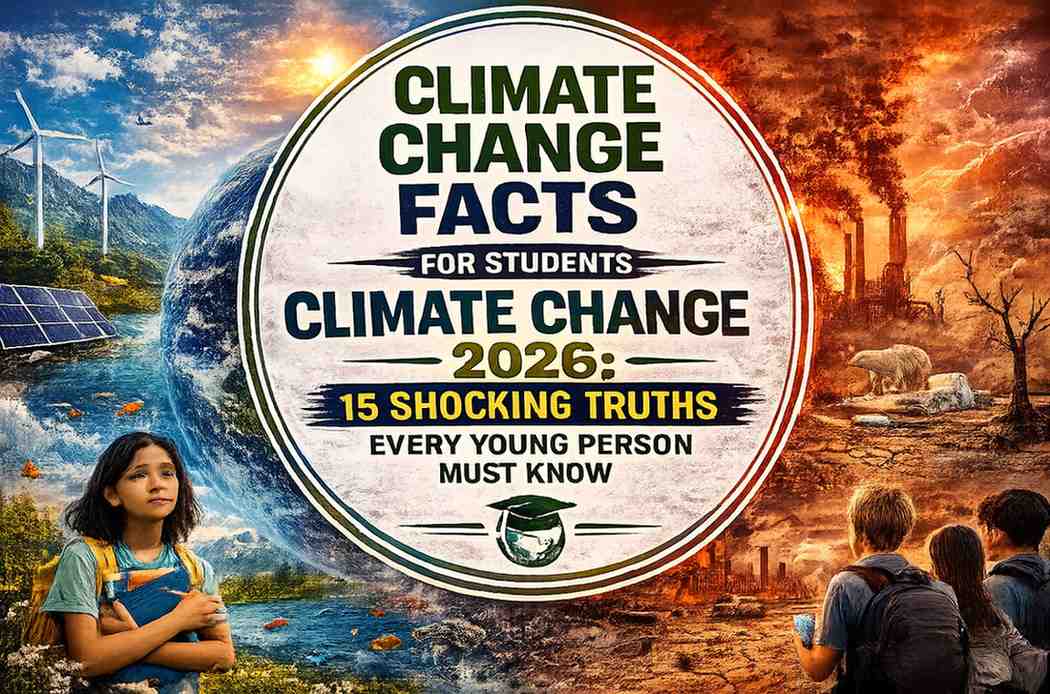
Here are 15 shocking climate change facts for students in 2026 — backed by the latest scientific data, explained in plain language.
Why Climate Change Facts Matter for Students in 2026
Understanding climate change facts as a student in 2026 isn’t just about passing an exam. It’s about understanding the world you will inherit.
- Students in school today will be in the workforce during the most critical decades of climate action (2030–2050)
- The decisions governments and corporations make right now — shaped in part by public pressure — will determine whether Earth stays livable
- Young people who understand the science make better voters, better consumers, and better leaders
These climate change facts for students are the foundation you need.
15 Shocking Climate Change Facts for Students 2026
Fact 1: 2024 Was the Hottest Year Ever Recorded — Again
One of the most urgent climate change facts for students in 2026 is the relentless temperature record-breaking.
2024 was the first calendar year to exceed 1.5°C above pre-industrial levels for an entire year. Earth’s average surface temperature is now approximately 1.6°C warmer than it was in the 1800s before mass industrialization.
Every decade since the 1980s has been hotter than the one before it.
Fact 2: CO₂ Levels Are Higher Than in 3 Million Years
Current atmospheric carbon dioxide concentration: approximately 424 ppm (parts per million) as of 2026.
The last time CO₂ was this high, sea levels were 10–25 metres higher than today, and temperatures were 2–3°C warmer. Humans didn’t exist yet.
This is one of the climate change facts for students in 2026 that puts our current moment in deep geological perspective.
Fact 3: The Arctic Is Warming 4x Faster Than the Global Average
The Arctic is the most rapidly warming region on Earth — a phenomenon called Arctic amplification. While global temperatures have risen ~1.6°C, the Arctic has warmed by over 4°C since pre-industrial times.
This matters for students because Arctic warming accelerates sea level rise globally, disrupts jet streams causing extreme weather in Europe and Asia, and thaws permafrost releasing methane — a greenhouse gas 80x more potent than CO₂ over 20 years.
Fact 4: Over 1 Million Species Face Extinction Risk from Climate Change
The IPBES (Intergovernmental Science-Policy Platform on Biodiversity) estimates that approximately 1 million plant and animal species face extinction — many within decades — due to habitat loss accelerated by climate change.
This is not a future problem. Coral reefs, which support 25% of all ocean species, have already lost 50% of their coverage since 1950.
Fact 5: Young People Will Experience 4x More Extreme Events Than Their Grandparents
A landmark 2021 study in Science found that a child born in 2020 will experience 2–7 times more extreme weather events in their lifetime than someone born in 1960 — under current emissions trajectories.
This is one of the most personal climate change facts for students in 2026: you, specifically, will live through far more heatwaves, floods, and storms than your grandparents did.
Fact 6: Melting Ice Sheets Could Raise Sea Levels by 1 Metre by 2100
The Greenland and Antarctic ice sheets contain enough ice to raise global sea levels by 65 metres combined if fully melted. That won’t happen by 2100. But even a 1-metre rise by 2100 — a moderate projection — would displace over 300 million people from coastal cities.
Mumbai, Dhaka, Shanghai, Miami, and Jakarta all sit within this flood zone.
Fact 7: Climate Change Is Already Reducing Global Food Production
Crop yields for staples like wheat, maize, and rice are declining in many regions due to heat stress, drought, and unpredictable monsoons. A 2022 IPCC report found that climate change has reduced global food productivity growth by approximately 1% per decade since 1980.
For 800 million people who already face food insecurity, this is not a small number.
Fact 8: Fossil Fuels Still Provide 80% of Global Energy
Despite decades of climate negotiations, as of 2025 fossil fuels (coal, oil, natural gas) still provide approximately 80% of global primary energy. Renewable energy is growing fast — but not fast enough to offset rising total energy demand.
This is one of the most sobering climate change facts for students in 2026: the transition has begun but the scale of what remains is enormous.
Fact 9: The Last Time Humans Saw 280 ppm CO₂ Was Before the Industrial Revolution
For all of human civilization — 10,000 years of agriculture, cities, and culture — CO₂ levels stayed between 180–280 ppm. We are now at 424 ppm and rising by ~2.5 ppm per year.
This pace of change is geologically unprecedented. The natural processes that previously shifted CO₂ took thousands of years. We’ve done this in 150.
Fact 10: Climate Change Amplifies Inequality
One of the most important climate change facts for students in 2026 is that it hits poorest communities hardest.
- Wealthy nations emitted most historical CO₂ — but poor nations face the worst impacts
- Low-lying countries like Bangladesh and Pacific Island nations contribute less than 1% of global emissions but face existential flooding risk
- Within countries, low-income communities live in more flood-prone, heat-vulnerable areas with less resources to adapt
Fact 11: We Have the Technology to Cut Emissions — But Not Yet the Political Will
Solar energy cost has dropped 89% since 2010. Wind energy dropped 70%. Electric vehicle sales are growing exponentially. Batteries are getting cheaper every year.
The technology exists to decarbonize electricity, transport, and buildings within 20 years. The barrier is political will, vested interests, and speed of deployment — not technical capability.
Fact 12: Permafrost Thaw Could Trigger a Climate “Tipping Point”
Permafrost (permanently frozen ground) covers ~25% of the Northern Hemisphere and locks in approximately 1.5 trillion tonnes of carbon — nearly twice what’s currently in the atmosphere.
As the Arctic warms, permafrost thaws and releases CO₂ and methane. This creates a feedback loop: warming causes thaw, which releases gases, which cause more warming — independent of human emissions.
This is what scientists call a tipping point — a threshold where climate change becomes self-reinforcing.
Fact 13: Ocean Heat Content Is at an All-Time Record
The ocean absorbs over 90% of excess heat trapped by greenhouse gases. This thermal energy doesn’t disappear — it intensifies hurricanes, bleaches coral reefs, raises sea surface temperatures, and affects fish distribution globally.
Ocean heat content reached its highest recorded level in 2024 — another all-time record in a decade full of them.
Fact 14: 3.6 Billion People Already Live in Climate-Vulnerable Areas
The IPCC estimates that 3.6 billion people — nearly half of humanity — currently live in highly vulnerable regions where they are “highly exposed to climate hazards.” This isn’t a 2080 projection. It’s the situation today.
For students in India, Southeast Asia, Sub-Saharan Africa, and Central America, this climate change fact for 2026 is immediate and personal.
Fact 15: Net Zero by 2050 Is Still Mathematically Possible — But the Window Is Closing
According to the International Energy Agency (IEA) and IPCC modelling, limiting warming to 1.5°C still requires global CO₂ emissions to reach net zero by 2050.
To achieve this, emissions need to fall by 43% by 2030 compared to 2019 levels. We are currently on track for a 14% reduction — roughly one-third of what’s needed.
The window is not closed. But it is closing. And the decisions made between 2026 and 2030 are the most consequential in climate history.
What Can Students Actually Do?
Understanding climate change facts as a student in 2026 naturally leads to the question: what now?
Individual actions that matter:
- Reduce meat consumption (livestock = ~15% of global emissions)
- Choose public transport, cycling, or EVs when possible
- Reduce air travel where alternatives exist
- Support and vote for climate-ambitious politicians
Collective actions that matter more:
- Join or support climate advocacy organizations
- Engage your school or college in sustainability commitments
- Use social media to amplify accurate climate science
- Study fields that contribute to climate solutions: renewable energy, ecology, policy, engineering, medicine
The climate change facts for students in 2026 are sobering. But students have always been the force that pushes societies to confront uncomfortable truths.
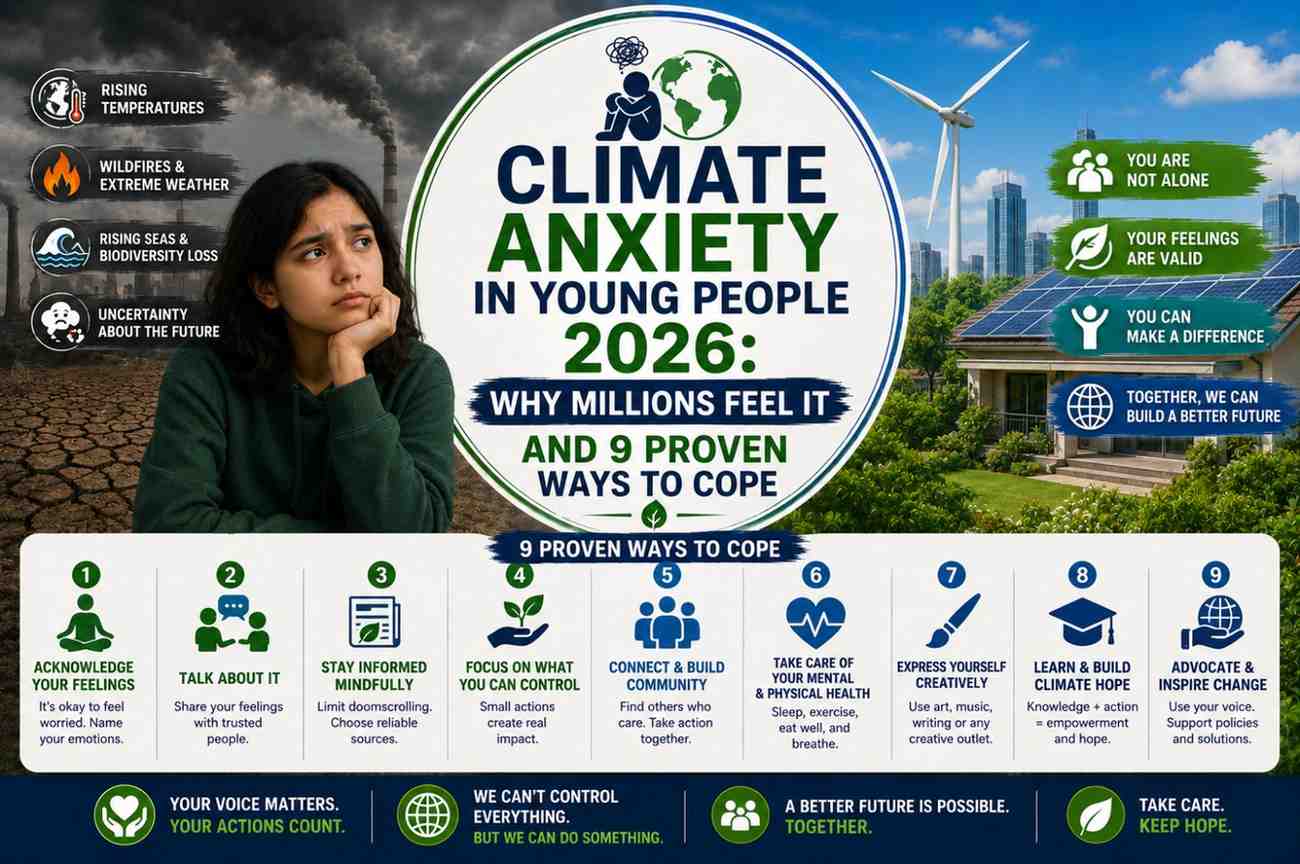
Related: Climate Anxiety in Young People 2026 — Why Millions Are Worried and How to Cope Healthily
Key Terms Every Student Should Know
- Greenhouse gases: CO₂, methane, nitrous oxide — gases that trap heat in the atmosphere
- Carbon budget: The total CO₂ we can emit while staying under 1.5°C warming
- Net zero: Balancing carbon emitted with carbon removed from the atmosphere
- Tipping points: Thresholds beyond which climate change becomes self-reinforcing
- Climate justice: The principle that those who suffer most from climate change deserve support from those who caused it most
5 Frequently Asked Questions
Q1: What is the most important climate change fact for students to know in 2026? That the choices made in the next 5–10 years will determine whether warming stays under 2°C or exceeds it. This window coincides exactly with when today’s students will be entering voting age and the workforce.
Q2: Is climate change man-made or natural? Scientists have determined with over 97% consensus that current climate change is primarily caused by human activities — burning fossil fuels, deforestation, and agriculture. Natural factors alone cannot explain the warming observed since 1850.
Q3: How does climate change affect students specifically? Higher temperatures affect learning (heat impairs cognitive performance), extreme weather disrupts schooling, and long-term economic instability reduces education access in vulnerable regions. These are documented climate change facts for students in 2026.
Q4: Which countries are most responsible for climate change? Historically, the United States has emitted the most cumulative CO₂. Currently, China emits the most annually (~30% of global total), followed by the US (~14%). However, per-capita emissions are highest in Gulf states and Australia.
Q5: Can individual actions really make a difference against climate change? Individual actions matter less than systemic change — but they’re not irrelevant. Collective consumer choices shift markets, and individual civic participation (voting, advocacy) shapes policy. Both are necessary and complementary.
Conclusion
These 15 climate change facts for students in 2026 paint a clear picture: the crisis is real, it is accelerating, and its impacts are already being felt by billions of people worldwide.
But the same facts tell another story: the technology exists, the solutions are known, and the generation alive right now has both the urgency and the tools to change course.
Understanding these climate change facts as a student in 2026 is not about fear. It’s about being informed enough to act — as a citizen, a consumer, a future professional, and a human being who shares this planet with everyone else.
Start with the facts. Then take action. Share this article with your classmates, discuss it in class, and explore our full climate science coverage below.
External sources: IPCC Sixth Assessment Report | NASA Climate Change Facts


 creator@ecometric.site