Introduction
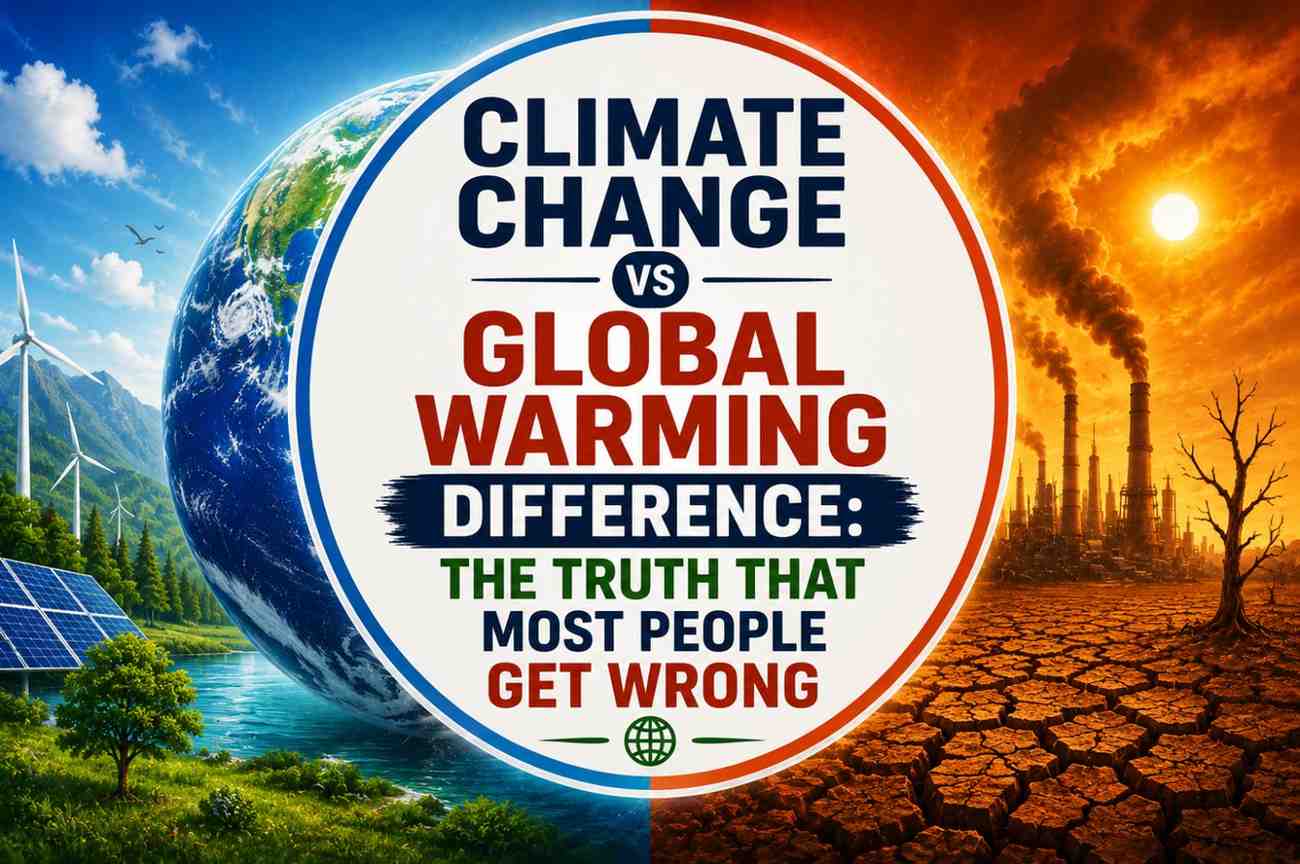
Climate change vs global warming — most people use these terms interchangeably. Most are wrong to do so, and the difference between climate change and global warming matters far more than a grammar lesson.
The two terms describe related but distinct phenomena. Using the wrong one can lead to misunderstanding the scope of the crisis, why some places are getting colder during “global warming,” and why scientists now almost uniformly prefer “climate change” in technical and policy contexts.
This article explains the climate change vs global warming difference clearly, where the terms came from, which is more accurate, and why the language we choose shapes how society responds to one of the greatest challenges in human history.
Defining the Terms: Climate Change vs Global Warming Difference
What Is Global Warming?
Global warming refers specifically to the long-term increase in Earth’s average surface temperature caused by rising concentrations of greenhouse gases (CO₂, methane, nitrous oxide) in the atmosphere.
It describes one phenomenon: temperatures going up.
The term was in common scientific use by the 1950s, popularized in broader discourse after NASA scientist James Hansen testified before the US Congress in 1988, warning of the dangers of global warming from greenhouse gas emissions.
Accuracy: Global warming is a real, precisely measurable phenomenon. Earth’s average surface temperature has risen approximately 1.6°C since pre-industrial times (1850–1900 baseline).
What Is Climate Change?
Climate change is a broader term that encompasses all the changes to Earth’s climate system resulting from global warming — not just rising temperatures, but also:
- Changes in precipitation patterns (more intense rainfall, longer droughts)
- Shifting seasons and growing seasons
- Rising sea levels from thermal expansion and ice melt
- Ocean acidification from CO₂ absorption
- Changes in wind patterns and ocean currents
- More frequent and intense extreme weather events
- Ecosystem disruptions (coral bleaching, species range shifts, migration pattern changes)
The climate change vs global warming difference in one sentence: Global warming is the cause (or a symptom); climate change is the full set of consequences.
The Climate Change vs Global Warming Difference: A Historical Perspective
Why “Global Warming” Dominated Early Coverage (1980s–2000s)
Global warming was the dominant term in both scientific and public discourse through the late 20th century because:
- It was scientifically precise for the primary measurable signal
- It communicated urgency simply: temperatures rising = bad
- Media coverage focused on temperature records and the greenhouse effect
Why “Climate Change” Replaced It as the Preferred Scientific Term
By the early 2000s, the climate change vs global warming difference had become important enough that scientific bodies began standardizing their terminology.
The IPCC (Intergovernmental Panel on Climate Change) — notably using “climate change” in its very name since its founding in 1988 — uses “climate change” as its primary term.
The shift occurred for several key reasons:
1. Some places get colder: Global warming confused people when regional temperatures dropped. Parts of the American Midwest, Scandinavia, and Siberia have experienced brutal cold snaps linked to a weakened polar vortex — itself caused by Arctic warming. “Global warming” seemed contradictory. “Climate change” accommodates both extremes.
2. Temperature is only part of the story: The most severe impacts of greenhouse gas emissions — flooding, drought, ocean acidification, ecosystem collapse — are poorly captured by a phrase about temperature alone.
3. “Warming” sounds pleasant: In northern Europe and Canada, “global warming” sometimes triggers association with milder winters rather than catastrophe. “Climate change” carries a more neutral but more alarming systemic connotation.
The Political Dimension of the Climate Change vs Global Warming Difference
This is where the climate change vs global warming difference gets genuinely controversial.
In 2002, Republican political consultant Frank Luntz advised the George W. Bush administration in a leaked memo to shift public messaging toward “climate change” and away from “global warming” — specifically because “climate change” sounded less frightening and urgent.
This created an odd situation where some climate activists now prefer “global warming” (or the even stronger “climate crisis” / “climate emergency”) precisely because it sounds more alarming than “climate change.”
The irony: scientists use “climate change” for accuracy; political strategists once suggested it for reassurance; activists now reclaim stronger language for urgency.
The Correct Usage: Climate Change vs Global Warming Difference Explained
Use “Global Warming” When:
- Discussing specifically the rise in global average temperature
- Referring to the greenhouse effect and its direct thermal impact
- Discussing temperature projections (e.g., “limiting global warming to 1.5°C”)
- The Paris Agreement specifically uses “global average temperature increase” — not “warming” as a standalone
Use “Climate Change” When:
- Discussing the full range of impacts on weather, ecosystems, sea levels, and agriculture
- Discussing policy responses, adaptation, and mitigation
- Communicating to general audiences about the overall crisis
- Referring to IPCC reports and scientific consensus language
The Strongest Alternative Terms
Beyond the climate change vs global warming difference, many scientists and journalists now use even stronger terminology:
- “Climate crisis” — used by many scientific journals and newspapers (The Guardian adopted this in their style guide in 2019) to convey urgency
- “Climate emergency” — used by cities, countries, and the UN General Assembly in formal declarations
- “Climate breakdown” — gaining traction in UK media, suggesting systemic collapse rather than gradual change
- “Global heating” — preferred by some scientists (including former IPCC chair Bob Watson) because “warming” understates the danger
Why the Climate Change vs Global Warming Difference Matters Practically
It Shapes Policy Conversations
When politicians debate “global warming legislation,” they often focus narrowly on emissions and temperature targets. “Climate change legislation” more naturally encompasses adaptation — building seawalls, redesigning cities for heat, protecting water supplies — which is equally critical.
It Affects Public Understanding
People in cold climates dismiss “global warming” when they experience record cold winters. Understanding that climate change includes destabilized weather patterns — including extreme cold from polar vortex disruption — is essential for accurate public understanding.
It Matters for Education
Students learning about the climate change vs global warming difference develop more accurate mental models of the climate system — understanding that the crisis is not simply “the world gets hotter” but rather “the entire system of Earth’s climate becomes less stable and more extreme.”
Related: Climate Change Facts for Students 2026 — 15 Shocking Truths Every Young Person Must Know
It Matters for Media Accuracy
Media outlets that use “global warming” in headlines about drought, flooding, or ecosystem collapse are being technically imprecise. The climate change vs global warming difference is relevant every time a journalist decides which term to use.
Other Related Terms You Should Know
Understanding the climate change vs global warming difference is part of a broader vocabulary:
Greenhouse effect: The natural process by which atmospheric gases trap heat from the sun. The enhanced greenhouse effect — caused by human emissions — is what’s driving climate change.
Carbon footprint: The total CO₂ equivalent emissions attributed to an individual, organization, product, or activity.
Net zero: Achieving a balance between greenhouse gas emissions produced and removed from the atmosphere.
Carbon neutrality: Similar to net zero but sometimes used more loosely (e.g., offsetting emissions rather than eliminating them).
Tipping points: Critical thresholds in the climate system that, once crossed, trigger self-reinforcing changes (e.g., permafrost thaw, ice sheet collapse).
Mitigation: Actions that reduce greenhouse gas emissions.
Adaptation: Actions that reduce harm from climate change that is already happening or unavoidable.
The Terms Scientists Currently Prefer
For the record, here is how major scientific institutions currently use these terms:
| Institution | Primary Term Used |
|---|---|
| IPCC | Climate change |
| WMO (World Meteorological Organization) | Climate change |
| NASA | Both (“global warming” for temperature specifically; “climate change” overall) |
| NOAA | Climate change |
| The Guardian (style guide) | Climate crisis / climate emergency |
| Nature (journal) | Climate change |
| Science (journal) | Climate change |
The climate change vs global warming difference has effectively been resolved in the scientific community: “climate change” is the preferred umbrella term.
Related: 1.5 Degree Celsius Climate Goal Failure 2026 — Why It Happened and What Comes Next
5 Frequently Asked Questions
Q1: Is global warming the same as climate change? No — that’s the core of the climate change vs global warming difference. Global warming refers specifically to rising temperatures caused by greenhouse gases. Climate change encompasses all the resulting changes to Earth’s climate system, including extreme weather, sea level rise, ocean acidification, and ecosystem disruption.
Q2: Which term do scientists prefer — climate change or global warming? Scientists overwhelmingly prefer “climate change” as the umbrella term for the full range of phenomena, reserving “global warming” for the specific discussion of temperature increases. The IPCC, WMO, NASA, and NOAA all primarily use “climate change.”
Q3: Why does it get colder in some places if global warming is happening? This is exactly why “climate change” is more accurate. Global warming destabilizes the polar vortex — the cold air mass over the Arctic. When it weakens, cold Arctic air spills southward, causing extreme cold events in North America, Europe, and Asia. This is a consequence of warming, not a contradiction of it.
Q4: Is “climate emergency” more appropriate than “climate change”? “Climate emergency” reflects the urgency of the situation — over 11,000 scientists signed a 2019 declaration using this term. It’s not scientifically wrong, but it’s a values-laden communication choice rather than a technical term. “Climate change” remains the scientific standard.
Q5: Who coined the term “global warming”? Geologist Wallace Smith Broecker popularized the term in a landmark 1975 paper titled “Climatic Change: Are We on the Brink of a Pronounced Global Warming?” It entered mainstream scientific discourse through the 1980s and became a public term after James Hansen’s 1988 Congressional testimony.
Conclusion
The climate change vs global warming difference is not pedantic — it shapes how millions of people understand one of the most consequential challenges in human history.
Global warming is the measurable rise in temperature. Climate change is everything that rise in temperature causes: floods, droughts, stronger storms, ocean death, food insecurity, mass migration, and ecosystem collapse.
Using these terms accurately leads to more accurate understanding, better policy conversations, and more honest communication about what we collectively face.
The language we choose is a small thing. What it describes is not small at all.
Explore our complete climate vocabulary guide and other explanations from our climate science series.
External sources: IPCC Glossary — Climate Change and Global Warming | NASA Global Climate Change Glossary


 creator@ecometric.site