Introduction
The climate change effects on oceans in 2026 represent some of the most profound and irreversible impacts of human-caused global warming — yet they receive far less public attention than land-based disasters.
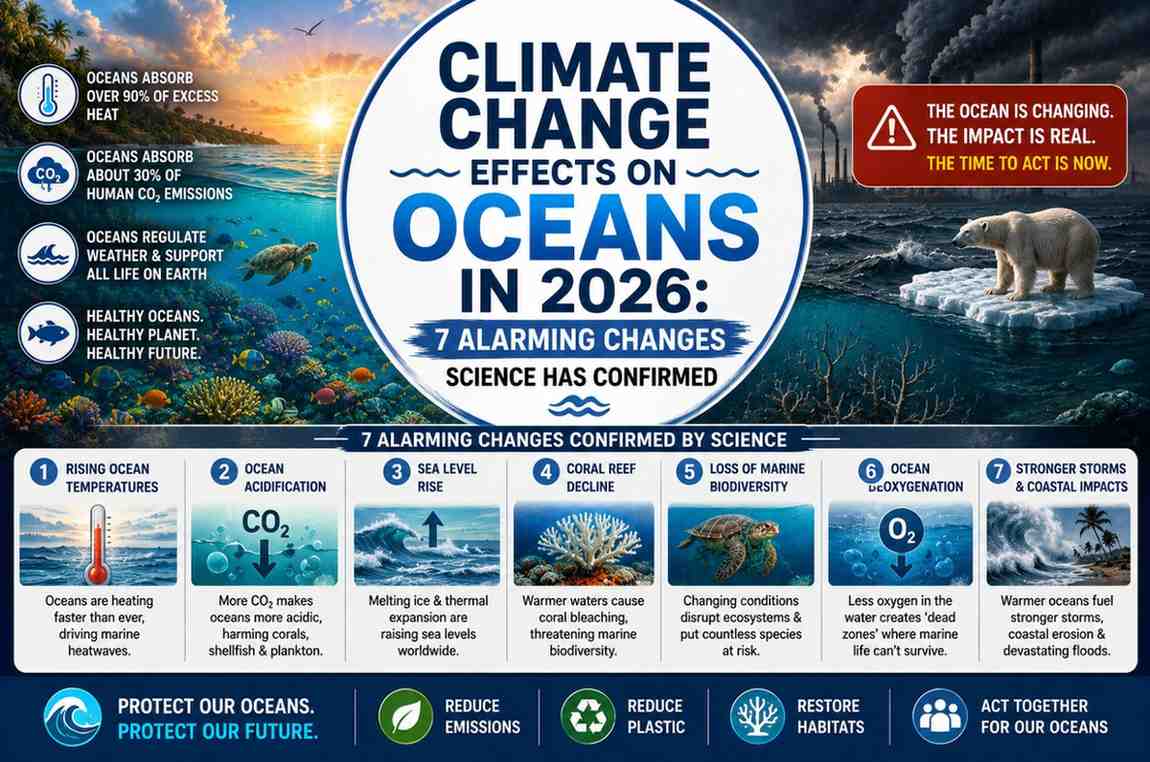
The ocean covers 71% of Earth’s surface and absorbs over 90% of the excess heat trapped by greenhouse gases, as well as approximately 25–30% of humanity’s CO₂ emissions. This makes the ocean the primary buffer of climate change — and the entity suffering the most from it.
This article covers the 7 most critical climate change effects on oceans in 2026, from sea level rise and coral bleaching to ocean acidification and circulation collapse, with the science behind each.
Why Ocean Health Is the Core of Climate Change
The climate change effects on oceans are not peripheral environmental concerns. They are central to:
- Food security: 3.3 billion people depend on seafood as their primary protein source
- Economic activity: $2.5 trillion in annual economic value from ocean-related industries
- Climate regulation: Oceans absorb heat and CO₂ — without them, warming would be far more severe
- Oxygen production: Ocean phytoplankton produce approximately 50% of Earth’s oxygen
- Coastal protection: Mangroves, coral reefs, and seagrass beds protect hundreds of millions from storm surge and erosion
Understanding the climate change effects on oceans in 2026 is therefore understanding the foundation of human life on Earth.
7 Alarming Climate Change Effects on Oceans in 2026
Effect 1: Record Ocean Heat Content — Every Year Breaking the Last
The most fundamental of climate change effects on oceans in 2026 is the absorption of heat.
In 2024, ocean heat content reached its highest ever recorded level — for the seventh consecutive year. The top 2,000 metres of the world’s oceans now hold more thermal energy than at any point in the instrumental record.
This has cascading consequences:
- Warmer ocean surface water provides more fuel for tropical cyclones — making hurricanes and typhoons more intense
- Warmer water expands — contributing directly to sea level rise (thermal expansion)
- Warmer water bleaches coral reefs — triggering ecosystem collapse
- Warmer water disrupts the seasonal cycles that fish populations depend on for feeding and reproduction
The rate of ocean warming has nearly doubled since 1993 compared to earlier decades. This acceleration is one of the most alarming climate change effects on oceans scientists are tracking in 2026.
Effect 2: Sea Level Rise — The Long Emergency
Sea level rise is the climate change effect on oceans with the most direct human consequence — and it is accelerating.
Current rate: Approximately 3.7mm per year globally (up from ~1.7mm per year in the 20th century). Cause: Roughly equal contributions from thermal expansion of warming ocean water (~40%) and melting of glaciers and ice sheets (~60%).
Projections for 2100:
- Low emissions scenario: ~0.3–0.6 metres above current levels
- Moderate emissions: ~0.5–1.0 metres
- High emissions: ~0.7–1.5 metres (with possible contributions from ice sheet instability adding 2+ metres)
What does this mean in practice?
- Over 1 billion people live less than 10 metres above current sea level
- Entire nations (Tuvalu, Marshall Islands, Kiribati, Maldives) face potential uninhabitability
- Storm surges that currently occur once per century in many coastal cities will occur annually
- Groundwater in coastal aquifers is already being contaminated by saltwater intrusion
Related: How Does Climate Change Affect India 2026 — Heatwaves, Floods & Food Security
Effect 3: Ocean Acidification — The Silent Crisis
Ocean acidification is the least visible but arguably most chemically transformative of the climate change effects on oceans in 2026.
The ocean absorbs approximately 10 billion tonnes of CO₂ per year — about 26% of human emissions. This CO₂ reacts with seawater to form carbonic acid. Since pre-industrial times, ocean pH has declined from 8.21 to approximately 8.09 — a 30% increase in acidity (pH scale is logarithmic).
This acidification:
- Dissolves the calcium carbonate shells and skeletons of mollusks, corals, sea urchins, and many plankton species
- Disrupts fish behaviour, including their ability to detect predators (acidic water impairs their sensory systems)
- Threatens the base of marine food webs — pteropods (tiny sea snails) that form critical links in polar food chains are dissolving in regions of the Southern Ocean today
- By 2100, under high emissions scenarios, ocean pH could drop to 7.95 — unprecedented in the past 20 million years
Effect 4: Coral Reef Collapse — The Canary in the Ocean
Coral reefs support approximately 25% of all marine species despite covering less than 1% of the ocean floor. They protect coastlines, support fisheries worth hundreds of billions of dollars, and provide livelihoods for approximately 500 million people.
The climate change effects on oceans are destroying them.
Bleaching mechanism: When water temperatures rise even 1°C above normal summer peaks for extended periods, corals expel the symbiotic algae (zooxanthellae) that give them colour and nutrition. The coral turns white — “bleached.” If temperatures stay elevated too long, the coral starves and dies.
Scale of loss:
- Global coral coverage has declined approximately 50% since 1950
- The Great Barrier Reef experienced mass bleaching events in 2016, 2017, 2020, 2022, and 2024 — unprecedented frequency
- The 2023–2024 global coral bleaching event was the fourth mass bleaching event in history and the most extensive ever recorded, affecting over 60% of the world’s reef areas
At 1.5°C of warming: 70–90% of coral reefs face severe bleaching. At 2°C: over 99% face functional extinction. We are currently tracking toward 2°C+.
Effect 5: Marine Ecosystem Disruption and Fish Population Collapse
Climate change effects on oceans in 2026 are reshaping where fish live, how much food they can find, and how successfully they reproduce.
- Range shifts: Fish species are moving poleward at approximately 70km per decade, following their preferred temperature zones. This is causing both bonanzas (Arctic nations gaining new fisheries) and collapses (tropical nations losing historical fishing grounds)
- Oxygen depletion: Warmer water holds less dissolved oxygen. “Dead zones” — oxygen-depleted areas where fish cannot survive — are expanding globally. There are now over 700 coastal dead zones, up from 45 in 1960
- Reproductive disruption: Many fish species use temperature, day length, and seasonal cues to trigger spawning. Warming and altered ocean chemistry disrupt these signals, causing mistimed spawning that reduces recruitment of juvenile fish
- Food web disruption: Declining phytoplankton populations (driven by ocean stratification from surface warming) reduce food availability throughout the entire marine food web
The FAO estimates that climate change will reduce sustainable seafood yields by 3–12% globally by 2050, with far larger losses in tropical regions.
Effect 6: Arctic Sea Ice Loss — Feedback Loop Accelerator
Arctic sea ice acts as a mirror, reflecting sunlight back into space. As it melts, the dark ocean surface beneath absorbs heat instead — amplifying warming in a powerful feedback loop.
The data on this climate change effect on oceans:
- Arctic sea ice extent in September 2023 hit its lowest level ever recorded — approximately 4.3 million km² (the 1979–1992 average was 7.5 million km²)
- Summer Arctic sea ice may disappear entirely by the 2030s–2050s even under moderate emissions scenarios
- This is accelerating Arctic warming (already 4x faster than the global average) and destabilizing the polar vortex
A seasonally ice-free Arctic changes ocean circulation patterns, weather systems across the Northern Hemisphere, and releases enormous amounts of methane from previously frozen seabed sediments.
Effect 7: Ocean Circulation Slowdown — AMOC at Risk
One of the most consequential and least understood climate change effects on oceans in 2026 involves the Atlantic Meridional Overturning Circulation (AMOC) — the system of ocean currents (including the Gulf Stream) that transports warm water northward and cold water southward, regulating temperatures across Europe and the Americas.
The science:
- AMOC is the weakest it has been in at least 1,000 years, according to a 2021 study in Nature Climate Change
- Fresh water from Greenland ice sheet melt is disrupting the density-driven circulation that powers AMOC
- Multiple studies suggest AMOC could pass a tipping point and collapse within decades — potentially this century
Consequences of AMOC slowdown or collapse:
- Northwestern Europe would cool significantly (ironically — even as the world warms)
- Sea levels on the US East Coast would rise faster than the global average
- Monsoon systems in Africa and Asia would be disrupted
- The Amazon rainforest dry season would intensify
An AMOC collapse is considered one of the most serious potential climate change effects on oceans — a potential tipping point that could trigger irreversible regional climate disruption.
What Ocean Scientists Are Most Worried About in 2026
Beyond the seven effects above, climate oceanographers in 2026 are particularly focused on:
- Compound events: Multiple stressors (heat + acidification + oxygen loss) simultaneously hitting marine ecosystems, making recovery impossible
- Irreversibility: Many ocean changes are essentially permanent on human timescales — once a coral ecosystem collapses, recovery requires decades under ideal conditions
- Monitoring gaps: Only about 5% of the ocean is well-monitored; deep-sea changes are poorly understood
5 Frequently Asked Questions
Q1: How much has ocean temperature risen due to climate change? The average global sea surface temperature has increased approximately 0.9°C since pre-industrial times, with the rate of warming accelerating. Deep ocean (2,000m) warming is slower but persistent and represents an enormous stored energy reserve.
Q2: When will sea levels become a serious problem for major cities? It’s already happening. Miami, Jakarta, Mumbai, and Shanghai all regularly flood at high tides today. By 2050, annual flood events in these cities will be what “100-year floods” are today. By 2100, permanent inundation threatens large parts of these cities under moderate scenarios.
Q3: Can coral reefs recover from bleaching? Yes, if temperatures return to normal quickly and the bleaching event is mild. Recovery takes 10–15 years. But bleaching is now occurring so frequently (multiple events per decade) that reefs have no time to recover between events. Under current trajectories, recovery is increasingly impossible.
Q4: Does ocean acidification affect humans directly? Yes — primarily through seafood. Oysters, mussels, clams, and many commercially valuable shellfish are highly vulnerable to acidification. Coral reef fisheries — supporting 500 million people — are severely threatened. These are direct human food security impacts.
Q5: Is there any good news about climate change effects on oceans in 2026? Marine Protected Areas (MPAs) are expanding. Where fully enforced, they allow ecosystems to recover and build resilience. Cold-water coral refugia exist at depth where bleaching does not occur. Kelp forests in some regions are expanding. But these are partial bright spots in an otherwise alarming picture.
Conclusion
The climate change effects on oceans in 2026 are among the most severe and least reversible consequences of greenhouse gas emissions. Ocean heat records, coral collapse, acidification, sea level rise, and circulation disruption represent fundamental changes to the system that regulates Earth’s climate and feeds billions of people.
The ocean has been humanity’s greatest ally in climate regulation — absorbing our heat and our CO₂ for over a century. But that buffer has limits. And in 2026, we are approaching some of them.
Every tonne of CO₂ not emitted is a fraction of ocean acidification prevented. Every half-degree of warming avoided is a fraction of coral reef saved. Every year we delay net zero is another year of ocean heat content records and sea level rise that cannot be undone.
Explore our full climate science coverage for more on ocean monitoring, marine conservation, and what policymakers can still do to protect the blue heart of our planet.
External sources: NOAA Ocean Climate Laboratory | IUCN Ocean and Climate Change Report



 creator@ecometric.site