Introduction
How does climate change affect biodiversity? Not slowly. Not gently. Not in ways that ecosystems can easily adapt to over centuries. Climate change is reshaping the conditions of life on Earth at a speed that evolution cannot match — and the consequences are cascading through every ecosystem on the planet.
Understanding exactly how climate change affects biodiversity is essential for anyone engaged with conservation, policy, farming, or simply living on a planet where the natural systems that sustain life are under unprecedented assault.
This article walks through nine distinct mechanisms through which climate change drives biodiversity collapse—and explains why the damage is not just additive but exponential.
The Climate-Biodiversity Connection: Why These Are Not Separate Crises
For too long, climate change and biodiversity loss were treated as two separate environmental issues. They are not. They are a single, intertwined crisis driven by the same root causes: the overexploitation of natural systems and the burning of fossil fuels.
How does climate change affect biodiversity? Most directly, by changing the conditions under which species evolved to survive—temperature, precipitation, sea level, ocean chemistry, and seasonal timing. When these conditions shift faster than species can adapt or migrate, populations collapse.
According to IPBES, climate change is now the third-largest direct driver of biodiversity loss globally, behind land-use change and direct exploitation. By 2030, it is projected to overtake both.
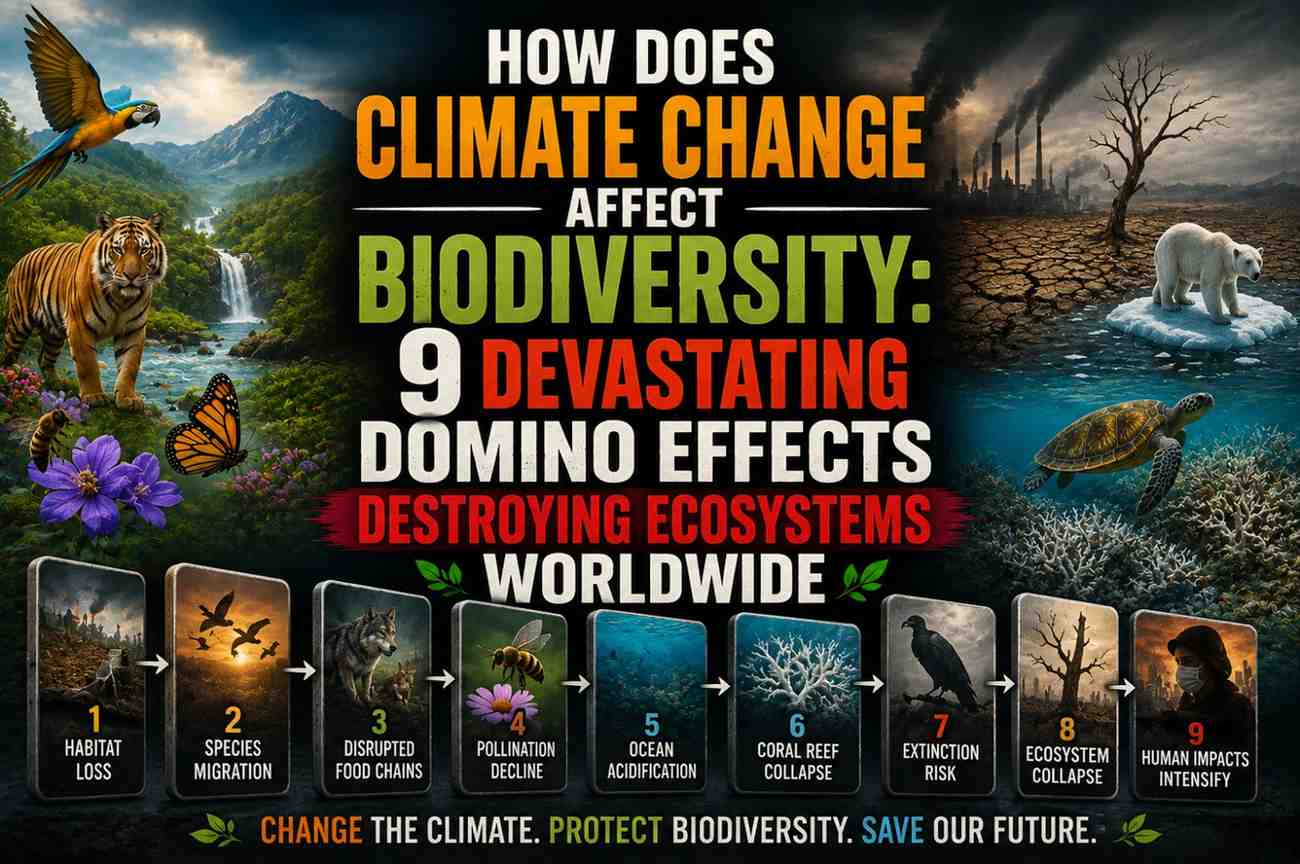
9 Devastating Ways Climate Change Affects Biodiversity
1. Thermal Range Compression
Every species has a thermal tolerance range — the range of temperatures within which it can survive, reproduce, and function. Climate change is shifting these ranges poleward and upward in altitude.
How does climate change affect biodiversity through thermal range compression? It squeezes species into smaller and smaller areas of suitable habitat. Mountain species have nowhere to go when temperatures rise — they are pushed uphill until there is no hill left. Cold-water marine species face the same logic in a warming ocean.
2. Coral Bleaching and Reef Collapse
Coral reefs host approximately 25% of all marine species on just 1% of the ocean floor. They are perhaps the most vivid illustration of how climate change affects biodiversity—and one of the most devastating.
When sea surface temperatures rise even 1–2°C above seasonal averages, corals expel their symbiotic algae and bleach white. Prolonged bleaching kills the coral. Since 2016, mass bleaching events have killed over 50% of the Great Barrier Reef’s coral. (See: Coral Reef Biodiversity Threats and Solutions 2026)
3. Phenological Mismatch
Phenology is the study of seasonal biological timing—when plants flower, when insects emerge, and when birds nest. Many of these timings are temperature-cued. Climate change is shifting them at different rates for different species.
How does climate change affect biodiversity through phenological mismatch? When oak trees leaf out three weeks earlier than caterpillars emerge, blue tit chicks—which depend on caterpillars to feed their young—face a catastrophic food shortage. When flowers bloom before their pollinators emerge, both parties suffer.
These mismatches are disrupting food webs across every ecosystem studied. According to NASA Climate, spring is arriving approximately 3–5 days earlier per decade across the Northern Hemisphere.
4. Habitat Fragmentation Through Climate Corridors
As climate zones shift, species must move to track suitable conditions. But movement requires connected habitats. In a world where natural habitats are already fragmented by roads, farms, and cities, many species cannot reach the new climate space they need.
How does climate change affect biodiversity in fragmented landscapes? It turns habitat islands — which were already dangerous — into death traps. Species that cannot move fast enough or cannot cross the barriers between habitat patches face local and regional extinction.
5. Ocean Acidification
The ocean absorbs approximately 30% of CO₂ emissions. As CO₂ dissolves in seawater, it forms carbonic acid—lowering ocean pH in a process called “ocean acidification.”
How does climate change affect biodiversity in the ocean? Ocean acidification dissolves the calcium carbonate shells and skeletons of corals, oysters, mussels, sea urchins, and many plankton species. These organisms form the base of marine food webs. Their decline ripples upward through every level of ocean life.
6. Increased Frequency of Extreme Weather Events
Climate change is intensifying tropical cyclones, extending droughts, increasing flood frequency, and driving more intense wildfires. Each of these events can eliminate entire local populations in a single event.
The 2019–2020 Australian bushfires killed or displaced an estimated 3 billion animals, incinerated 21% of Australia’s temperate broadleaf forest, and drove multiple species to the brink of extinction in weeks. This illustrates with brutal clarity how climate change affects biodiversity through extreme event intensification.
7. Glacier and Snowpack Loss
Glaciers and seasonal snowpack are the water towers of mountain ecosystems. Rivers fed by glacial melt sustain downstream freshwater habitats that evolved over millennia around predictable seasonal flow patterns.
How does climate change affect biodiversity in glacially fed river systems? As glaciers shrink and snowpack declines, river flows become erratic, peak flows shift earlier, and dry-season flows decrease. Cold-water fish like trout and salmon—and the thousands of species that depend on them—face a fundamentally altered hydrological regime. India’s Himalayan rivers, which feed the Ganges and Brahmaputra basins, are among the most vulnerable in the world.
8. Spread of Disease and Invasive Species
Warmer temperatures expand the range of mosquito-borne diseases, tick-borne pathogens, and fungal infections. How does climate change affect biodiversity through disease? By expanding the geographic range of pathogens into areas where species have no evolutionary defense.
Batrachochytrium dendrobatidis, the chytrid fungus driving global amphibian extinctions, has spread dramatically as climate change has created more favorable conditions at higher altitudes and latitudes. Mosquito-borne avian malaria is now killing Hawaiian honeycreepers at elevations that were previously too cold for the disease.
9. Permafrost Thaw and Carbon Feedback
Permafrost contains an estimated 1.5 trillion tons of frozen organic carbon—roughly double the amount currently in the atmosphere. As permafrost thaws, this carbon is released as CO₂ and methane, accelerating the very warming that caused the thaw.
How does climate change affect biodiversity through permafrost feedback? It floods wetland and tundra ecosystems with methane, alters drainage patterns, and triggers the collapse of habitats that took thousands of years to form. Species that evolved in stable permafrost environments — from lemmings to caribou — face rapid and irreversible habitat change.
The Synergistic Effect: When All Nine Interact
The answer to how climate change affects biodiversity becomes most alarming when these nine mechanisms are understood not in isolation but together. Climate change does not affect biodiversity through one mechanism—it attacks through all nine simultaneously. And it does so on a foundation already weakened by habitat destruction, pollution, overexploitation, and invasive species.
The combination produces effects that are greater than the sum of their parts—feedback loops that accelerate biodiversity loss faster than any single driver would cause alone. (See: Biodiversity Loss Causes and Effects 2026)
What Must Be Done
How climate change affects biodiversity is ultimately a question about what is being done to humanity’s most essential life-support systems. The answer requires both climate action — aggressive emissions reduction — and biodiversity action: protecting intact ecosystems, restoring degraded ones, and eliminating the subsidies and practices that make ecosystems more vulnerable.
The two crises must be addressed together. Solving climate change without addressing biodiversity loss leaves ecosystems too degraded to regulate the climate effectively. Protecting biodiversity without addressing climate change leaves species unable to survive in warming conditions.
Together, these actions represent humanity’s best and most urgent opportunity to secure a stable, life-supporting planet. (See: COP17 Biodiversity Goals 2026 Armenia)
Conclusion: The Domino Is Already Falling
How does climate change affect biodiversity? It is the accelerant on a fire that was already burning. It turns manageable stresses into existential crises. It converts fragmented habitats into extinction traps. It misaligns the finely tuned timing relationships that hold ecosystems together.
The dominoes are already falling. The question is whether humanity moves fast enough to stop the chain reaction or watches it run to its devastating conclusion.
Last updated: May 2026 | Related: Coral Reef Biodiversity Threats and Solutions 2026 | Biodiversity Loss Causes and Effects 2026


 creator@ecometric.site