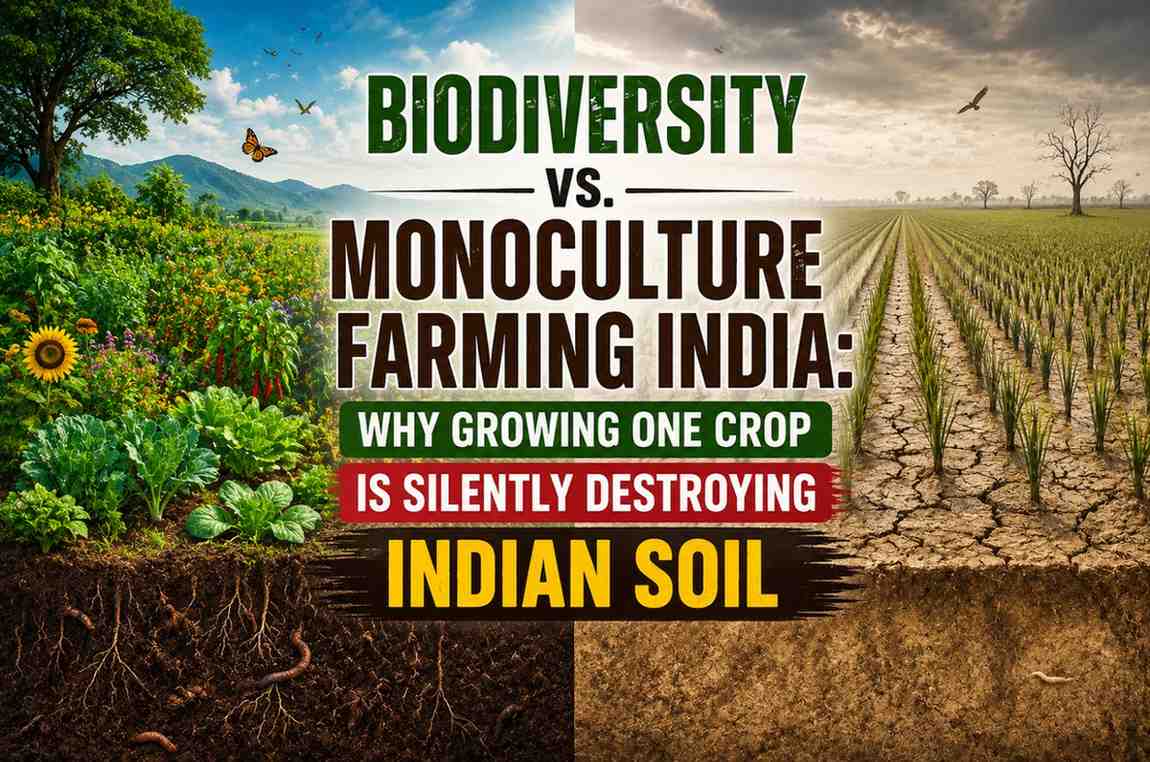
Biodiversity vs. monoculture farming in India is not an abstract academic debate. It is playing out right now in every Indian state—in wheat fields that spread uniformly to every horizon; in rice paddies where no weed, no flower, and no insect are permitted to exist; and in the silent absence of the birds and frogs that once populated these landscapes.
India feeds 1.4 billion people. The agricultural intensification that made that possible — the Green Revolution, the spread of high-yielding seed varieties, the expansion of irrigation and chemical inputs — was a genuine triumph of human ingenuity. But its hidden cost is becoming impossible to ignore.
The biodiversity vs. monoculture farming India question is ultimately about the long-term sustainability of Indian agriculture itself—and whether the soil, water, and ecological services that farming depends on can survive the way farming is currently being practiced.
What Is Monoculture Farming?
Monoculture farming is the cultivation of a single crop species over a large area, season after season. In India’s context, the most significant monocultures are wheat in Punjab and Haryana, rice across much of the Gangetic Plain, sugarcane in Maharashtra and Uttar Pradesh, and cotton in Vidarbha and Telangana.
Monoculture systems are optimized for yield and mechanization. They enable large-scale input application—uniform doses of fertilizer, herbicide, and pesticide—and facilitate the use of combine harvesters and other mechanized equipment.
They are also, from a biological standpoint, a catastrophic simplification of what was once a complex, biodiverse agricultural landscape.
What Biodiversity Means in Agricultural Contexts
Biodiversity vs monoculture farming India becomes a concrete comparison when we examine what traditional Indian farming systems actually contained. Polyculture intercropping of pulses, millets, oilseeds, and vegetables. Field margins thick with flowering plants that hosted predatory insects. Scattered trees—ber, neem, and babul—that provided fruit, fodder, shade, and habitat. Seasonal wetlands in rice paddies that supported frogs, fish, and waterbirds. Traditional seed systems maintaining dozens of locally adapted crop varieties.
This agricultural biodiversity was not inefficient. It was resilient, multi-functional, and deeply integrated with the ecological systems that surrounded the farm.
The 6 Ways Monoculture Is Destroying Indian Agriculture and Its Ecosystems
1. Soil Degradation
Soil is not dirt. It is a living ecosystem containing billions of organisms per teaspoon—bacteria, fungi, nematodes, earthworms, and the extraordinary complexity of the soil food web.
Monoculture systems repeatedly remove the same combination of nutrients from the soil, require ever-increasing inputs of synthetic fertilizer to maintain yields, and eliminate the crop diversity that would otherwise feed a diverse microbial community.
The biodiversity vs. monoculture farming India soil health comparison is stark. Studies in Punjab’s rice-wheat belt show progressive declines in soil organic matter, soil microbial diversity, and earthworm populations—all indicators of long-term soil health.
2. Pesticide Treadmill and Pest Resistance
Monocultures are uniquely vulnerable to pest outbreaks. A field of genetically uniform wheat is an unlimited food source for any organism that can eat wheat. The response—intensive pesticide application—kills not only the target pest but also the predatory insects that would naturally regulate pest populations.
Within years, pests develop resistance. Doses increase. New chemicals are needed. The cost of the pesticide treadmill is borne by farmers — and by the wildlife that disappears as the chemicals spread. In the biodiversity vs. monoculture farming India pest management comparison, polyculture consistently outperforms monoculture when measured over full ecological cost accounting.
3. Water Overconsumption and Groundwater Depletion
Punjab’s rice-wheat monoculture belt is extracting groundwater at rates that have caused water tables to fall by several meters per decade. Rice cultivation in particular—a crop poorly matched to Punjab’s climate but heavily incentivized by procurement policies—requires enormous amounts of water.
The biodiversity vs. monoculture farming India water efficiency comparison shows that diversified cropping systems with a mix of drought-tolerant millets, legumes, and oilseeds can produce comparable nutritional output with dramatically lower water consumption.
4. Collapse of Agricultural Biodiversity and Seed Heritage
India once cultivated over 100,000 varieties of rice. Today, fewer than 10 varieties account for the vast majority of rice grown in the country. The genetic narrowing that accompanies monoculture adoption has eliminated thousands of locally adapted varieties that contained irreplaceable genetic diversity.
This genetic erosion is one of the most alarming dimensions of the biodiversity vs. monoculture farming India debate—because once a traditional variety is lost from cultivation and from seed banks, it is lost forever.
5. Elimination of Natural Pest Predators and Pollinators
Traditional farming landscapes supported populations of frogs, spiders, ground beetles, parasitic wasps, and other natural pest predators. They also supported diverse pollinator communities beyond the domesticated honeybee.
As monoculture systems have spread and pesticide use has intensified, these populations have collapsed. Frog populations — key controllers of rice field pests — have declined dramatically across India’s paddy landscape. Sparrow populations, which historically fed on crop pests, have crashed in agricultural areas. The biodiversity vs. monoculture farming India wildlife comparison tells a consistent story of ecological impoverishment.
6. Farmer Debt and Agrarian Crisis
The intensification of monoculture farming in India has been accompanied by a deepening agrarian crisis. Farmers in the Punjab-Haryana belt face rising input costs, declining soil productivity, falling water tables, and growing indebtedness. The farmer suicide crisis in cotton-growing regions of Vidarbha is directly connected to the high input costs and yield volatility of monoculture cotton systems.
The Case for Agricultural Biodiversity
Biodiversity vs. monoculture farming in India is not a call to return to subsistence agriculture. It is a call to redesign Indian farming systems around principles that build rather than deplete the natural capital they depend on.
The models already exist. Systems-based approaches like Zero Budget Natural Farming (ZBNF), agroforestry, System of Rice Intensification (SRI), and millet promotion programs have demonstrated that agricultural productivity and ecological health are not in opposition—when the right incentives and knowledge systems are in place.
Promoting native seed varieties, restoring field margins, reintroducing crop diversity through policy reform, and reforming the procurement systems that currently reward only wheat and rice with guaranteed minimum support prices are all concrete interventions in the biodiversity vs. monoculture farming India policy space.
What Needs to Change
The biodiversity vs. monoculture farming India crisis will not be solved by farmers alone. The policy environment—procurement prices, input subsidies, credit systems, and extension services—has systematically incentivized monoculture and punished diversity.
Reforming agricultural subsidies to reward farmers for ecological outcomes, expanding the minimum support price system to cover diverse crops including millets and pulses, and investing in research and extension for agroecological approaches are all essential components of a genuine solution. (See: COP17 Biodiversity Goals 2026 Armenia)
FAQ: Biodiversity vs. Monoculture Farming
1. What is the most sustainable type of farming?
Organic and regenerative farming are considered most sustainable because they improve soil health, conserve water, reduce chemicals, and support long-term biodiversity.
2. Does monoculture promote biodiversity?
No, monoculture reduces biodiversity because only one crop grows repeatedly, decreasing plant variety and increasing risks from pests, diseases, and soil depletion.
3. Which vegetable is more profitable?
Tomato, capsicum, cucumber, broccoli, and chili are highly profitable vegetables due to strong market demand, fast growth, and good commercial value.
4. Which farming is known as monoculture?
Monoculture farming means growing a single crop on the same land repeatedly for large-scale production and easier farming management.
5. What are examples of monoculture plants?
Common monoculture plants include wheat, rice, corn, soybeans, sugarcane, cotton, bananas, and tea grown extensively in single-crop farming systems.
Conclusion: The Soil Is Still Speaking
The biodiversity vs. monoculture farming India debate will be settled in the end by the soil itself. Soil that has lost its biology cannot sustain indefinite yield increases regardless of how much input is applied. The question is not whether change will come — it will — but whether it comes through proactive redesign or through the collapse of systems that have been pushed past their ecological limits.
India has the knowledge, the traditional ecological wisdom, and the innovative farming communities to lead a global transition to biodiverse, resilient agriculture. The biodiversity vs. monoculture farming in India question is ultimately a question of political will—and of whose interests the food system is designed to serve.
Last updated: May 2026 | Related: Biodiversity Loss Causes and Effects 2026 | Biodiversity Hotspots in India 2026




 creator@ecometric.site