
Introduction
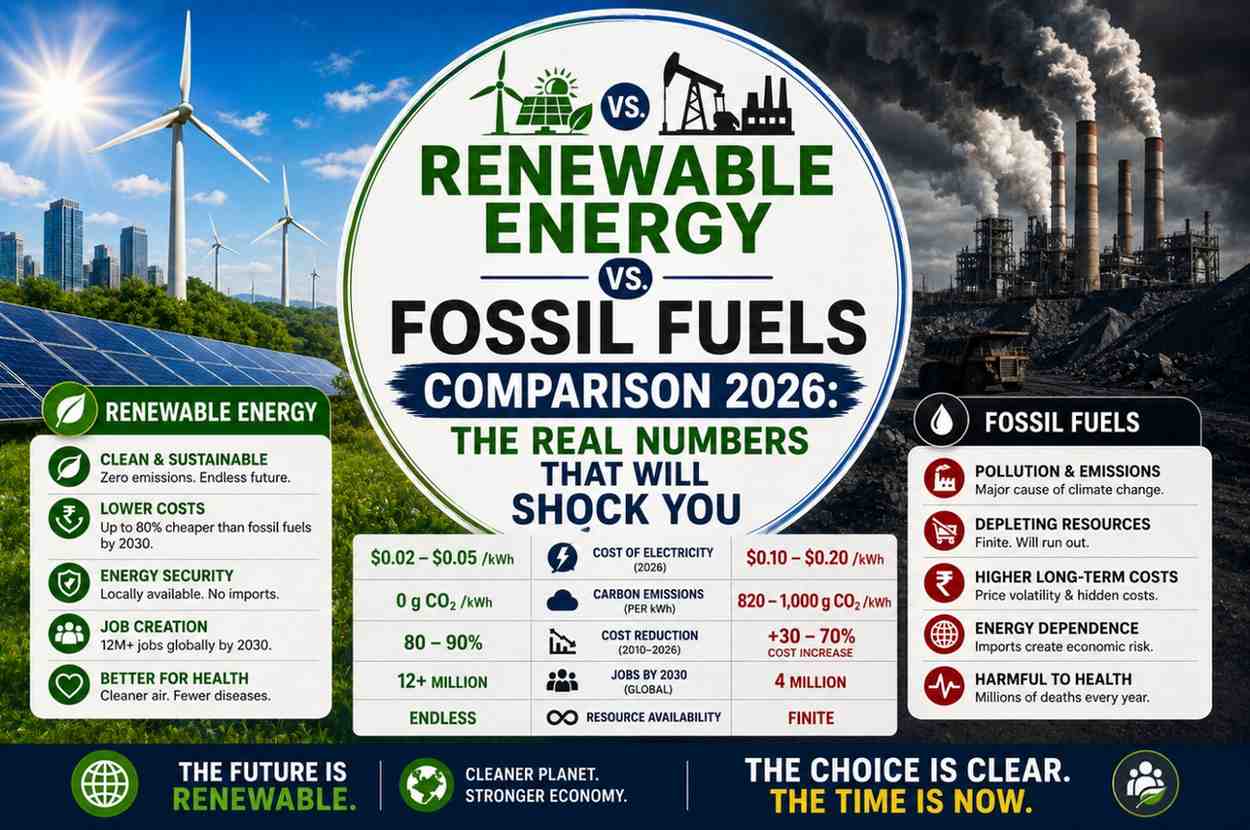
The renewable energy vs. fossil fuels comparison of 2026 has shifted dramatically—and the numbers no longer favor coal, oil, or gas the way they once did. For most of human industrial history, fossil fuels were the undisputed cost champions. That era is over.
In 2026, solar and wind electricity are cheaper than new coal in virtually every major economy. But the full picture is more nuanced than a single price comparison.
Here’s the complete, honest renewable energy vs. fossil fuels comparison for 2026—covering costs, reliability, emissions, jobs, and the future.
Cost Comparison: Renewable Energy vs Fossil Fuels 2026
Levelized Cost of Energy (LCOE)
The most objective way to compare energy sources is the Levelized Cost of Energy (LCOE) — the average cost to generate one megawatt-hour (MWh) over a plant’s lifetime.
Here’s the renewable energy vs. fossil fuels comparison for 2026 on LCOE:
| Energy Source | Global LCOE (USD/MWh) 2026 |
|---|---|
| Utility-scale Solar PV | $25–$45 |
| Onshore Wind | $28–$50 |
| Offshore Wind | $65–$115 |
| Geothermal | $40–$75 |
| Coal (new plant) | $65–$150 |
| Natural Gas (CCGT) | $55–$110 |
| Nuclear | $80–$180 |
| Oil (power generation) | $150–$250 |
The data is unambiguous. New utility-scale solar and onshore wind are the cheapest sources of electricity in history. The renewable energy vs. fossil fuels comparison in 2026 on pure cost is not even close.
Why Fossil Fuel Costs Are Rising
While renewable costs have plummeted:
- Coal faces carbon taxes in over 70 countries
- Natural gas prices remain volatile post-2022 energy crisis
- Aging fossil fuel infrastructure requires expensive maintenance
- Insurance and financing costs for fossil fuel projects have surged
- Stranded asset risk makes long-term capital investment increasingly difficult
Reliability Comparison: The Real Honest Picture
The most common objection in any renewable energy vs. fossil fuel comparison is reliability. Solar doesn’t shine at night. Wind doesn’t always blow.
This is true — and it matters. Here’s the honest breakdown:
Fossil Fuels: Dispatchable but Expensive
Coal and gas plants can generate power on demand 24/7. This “dispatchability” remains genuinely valuable for grid stability.
Renewables: Variable but Increasingly Manageable
In 2026, the reliability gap has narrowed significantly because of:
- Battery storage — utility-scale battery costs have fallen 85% since 2015
- Grid interconnection—diversified renewable sources across large areas smooth variability
- Demand response — smart grids shift consumption to match generation
- Pumped hydro — the world’s most proven large-scale energy storage
- Green hydrogen — emerging as a long-duration storage solution
The renewable energy vs. fossil fuels comparison in 2026 on reliability is no longer a simple win for fossil fuels. Managed grids with high renewable penetration are proving stable in multiple countries.
Emissions Comparison
This is where the renewable energy vs. fossil fuels comparison of 2026 diverges most sharply:
| Energy Source | Lifetime CO₂ (gCO₂/kWh) |
|---|---|
| Solar PV | 20–50 |
| Wind (onshore) | 7–15 |
| Natural Gas | 490–650 |
| Coal | 820–1,050 |
| Oil | 650–780 |
| Nuclear | 12–29 |
Coal emits 20–50 times more carbon per kilowatt-hour than solar or wind over their full lifecycle. For any country with climate commitments, the renewable vs. fossil fuel comparison on emissions requires no further debate.
Jobs and Economic Comparison
The renewable energy vs. fossil fuels comparison in 2026 extends beyond electricity bills:
- Solar employed 4.9 million people globally in 2025—up 12% year-on-year
- Wind employed 1.4 million people globally
- Coal employment declined 8% globally in 2025
- Renewable energy jobs are more geographically distributed—creating rural and regional employment
- Fossil fuel jobs are concentrated in specific geographies
India is a particularly striking case. The renewable vs. fossil fuel job comparison shows solar alone employing hundreds of thousands in manufacturing, installation, and maintenance—spread across every state.
Energy Security: Renewables Win for Import-Dependent Nations
For countries like India—which imports 85% of its crude oil—the renewable energy vs. fossil fuels comparison of 2026 has a strategic dimension beyond cost.
Domestic solar and wind resources don’t require foreign currency, aren’t subject to geopolitical disruption, and cannot be embargoed.
Every unit of renewable energy generated domestically replaces an imported energy equivalent. For India, this is both a financial and national security imperative.
Where Fossil Fuels Still Win in 2026
An honest renewable energy vs. fossil fuels comparison in 2026 acknowledges areas where fossil fuels retain advantages:
- Aviation fuel — no economically viable renewable alternative at scale yet
- High-temperature industrial processes—steel, cement, glass require extreme heat
- Shipping — transitioning but still largely fossil-fuel dependent
- Dispatchable baseload — gas peakers still play a role in grid balancing
These “hard-to-abate” sectors are the frontier of the clean energy transition. But electricity generation—which is where the comparison has historically been fiercest—is now firmly in renewables’ favor.
Related Article: Green Hydrogen Energy Future 2026
External Resources
FAQ: Renewable Energy vs Fossil Fuels Comparison 2026
Q1: Is renewable energy cheaper than fossil fuels in 2026? Yes — new solar and onshore wind are now cheaper than new coal or gas plants in most of the world, based on LCOE data.
Q2: Are renewables reliable enough to replace fossil fuels? Increasingly yes — battery storage, grid interconnection and demand management are rapidly closing the reliability gap in the renewable energy vs fossil fuels comparison 2026.
Q3: Which produces more jobs — renewables or fossil fuels? Renewable energy now employs more people globally than fossil fuels, with solar alone employing nearly 5 million people worldwide.
Q4: What are fossil fuels still better at in 2026? Aviation, shipping, high-temperature industrial processes and grid balancing during peak demand remain areas where fossil fuels maintain advantages.
Q5: How much less CO₂ does wind produce compared to coal? Wind energy produces approximately 7–15 grams of CO₂ per kWh versus 820–1,050 grams for coal — roughly 60–100 times less.
Conclusion
The renewable energy vs. fossil fuels comparison 2026 delivers a clear verdict on electricity: renewables win on cost, emissions, job creation, and energy security.
The transition isn’t complete — storage, grid investment, and industrial decarbonization remain significant challenges. But the economic and environmental case for accelerating the shift from fossil fuels to renewable energy has never been stronger.
The real question in 2026 is no longer “can renewables compete?” It’s “how fast can we complete the transition?”




 creator@ecometric.site