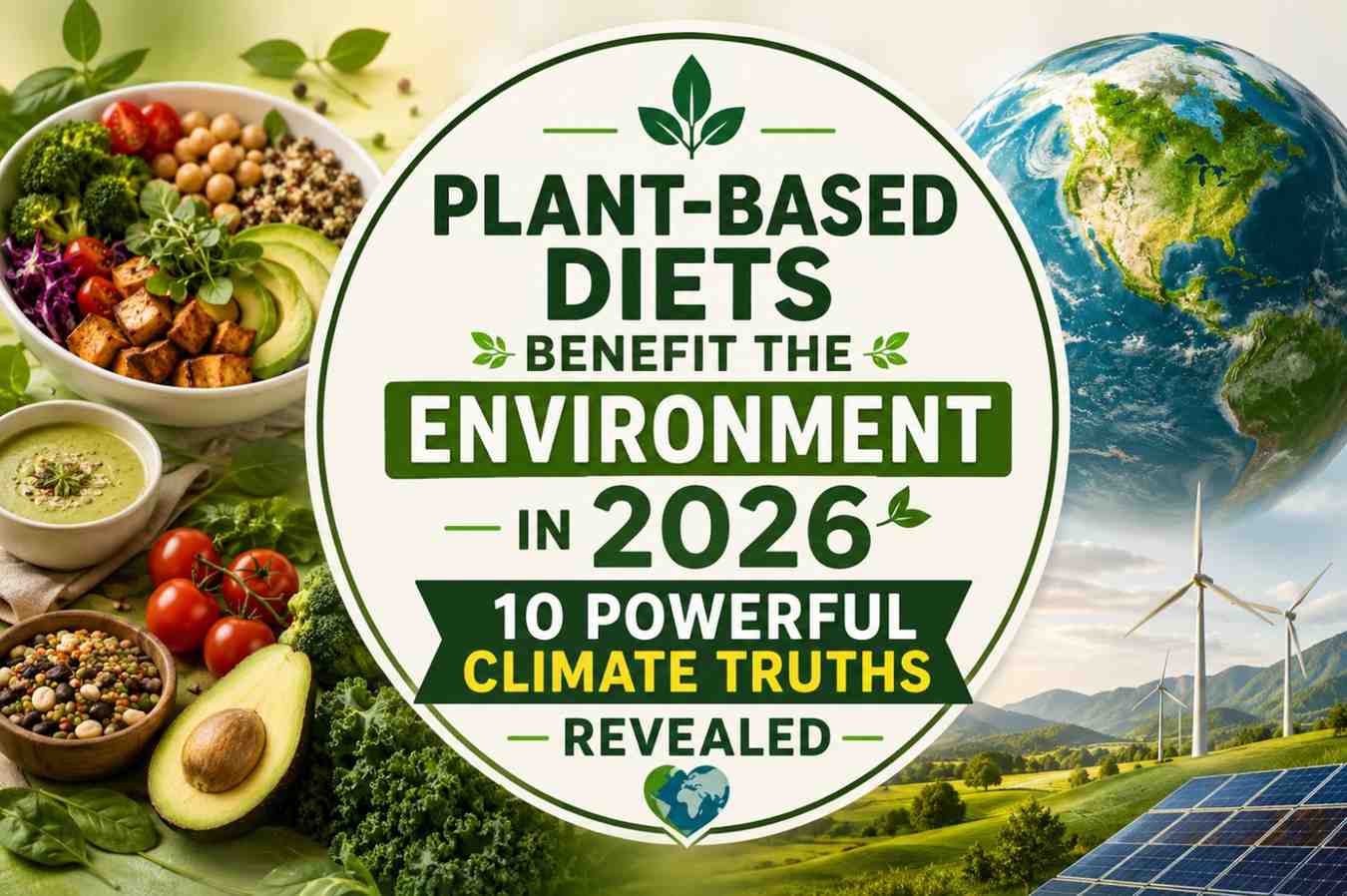
The connection between what we eat and the health of our planet is one of the most important — and most overlooked — dimensions of the climate crisis. The science is clear: plant-based diets benefit the environment. 2026 research continues to confirm what earlier studies established—shifting dietary patterns away from animal products, especially red meat, is one of the most powerful individual actions available to combat climate change, protect biodiversity, and conserve water.
Plant-based diets benefit the environment; 2026 findings are particularly significant for India. Our country is simultaneously one of the world’s largest livestock sectors and home to the world’s largest vegetarian population. India is perfectly positioned to lead a global shift toward plant-based eating — not as an imported trend, but as a celebration and expansion of dietary traditions already embedded in our culture.
This article explains, with specific data, exactly how eating less meat fights climate change — and what that means for Indian eaters in 2026.
The Scale of Food’s Environmental Impact
The global food system is responsible for approximately 26% of all greenhouse gas emissions — more than aviation, shipping, and personal transport combined. Within the food system, animal agriculture accounts for the majority of emissions: approximately 14.5% of global emissions, according to the Food and Agriculture Organization of the United Nations.
The breakdown:
- Beef and dairy cattle: ~65% of livestock emissions
- Pigs: ~9%
- Poultry: ~8%
- Other livestock: ~18%
A kilogram of beef generates approximately 27 kg of CO₂ equivalent across its lifecycle. A kilogram of tofu generates 2 kg. Lentils — the foundation of Indian dal — generate just 0.9 kg of CO₂ per kilogram produced.
The math of plant-based diet benefits the environment: 2026 science documents are stark and undeniable.
10 Environmental Benefits of a Plant-Based Diet
1. Dramatically Lower Greenhouse Gas Emissions
Switching from a meat-heavy diet to a predominantly plant-based one can reduce an individual’s food-related carbon footprint by 50–73%, according to research published in the journal Science. For a family of four, this represents a reduction of approximately 1.5–2.5 tonnes of CO₂ equivalent per year—comparable to eliminating a second car.
The plant-based diet benefits the environment. 2026 modeling consistently shows this to be the single most impactful dietary change for emissions reduction.
2. Radically Reduced Water Consumption
Animal agriculture is extraordinarily water-intensive:
- 1 kg of beef requires approximately 15,400 litres of water to produce
- 1 kg of chicken: ~4,300 litres
- 1 kg of wheat: ~1,600 litres
- 1 kg of lentils: ~900 litres
In a country where groundwater is depleting at alarming rates and millions lack reliable water access, this difference is not abstract—it is urgent. Shifting dietary demand toward plant proteins measurably reduces pressure on India’s water systems.
3. Liberation of Agricultural Land
Globally, 80% of all agricultural land is used for livestock—either as pasture or to grow animal feed. Yet livestock provides only 18% of global calories. This extraordinary inefficiency means that shifting to plant-based diets could free enormous areas of land for reforestation, rewilding, and biodiversity recovery.
In India, reducing pressure on agricultural land — currently among the most intensively farmed in the world — is critical for ecosystem recovery.
4. Reduced Deforestation
Much of the world’s most biodiverse tropical forest is being cleared for cattle ranching and soy cultivation (used primarily as animal feed). While India’s direct deforestation-livestock link is less severe than Brazil’s, India imports significant quantities of palm oil and soy, whose production drives deforestation elsewhere.
Reducing demand for these commodities through plant-based eating has global ripple effects.
5. Improved River and Ocean Health
Livestock farming produces enormous volumes of waste — manure, urine, and antibiotic-laden runoff — that contaminates rivers, groundwater, and coastal ecosystems. Livestock-based fertilizer runoff is the leading cause of aquatic dead zones globally, areas of ocean where oxygen depletion kills all marine life.
India’s rivers—many already severely polluted—bear significant livestock effluent loads. Reduced livestock scale means cleaner water ways.
6. Reduced Antibiotic Resistance
India uses more antibiotics in livestock than any other country—contributing to the catastrophic rise of antibiotic-resistant bacteria that threatens human health globally. This is a direct consequence of factory farming practices designed to prevent disease in overcrowded conditions.
Reduced meat consumption directly reduces the demand that drives these practices.
7. Biodiversity Protection
Habitat loss from agriculture — especially livestock — is the leading driver of species extinction globally. In India, grasslands, wetlands, and forest margins that provide habitat for tigers, elephants, birds, and thousands of plant species are under pressure from expanding agriculture.
The plant-based diet benefits the environment. 2026 data clearly shows that dietary shifts are one of the most effective tools for biodiversity conservation.
8. Reduced Air Pollution
Livestock farming produces significant volumes of ammonia (from manure) and methane—both contributing to air pollution and greenhouse gas accumulation. India’s air quality crisis is driven by multiple factors; reducing livestock-related atmospheric pollution is one lever available through dietary choices.
9. Better Food Security
Plant-based foods are dramatically more calorie-efficient than animal products. It takes approximately 6–8 kg of grain to produce 1 kg of beef. A world (and a country) where more people eat lower on the food chain is a world with more food available per unit of land and water — a critical consideration for food security in a warming climate.
10. Healthier Soils Through Diverse Cropping
Monocrop agriculture — growing single crops to feed livestock at scale — degrades soil health over time. Diverse plant-based food systems, incorporating legumes, grains, vegetables, and tubers in rotation, build soil organic matter, reduce erosion, and sequester carbon in soil. Indian farming traditions of mixed cropping and crop rotation embody exactly these principles.
The Indian Advantage: We Are Already Ahead
India has an extraordinary foundation for plant-based eating:
- 38% of India’s population is already vegetarian—the world’s highest proportion
- India has the world’s richest tradition of plant-based cooking: dal, sabzi, idli, dosa, rajma, chana, paneer-free curries, and hundreds of regional vegetarian traditions
- Indian legumes—masoor, moong, chana, toor, urad—are among the most nutritionally complete and environmentally efficient protein sources in the world
- Traditional Indian diets are already inherently seasonal and locally adapted
The plant-based diet benefits the environment 2026 researchers point to are not a foreign prescription for Indians. They are a validation and amplification of what India has known for millennia.
What Eating Less Meat Actually Looks Like — Practically
You do not need to become fully vegetarian to make a measurable environmental impact. Research consistently shows that the biggest environmental gains come from reducing beef and lamb (the highest-emission meats) even more than from eliminating chicken or eggs.
Practical steps for Indian non-vegetarians:
- Replace beef and mutton with chicken or fish—reduces red meat emissions by 50–70%
- Adopt Meatless Monday — one fully plant-based day per week
- Explore regional vegetarian dishes—Gujarati thali, Kerala sadhya, Bengali posto, Tamil Nadu’s Chettinad vegetarian options
- Experiment with plant proteins—soya chunks (nutrela), tofu, paneer, legumes, and seeds are complete protein sources
For already-vegetarian households:
- Reduce dairy consumption — particularly processed dairy products with high packaging and transport footprints
- Choose local, seasonal produce over imported or packaged alternatives
- Explore fermenting and preserving to extend seasonal produce and reduce waste
The Plant-Based Diet and Indian Children
Research on childhood nutrition increasingly supports the adequacy of well-planned plant-based diets for children’s growth and development. India’s vegetarian communities—Jain, many Hindu, and some Buddhist populations—have centuries of evidence of healthy, thriving children raised on plant-based diets when these diets are nutritionally balanced.
The key nutrients to monitor for growing children on reduced-meat diets are iron, B12, zinc, and omega-3 fatty acids — all obtainable from Indian food sources (ragi, sesame, flaxseed, spirulina, and fortified foods) with appropriate planning. Consult a nutritionist for personalized guidance.
The Future Is Plant-Based — India Is Leading the Way
For authoritative global data on food system emissions and plant-based diet environmental benefits, the Our World in Data food and climate explorer (rel=”dofollow”) provides the most comprehensive and accessible scientific summaries available.
The plant-based diet benefits the environment: 2026 science documents are compelling. But perhaps more compelling is this: India already knows how to cook the most delicious, nutritious, and environmentally sustainable food on earth. We have always known. The task now is to choose it more intentionally.
FAQ: Plant-based diets benefit the environment
1. How do plant-based diets benefit the environment?
Plant-based diets reduce greenhouse gas emissions, conserve water, decrease deforestation, protect biodiversity, and require far less land compared to meat-heavy diets.
2. Which foods have the highest carbon footprint?
Beef and lamb have the highest environmental impact because livestock farming produces large amounts of methane, uses huge quantities of water, and requires extensive agricultural land.
3. Can reducing meat consumption really help fight climate change?
Yes. Studies show that reducing red meat consumption significantly lowers personal carbon footprints and decreases emissions linked to livestock farming and food production.
4. Is a plant-based diet suitable for Indian lifestyles?
Absolutely. Traditional Indian cuisine already includes many sustainable plant-based foods like dal, rajma, chana, idli, dosa, sabzi, millet, and seasonal vegetables rich in nutrients and protein.
5. Do you need to become fully vegetarian to help the environment?
No. Even small changes like Meatless Mondays, reducing beef and mutton intake, or replacing some meals with plant-based alternatives can create measurable environmental benefits.
Final Conclusion
The evidence is now overwhelming: plant-based diets benefit the environment in powerful and measurable ways. From lowering greenhouse gas emissions and conserving water to protecting forests, biodiversity, and soil health, reducing dependence on animal agriculture is one of the most effective climate actions individuals can take.
For India, this shift is especially important because many sustainable eating habits are already deeply rooted in traditional food culture. Indian cuisines built around dal, legumes, grains, vegetables, and seasonal produce are naturally aligned with low-carbon, environmentally responsible living.
Importantly, climate-friendly eating does not require perfection or extreme restrictions. Even moderate reductions in red meat consumption combined with more plant-based meals can create substantial environmental impact over time. Small daily food choices, multiplied across millions of households, can significantly reduce pressure on land, water, and ecosystems.
The future of sustainable food is not about giving up flavour or culture — it is about rediscovering the strength of traditional, diverse, plant-rich diets that nourish both people and the planet. India is uniquely positioned to lead this global transition toward healthier and more sustainable eating in 2026 and beyond.
Related reading: Zero Waste Kitchen Tips India 2026 | Composting at Home for Beginners India | How to Reduce Carbon Footprint in Daily Life India

 creator@ecometric.site