
Introduction
India is a land of breathtaking wildlife diversity. Yet in 2026, the list of the most endangered species India is facing reads like a heartbreaking catalogue of human failure—and of remarkable conservation resilience.
Understanding which animals are most at risk, why they are disappearing, and what conservation programs are doing to reverse the trend is essential for anyone who cares about India’s natural heritage.
The most endangered species India 2026 data reveals a pattern: these animals are not declining because of natural change but because of habitat destruction, poaching, climate change, and conflict with human development. Each one is a warning. Each one is also a chance to do better.
Why India’s Wildlife Crisis Is Unique
India is one of the world’s 17 megadiverse nations. It is home to over 45,000 plant species and more than 91,000 animal species. It hosts the Bengal tiger, the Asiatic lion, the Indian rhinoceros, and dozens of endemic birds, reptiles, and mammals found nowhere else on Earth.
But India also has one of the world’s fastest-growing human populations and one of the most intense pressures on land and water. The result is a collision between development and biodiversity that produces the grim list of the most endangered species in India 2026. Scientists and conservationists are fighting to shorten it.
India’s Wildlife Protection Act, Project Tiger, Project Elephant, and a growing network of wildlife sanctuaries and national parks provide the legal and institutional framework for conservation. But legal protection alone is rarely sufficient. (See: Biodiversity Hotspots in India 2026)
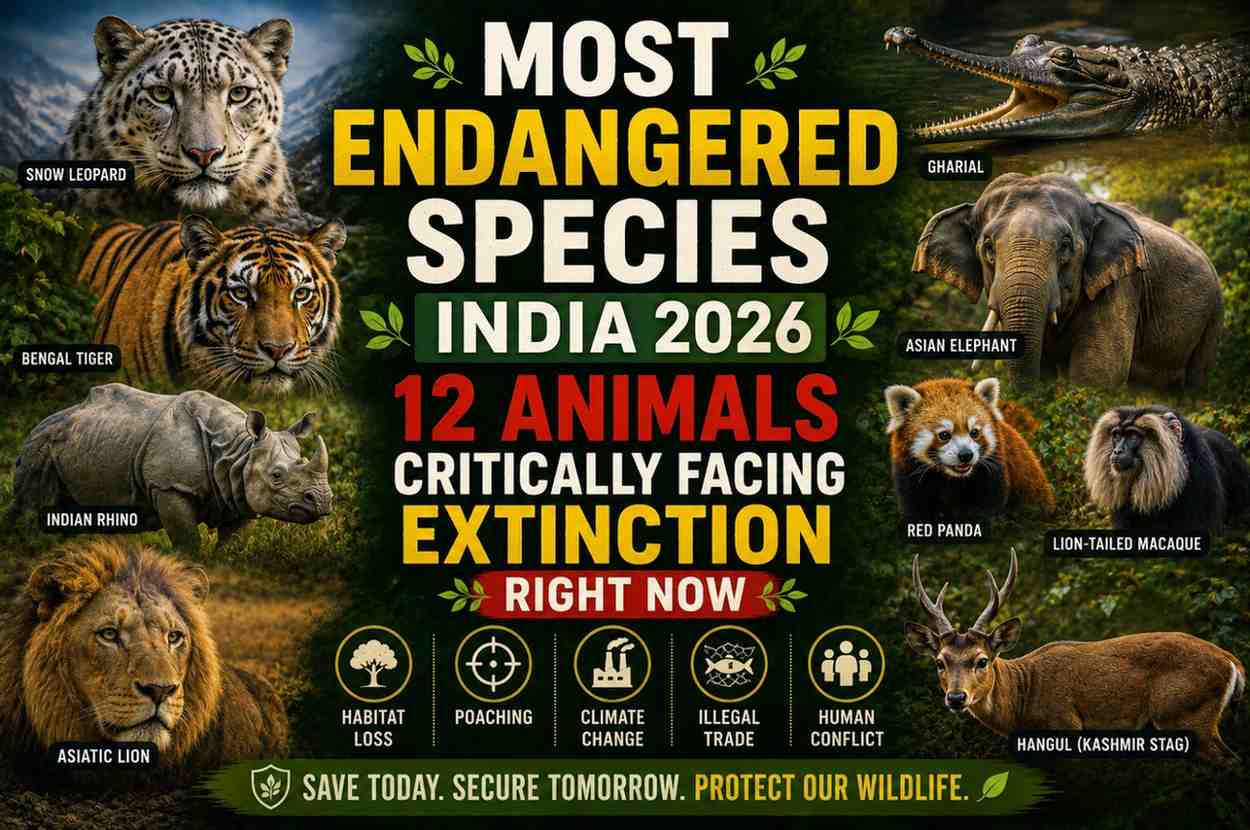
The 12 Most Endangered Species in India in 2026
1. Bengal Tiger (Panthera tigris tigris)
The Bengal Tiger is India’s national animal and one of the most iconic of all the most endangered species India’s 2026 conservationists are monitoring. Population estimates have risen to approximately 3,000–3,500 in India, thanks to decades of Project Tiger work. But habitat fragmentation, poaching, and human-tiger conflict continue to threaten long-term survival.
2. Asiatic Lion (Panthera leo persica)
Found only in the Gir Forest of Gujarat, the Asiatic lion is among the rarest big cats on Earth. With a population of approximately 700 individuals, this subspecies remains critically vulnerable to disease outbreaks, habitat loss, and the dangers of having all individuals in a single location.
The Wildlife Institute of India has been advocating for a second population to be established as an insurance against catastrophic loss.
3. Indian One-Horned Rhinoceros (Rhinoceros unicornis)
The Indian Rhinoceros is a conservation success story—and still among the most endangered species in India; 2026 researchers monitor it closely. Populations have recovered from under 200 in the early 20th century to approximately 4,000 today, largely thanks to protection in Kaziranga National Park.
Poaching for rhino horn and flooding threats from climate change remain serious risks.
4. Snow Leopard (Panthera uncia)
The snow leopard inhabits the remote high-altitude landscapes of the Himalayas and Ladakh. India has an estimated 400–700 individuals, making it one of the country’s most vulnerable large predators.
Climate change is shrinking its habitat from above and below simultaneously, as human settlements move uphill and glacier coverage declines. The snow leopard frequently appears at the top of most endangered species in India’s 2026 threat assessments.
5. Ganges River Dolphin (Platanista gangetica)
The Ganges River Dolphin is India’s national aquatic animal and one of the freshwater world’s most threatened mammals. Fewer than 3,000 are believed to survive.
Pollution, dam construction that fragments river habitats, fishing net entanglements, and sand mining all contribute to its decline. It sits prominently among the most endangered species India 2026 riverine ecosystem reports flag.
6. Red Panda (Ailurus fulgens)
The red panda inhabits the Eastern Himalayas, including parts of Sikkim, West Bengal, and Arunachal Pradesh. With an estimated 2,500 mature individuals globally and India’s subpopulation under particular pressure from deforestation and illegal trade, the red panda is classified as Endangered by the IUCN Red List.
7. Nilgiri Tahr (Nilgiritragus hylocrius)
Endemic to the Western Ghats, the Nilgiri Tahr is a mountain ungulate that has lost most of its former range to encroachment and poaching. Only around 3,000 individuals remain, confined to steep grassland habitats that are increasingly threatened by invasive plant species and climate variability.
8. Fishing Cat (Prionailurus viverrinus)
The Fishing Cat is a wetland specialist that has lost much of its habitat to drainage, aquaculture conversion, and urban expansion. Among the most endangered species India’s 2026 wetland conservation reports highlight, the Fishing Cat is particularly at risk because wetlands themselves are India’s least-protected habitat type.
9. Indian Wild Dog / Dhole (Cuon alpinus)
The Dhole is a pack-hunting canid found across central and peninsular India. Fewer than 2,500 mature Dholes are thought to survive globally, with India hosting the largest remaining population. Habitat loss and the depletion of prey species are its primary threats.
10. Gharial (Gavialis gangeticus)
The Gharial is a critically endangered crocodilian found only in the Chambal, Ghaghra, and Gandak rivers. Its distinctive long, narrow snout is perfectly adapted for catching fish—but makes it useless as a threat to humans. Despite this, it has been hunted and displaced to near extinction.
The Gharial population has fallen from an estimated 5,000–10,000 in the 1940s to fewer than 300 adults today, making it one of the most critically endangered of all endangered species in India. In 2026, herpetologists are tracking it.
11. Great Indian Bustard (Ardeotis nigriceps)
The Great Indian Bustard is one of the heaviest flying birds in the world—and one of the closest to extinction. Fewer than 150 individuals are believed to survive in the wild, mostly in Rajasthan’s Thar Desert.
Power line collisions, habitat conversion to solar farms, and hunting have reduced its numbers to crisis levels. Conservation teams are now implementing captive breeding and power line diversion programs as emergency interventions.
12. Indian Vultures (Gyps bengalensis, Gyps indicus, Gyps tenuirostris)
India’s vulture populations collapsed by over 99% between the 1990s and 2010s due to diclofenac poisoning—a veterinary anti-inflammatory drug that is lethal to vultures that feed on treated livestock. Three species remain among the most endangered species in India that ornithologists urgently monitor in 2026.
Vultures are critical ecological cleaners that prevent disease spread and reduce carcass contamination. Their loss has had cascading consequences for public health.
What Conservation Is Doing
India’s conservation system is working hard — and showing real results in some areas.
Project Tiger has overseen a steady rise in tiger numbers over four decades. The 2022 tiger census counted 3,167 tigers, making India home to over 70% of the world’s wild tigers.
Project Elephant manages over 30 elephant reserves covering 65,000 square kilometers. The program focuses on maintaining corridors between fragmented forest patches.
Community conservation is increasingly recognized as vital. Indigenous communities and local farmers often serve as the first and best guardians of wildlife when their rights and livelihoods are respected and supported.
Captive breeding and reintroduction programs for species like the Great Indian Bustard, Gharial, and Asiatic Lion are providing a crucial safety net.
The Challenges Ahead
Despite real progress, the most endangered species India 2026 data shows that many populations remain critically small and vulnerable. Habitat fragmentation, linear infrastructure cutting across wildlife corridors, climate change, and the persistent demand for wildlife parts in illegal trade markets continue to undermine conservation gains.
India needs to accelerate the protection of key corridors, strengthen enforcement, expand community engagement, and align development planning with biodiversity outcomes. (See: Biodiversity Loss Causes and Effects 2026)
Most Endangered Species – FAQs
1. What are endangered species?
Endangered species are animals or plants facing a very high risk of extinction because of habitat loss, hunting, pollution, or climate change.
2. Which is the most endangered animal in the world?
The vaquita porpoise is considered the world’s most endangered animal, with fewer than 20 individuals remaining in the wild.
3. Why do species become endangered?
Species become endangered due to deforestation, illegal hunting, pollution, climate change, habitat destruction, and human activities affecting natural ecosystems.
4. What are some examples of endangered species?
Examples include tigers, rhinos, orangutans, sea turtles, snow leopards, red pandas, elephants, and the vaquita porpoise.
5. How does climate change affect endangered species?
Climate change destroys habitats, changes weather patterns, reduces food sources, and increases survival challenges for many endangered species worldwide.
Conclusion: India Can Lead
India has both the biodiversity and the institutional capacity to be a global leader in conservation. The most endangered species in India, 2026: the crisis is real—but so is the evidence that concerted action can produce measurable recovery.
Each of the 12 species profiled here is not just a conservation priority. Each is an indicator of ecosystem health, a measure of India’s stewardship of its natural heritage, and a symbol of what is possible when policy, science, and community action work in unison.
The question is not whether these species can be saved. The evidence says they can. The question is whether India will act boldly enough, and soon enough, to make it happen.
Last updated: May 2026 | Related: Biodiversity Hotspots in India 2026 | Biodiversity Loss Causes and Effects 2026



 creator@ecometric.site