Introduction
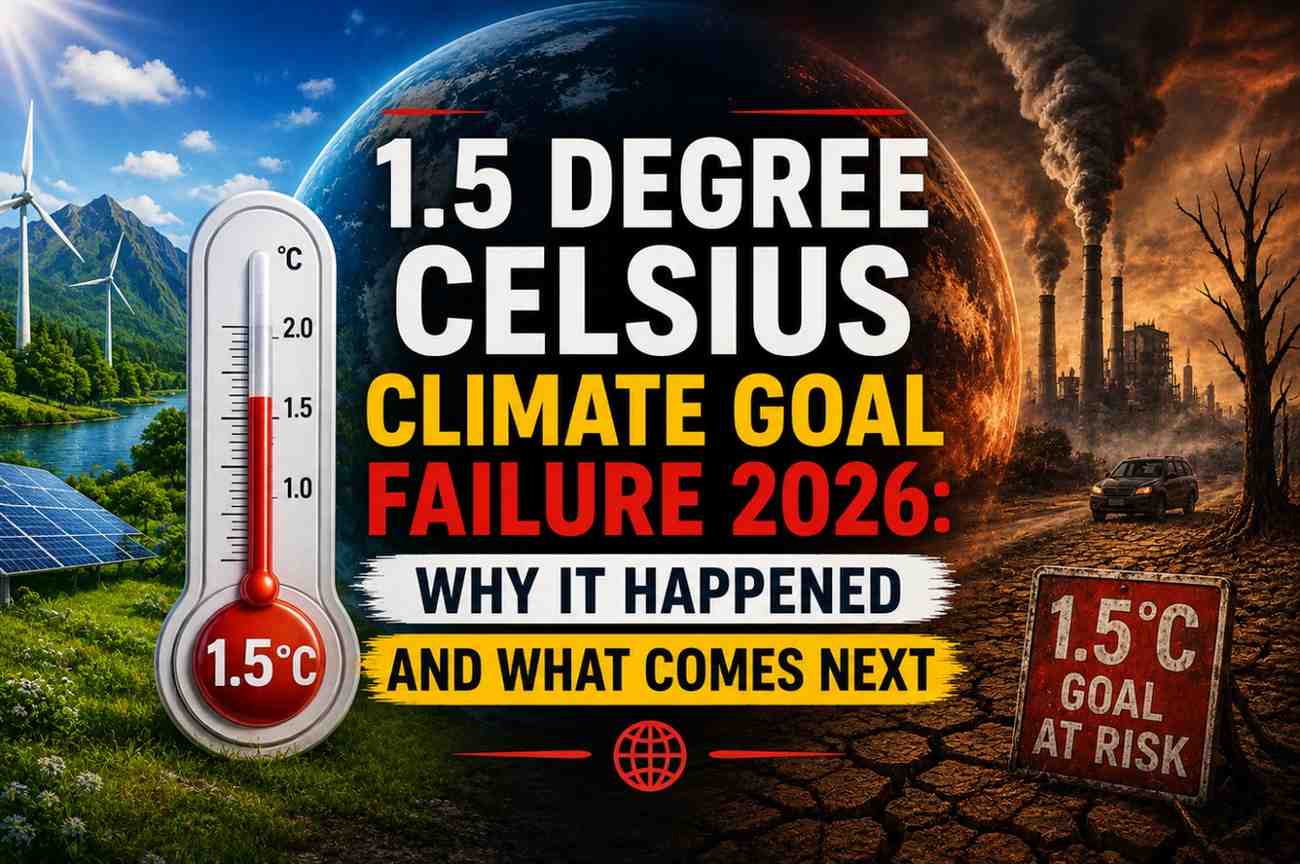
The 1.5 degree Celsius climate goal was the most ambitious target ever written into international law — the Paris Agreement of 2015. It was meant to be humanity’s red line: the threshold beyond which climate impacts become catastrophic and potentially irreversible.
In 2024, Earth crossed that line for the first full calendar year. By 2026, most climate scientists now assess that keeping warming permanently below the 1.5 degree Celsius climate goal is no longer achievable without technologies that don’t yet exist at scale.
This article explains why we failed the 1.5 degree Celsius climate goal, what that failure actually means for the planet, and — critically — why the fight is far from over.
What Was the 1.5 Degree Celsius Climate Goal?
The 1.5 degree Celsius climate goal was established in Article 2 of the Paris Agreement, signed by 196 nations at COP21 in December 2015.
The goal was to limit global average temperature rise to 1.5°C above pre-industrial levels (defined as 1850–1900 baseline temperatures).
Why 1.5°C specifically? The number emerged from scientific models showing:
- At 1.5°C: Severe but manageable impacts — significant coral bleaching, increased extreme weather, rising seas
- At 2.0°C: Dramatically worse outcomes — virtually all coral reefs dead, hundreds of millions more exposed to water stress, far more intense storms
- At 3.0°C+: Potentially catastrophic, irreversible changes to agricultural systems, sea levels, and habitability of entire regions
The 1.5 degree Celsius climate goal was therefore not an arbitrary number — it was a scientific threshold separating difficult adaptation from potentially impossible adaptation.
Why Did the World Fail the 1.5 Degree Celsius Climate Goal?
Reason 1: Emissions Never Peaked
The fundamental requirement of the 1.5 degree Celsius climate goal was global CO₂ emissions peaking before 2025 and then declining rapidly.
Instead:
- Global CO₂ emissions reached a new record in 2023 (~37.4 billion tonnes)
- 2024 saw no significant reduction
- Emissions from coal increased in Asia while declining in Europe
- Aviation and shipping rebounded strongly post-COVID
The 1.5 degree Celsius climate goal required immediate, massive emissions reductions. What happened was continued growth.
Reason 2: NDCs Were Never Ambitious Enough
Under the Paris Agreement, countries submit Nationally Determined Contributions (NDCs) — their own emissions reduction pledges.
The problem: even if every NDC submitted by 2025 were fully implemented (which they aren’t), the world would still be on track for approximately 2.5–2.7°C of warming — nowhere near the 1.5 degree Celsius climate goal.
This isn’t a failure of one country. It’s a collective failure of political ambition.
Reason 3: Fossil Fuel Industry Resistance
The fossil fuel industry spent decades — and hundreds of billions of dollars — funding disinformation campaigns, lobbying against climate legislation, and slowing the energy transition.
Internal documents from ExxonMobil (revealed in congressional investigations) showed the company’s scientists accurately predicted global warming as far back as the 1970s — while publicly denying it.
This organized delay directly contributed to the failure of the 1.5 degree Celsius climate goal.
Reason 4: The Carbon Budget Burned Faster Than Expected
The “carbon budget” — the total CO₂ emissions allowable while staying under 1.5°C — was estimated at approximately 500 billion tonnes when the Paris Agreement was signed in 2015.
By 2026, roughly 200 billion tonnes of that budget has been spent. At current emission rates, the remaining budget runs out by 2030.
Reason 5: Climate Finance Never Materialized
Rich nations promised $100 billion per year in climate finance to developing countries at Copenhagen in 2009. This target was not consistently met until 2022 — and even then, most of the money was loans rather than grants, and far below what developing nations actually need.
Without adequate finance, developing nations cannot transition away from coal and cheap fossil fuels — making the 1.5 degree Celsius climate goal mathematically impossible regardless of rich-country actions alone.
Has the 1.5 Degree Celsius Climate Goal Been Officially Abandoned?
No — and this distinction matters enormously.
The 1.5 degree Celsius climate goal remains the official target of the UNFCCC (UN Framework Convention on Climate Change) and was reaffirmed at COP28 in Dubai (2023) and COP29 in Baku (2024).
What has changed is the scientific community’s assessment of probability:
- A 2023 study in Nature Climate Change found less than a 50% chance of staying below 1.5°C even under aggressive action
- The World Meteorological Organization confirmed 2024 as the first year to exceed 1.5°C as an annual average
- Most IPCC scenarios now treat temporary “overshoot” of 1.5°C as inevitable, with the hope of returning below that level through carbon dioxide removal (CDR) by 2100
This is a crucial shift: the 1.5 degree Celsius climate goal is now being reframed from “prevent crossing” to “cross temporarily, then come back.”
Related: Is Climate Change Reversible 2026? What Scientists Actually Say
What Does Exceeding the 1.5 Degree Celsius Climate Goal Actually Mean?
For Coral Reefs
The 1.5 degree Celsius climate goal was specifically calibrated to preserve most coral reefs. At 1.5°C, 70–90% of coral reefs face severe bleaching. At 2°C, over 99% face functional extinction.
We are currently on a trajectory that threatens virtually all coral reef ecosystems within decades — one of the most visible and immediate consequences of failing the 1.5 degree Celsius climate goal.
For Extreme Weather
Every fraction of a degree beyond the 1.5 degree Celsius climate goal translates to:
- More intense rainfall events (warmer air holds more moisture)
- More severe droughts in already-dry regions
- More powerful tropical cyclones (warmer seas provide more energy)
- More frequent and severe heatwaves
The difference between 1.5°C and 2°C may seem small. But for the 3.6 billion people living in climate-vulnerable regions, it is the difference between adaptation and catastrophe.
For Sea Level Rise
At 1.5°C: ~0.4 metres of sea level rise by 2100 (median projection) At 2°C: ~0.5 metres of sea level rise by 2100 — plus increased risk of ice sheet instability leading to metres more over centuries
These projections affect coastal cities home to hundreds of millions of people.
For Food Systems
Crop yield losses from heat stress, drought, and precipitation changes become significantly worse above the 1.5 degree Celsius climate goal. South Asian and Sub-Saharan African agricultural systems — which feed billions of people — are among the most vulnerable.
Why 2°C Is Now the Critical Target
With the 1.5 degree Celsius climate goal effectively in overshoot territory, climate policy has pivoted — without abandoning 1.5°C — to treating 2°C as the new critical red line.
The difference between 1.5°C and 2°C impacts is enormous. The difference between 2°C and 3°C is catastrophic. Every fraction of a degree matters, regardless of whether 1.5°C is still reachable.
This is the core message for understanding the 1.5 degree Celsius climate goal in 2026: failure to achieve 1.5°C does not mean “game over.” It means the fight shifts to preventing 2°C, then 2.5°C, then 3°C. Each threshold we hold has massive real-world consequences.
The Role of Carbon Dioxide Removal
The most controversial aspect of current climate planning post-1.5 degree Celsius climate goal overshoot is reliance on Carbon Dioxide Removal (CDR) to eventually pull temperatures back down.
CDR technologies include:
- Direct Air Capture (DAC): Industrial machines pulling CO₂ directly from air (expensive; exists at small scale)
- Bioenergy with Carbon Capture (BECCS): Growing biomass, burning it for energy, capturing the CO₂
- Enhanced weathering: Spreading crushed silicate rocks to accelerate CO₂ absorption
- Reforestation: Planting trees to absorb carbon (significant but limited potential)
Current global DAC capacity: approximately 0.01 million tonnes CO₂ per year. We would need to remove 6–10 billion tonnes per year by 2050 to achieve the overshoot-and-return pathway envisioned in IPCC models.
The gap between current CDR capacity and required CDR capacity is arguably as alarming as the emissions gap itself.
5 Frequently Asked Questions
Q1: Is the 1.5 degree Celsius climate goal officially dead? Not officially — it remains the target of the Paris Agreement. But scientifically, most assessments now treat temporary overshoot as inevitable, with the goal reframed as returning below 1.5°C by 2100 using carbon removal technologies.
Q2: What temperature is the world actually heading toward in 2026? Current policies put the world on track for approximately 2.6–2.8°C of warming by 2100. Pledges (if implemented) would limit this to ~2.0–2.4°C. The 1.5 degree Celsius climate goal requires dramatically more ambition than either scenario.
Q3: Which countries are most responsible for failing the 1.5 degree Celsius climate goal? Historically, the US and EU bear the greatest responsibility for cumulative emissions. Currently, China (~30% of annual global emissions) is the largest single national contributor to ongoing goal failure.
Q4: Does the 1.5 degree Celsius climate goal still matter if we’ve already crossed it temporarily? Yes — enormously. Every fraction of a degree of warming we prevent or reverse reduces harm to millions of people. The goal still matters as a long-term target requiring temporary overshoot correction.
Q5: What would it take to still meet the 1.5 degree Celsius climate goal? Emissions would need to peak immediately and fall 43% by 2030 relative to 2019. This requires unprecedented policy action, massive renewable energy deployment, ending new fossil fuel development, and scaling carbon removal technologies simultaneously.
Conclusion
The world has failed the 1.5 degree Celsius climate goal as an immediate target. That is a fact, not a prediction.
But the story doesn’t end there. Every degree of warming prevented matters. Every year we delay net zero makes the eventual damage worse. And every government, company, and individual that takes ambitious action shortens the time before humanity stabilizes the climate.
The 1.5 degree Celsius climate goal was always a political and moral statement as much as a scientific one: it said that the world’s most vulnerable people deserve protection from the consequences of others’ emissions.
That principle hasn’t changed. And it’s why the fight continues — at 1.5°C, at 2°C, and beyond.
Stay informed with our complete climate science coverage — because understanding the problem is the first step toward changing it.
External sources: IPCC AR6 Climate Report | UNEP Emissions Gap Report


 creator@ecometric.site