Introduction
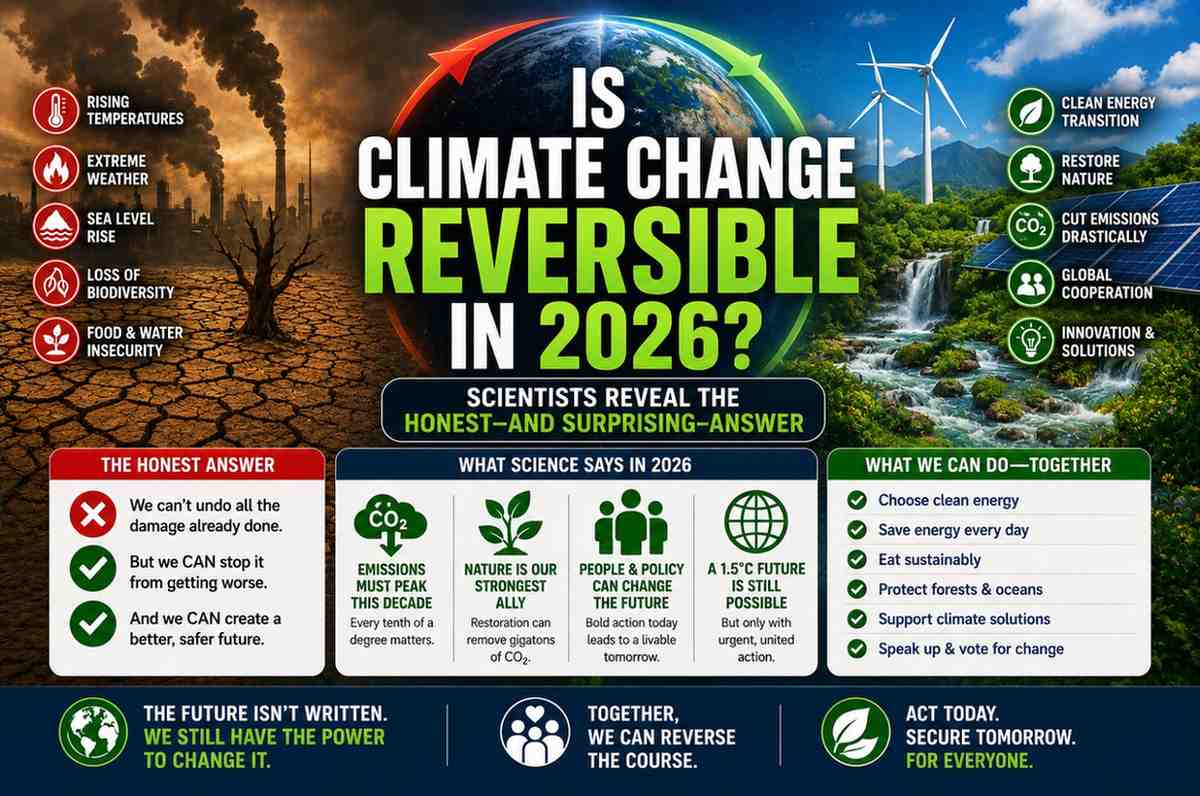
Is climate change reversible in 2026? It’s the question scientists get asked most often, the question that drives climate anxiety and hope simultaneously, and the question that deserves a genuinely honest — not reassuring, not despairing — answer.
The true answer is: it depends on what you mean by “reversible,” and which aspects of climate change you’re asking about.
Some changes are already irreversible on human timescales. Others are partially reversible if we act aggressively. Some could be reversed within decades with the right technology. And some of the most feared outcomes — crossing major tipping points — remain preventable.
This article gives you exactly what scientists say about whether climate change is reversible in 2026 — without false hope and without unnecessary despair.
What Does “Reversible” Actually Mean in Climate Science?
Before answering “is climate change reversible in 2026?” we need to define the term carefully — because scientists use it in a precise way.
Reversible in climate science means: if human emissions stopped tomorrow, would this change return to its pre-industrial state within a meaningful human timeframe (decades to centuries)?
By this definition, different components of the climate system have very different answers:
| Climate Element | Reversible? | Timescale |
|---|---|---|
| Global average temperature | Partially | Decades–centuries |
| Atmospheric CO₂ concentration | Very slowly | Centuries–millennia |
| Ocean acidification | Very slowly | Centuries |
| Glacier volume | Slowly | Centuries (some: never) |
| Sea level rise | Very slowly | Centuries–millennia |
| Coral reef ecosystems | Conditionally | Decades (if conditions allow) |
| Permafrost | Very slowly | Centuries |
| Some extreme weather patterns | Yes | Years–decades |
| Extinct species | No | Never |
The honest answer to “is climate change reversible in 2026?” is therefore: some of it is, some of it isn’t, and the window for preventing the worst irreversible changes is closing.
What Is Already Irreversible
CO₂ Concentration and Atmospheric Chemistry
One of the most sobering answers to “is climate change reversible in 2026?” concerns CO₂ itself.
Carbon dioxide molecules emitted today will remain in the atmosphere for 300–1,000 years. Some will remain for tens of thousands of years. Even if humanity reached absolute zero emissions tomorrow, the CO₂ already in the atmosphere (currently ~424 ppm) would continue warming the planet for centuries.
This is called committed warming — warming that is already “baked in” from historical emissions regardless of future action.
Current committed warming: Even at zero emissions today, Earth is committed to an additional ~0.3–0.5°C of warming above current levels from heat already stored in the oceans and absorbed by the atmosphere. This is irreversible on any human timescale.
Some Glacier Loss
Many glaciers that have disappeared or retreated significantly will not return within any relevant human timeframe even if temperatures stabilize. The glaciers feeding Himalayan rivers, the tropical Andes glaciers, and many Arctic glaciers have passed their own points of no return.
This is one of the clearest answers to “is climate change reversible in 2026?” — glacier loss in many regions is effectively permanent.
Extinct Species
Species that go extinct due to climate change — and tens of thousands have — do not return. Coral species, amphibians, pollinators, and high-altitude specialists are among those most threatened. This loss of biodiversity is permanent.
Some Sea Level Rise
The thermal expansion component of sea level rise cannot be quickly reversed — oceans release heat very slowly. And portions of the Greenland and West Antarctic ice sheets that may be in irreversible decline will continue contributing to sea level rise for centuries regardless of emissions cuts.
What Is Partially Reversible
Global Average Temperature
This is the most important and nuanced answer to “is climate change reversible in 2026?”
If net CO₂ emissions reach zero AND we actively remove CO₂ from the atmosphere at scale, global temperatures could begin to slowly decline. IPCC models show that temperatures would start decreasing within decades of achieving net negative emissions.
This is the scientific basis for overshoot scenarios: temporarily exceed 1.5°C, then pull temperatures back down through carbon dioxide removal (CDR). It’s theoretically possible — but requires CDR technologies at scales that don’t currently exist.
The key word is “net negative” — not just zero emissions, but actively removing more CO₂ than we emit.
Some Extreme Weather Patterns
Many of the weather pattern changes associated with warming would partially reverse within years to decades of temperatures stabilizing or declining. Heatwave frequency, precipitation extremes, and some drought patterns are closely linked to current temperature levels — not just historical cumulative warming.
This means reducing emissions still matters enormously for reducing extreme weather damage, even if some warming is locked in.
The Tipping Points: The Real “Point of No Return” Question
When people ask “is climate change reversible in 2026?”, they often mean: have we already crossed the point of no return? Are tipping points already triggered?
Climate tipping points are thresholds beyond which a climate subsystem becomes self-sustaining in its change — independent of further human emissions. The most critical include:
1. West Antarctic Ice Sheet Collapse
Some research suggests the West Antarctic Ice Sheet may already be in irreversible collapse — locked into eventual melting that would contribute 3–5 metres of sea level rise over centuries.
A 2023 study in Nature Climate Change suggested this collapse may now be unavoidable regardless of emissions reductions. However, other scientists dispute this interpretation, and the timeline (centuries) provides time to adapt.
Assessment: Possibly already tipped; damage limitation still possible.
2. Greenland Ice Sheet Destabilization
The Greenland ice sheet contains enough ice for ~7 metres of sea level rise. Current science suggests a tipping point may exist around 1.5–2.5°C of warming — meaning we may already be close.
However, even if Greenland is losing mass irreversibly, the timescale is thousands of years — providing long (if inadequate) time for coastal adaptation.
3. Amazon Rainforest Dieback
The Amazon is approaching a tipping point from combined pressures of deforestation and climate change. When forest cover drops below a critical threshold (~25% deforestation — currently at ~20%), reduced rainfall from forest transpiration may trigger a self-reinforcing dieback converting the Amazon from a carbon sink to a carbon source.
Assessment: Not yet tipped; preventable with deforestation reversal AND emissions cuts.
4. Permafrost Carbon Release
Arctic permafrost locks in approximately 1.5 trillion tonnes of carbon. As it thaws, it releases CO₂ and methane. Some permafrost thaw is already underway and irreversible. Whether it accelerates into a major self-reinforcing feedback depends on how much warming occurs.
Assessment: Partially triggered; worse outcomes preventable.
5. Atlantic Meridional Overturning Circulation (AMOC) Collapse
As discussed in ocean impacts, AMOC is weakening. A collapse could trigger abrupt regional climate shifts in Europe, disrupt monsoons, and accelerate sea level rise on the US East Coast.
Assessment: Not yet tipped; risk increases with every degree of warming.
The Scientific Consensus on “Is Climate Change Reversible in 2026?”
Climate scientists in 2026 broadly agree on the following:
What is effectively irreversible:
- Some committed warming (~0.3–0.5°C above current levels)
- Some glacier loss
- Elevated CO₂ concentration for centuries
- Some baseline level of sea level rise (decades to centuries)
- Extinction of species already lost
What is preventable/reversible with action:
- Exceeding 2°C of warming (vs. current trajectory of 2.6°C+)
- Most tipping point scenarios (AMOC collapse, major Amazon dieback)
- The majority of coral reef systems (under 1.5°C vs. 2°C)
- Catastrophic sea level rise of 2+ metres
- The worst food security and water crisis outcomes
What could be reversed with net negative emissions:
- Global temperatures (over decades to centuries with large-scale CDR)
- Atmospheric CO₂ concentration (over centuries)
- Some weather pattern changes (within years to decades)
The answer to “is climate change reversible in 2026?” is therefore: not fully, not quickly — but preventing the worst outcomes is absolutely still possible and requires urgent action.
Related: 1.5 Degree Celsius Climate Goal Failure 2026 — Why It Happened and What Comes Next
Carbon Dioxide Removal: The Tool for Partial Reversal
If climate change is to be partially reversed, Carbon Dioxide Removal (CDR) is the mechanism.
Current CDR capacity globally: approximately 0.01 billion tonnes CO₂ per year (almost entirely from nature-based solutions).
Required CDR to achieve overshoot-and-return to 1.5°C: 5–10 billion tonnes per year by 2050.
The gap is enormous. CDR technologies include:
- Reforestation/afforestation (limited by land availability)
- Soil carbon sequestration (limited and uncertain)
- Direct Air Capture (DAC) (expensive; scaling rapidly but from near zero)
- Bioenergy with Carbon Capture (BECCS) (controversial land-use implications)
- Enhanced weathering (promising; largely unproven at scale)
- Blue carbon (mangroves, seagrasses, tidal marshes — restoration with co-benefits)
Related: Climate Change Facts for Students 2026 — 15 Shocking Truths Every Young Person Must Know
5 Frequently Asked Questions
Q1: Is climate change reversible if we stop all emissions tomorrow? Not fully. Committed warming already locked in from historical CO₂ would continue for decades. Sea level rise and CO₂ concentration would remain elevated for centuries. However, the worst impacts (3°C+ warming, major tipping points) would be avoided, and temperatures could begin to decline over centuries through natural carbon cycle processes.
Q2: What is the “point of no return” for climate change? There is no single point of no return. Each degree of warming avoided prevents specific, quantifiable harm. Some tipping points may already be triggered (possible Greenland instability); others remain preventable. The concept of a single “point of no return” is scientifically misleading.
Q3: Can technology reverse climate change? Technology can help — particularly direct air capture of CO₂ and solar radiation management (controversial). But no technology currently exists at the scale needed to reverse warming significantly. Technology is more likely to prevent future warming than reverse past damage.
Q4: Is climate change reversible on a human lifetime timescale? Partially. Some weather pattern changes could improve within decades of major emissions reductions. Temperatures could stabilize. But atmospheric CO₂, sea levels, and glacier loss operate on century-to-millennium timescales — beyond any individual human lifetime.
Q5: Does “irreversible” mean we should give up on climate action? The opposite. The fact that some damage is already locked in makes preventing additional damage more important, not less. Every fraction of a degree prevented, every tipping point avoided, saves millions of lives and trillions in economic damage. Irreversibility of past losses makes future loss prevention more urgent.
Conclusion
Is climate change reversible in 2026? The honest answer is: some of it cannot be undone; much of the worst can still be prevented; and with massive action including carbon removal, partial reversal on century timescales is scientifically plausible.
The question itself — is climate change reversible in 2026? — contains a dangerous implicit assumption: that if the answer is no, action is pointless. Scientists reject this framing completely. The climate doesn’t have a binary “fixed” or “broken” state. Every tonne of CO₂ not emitted, every degree of warming prevented, every tipping point avoided translates to measurable reductions in human suffering.
The window is not closed. What is certain is that it won’t stay open much longer.
Act as if it matters — because it does. Explore our complete climate science library for more on what’s possible, what science tells us, and how societies can respond.
External sources: IPCC AR6 Synthesis Report | Nature Climate Change — Tipping Points Review


 creator@ecometric.site