
Introduction
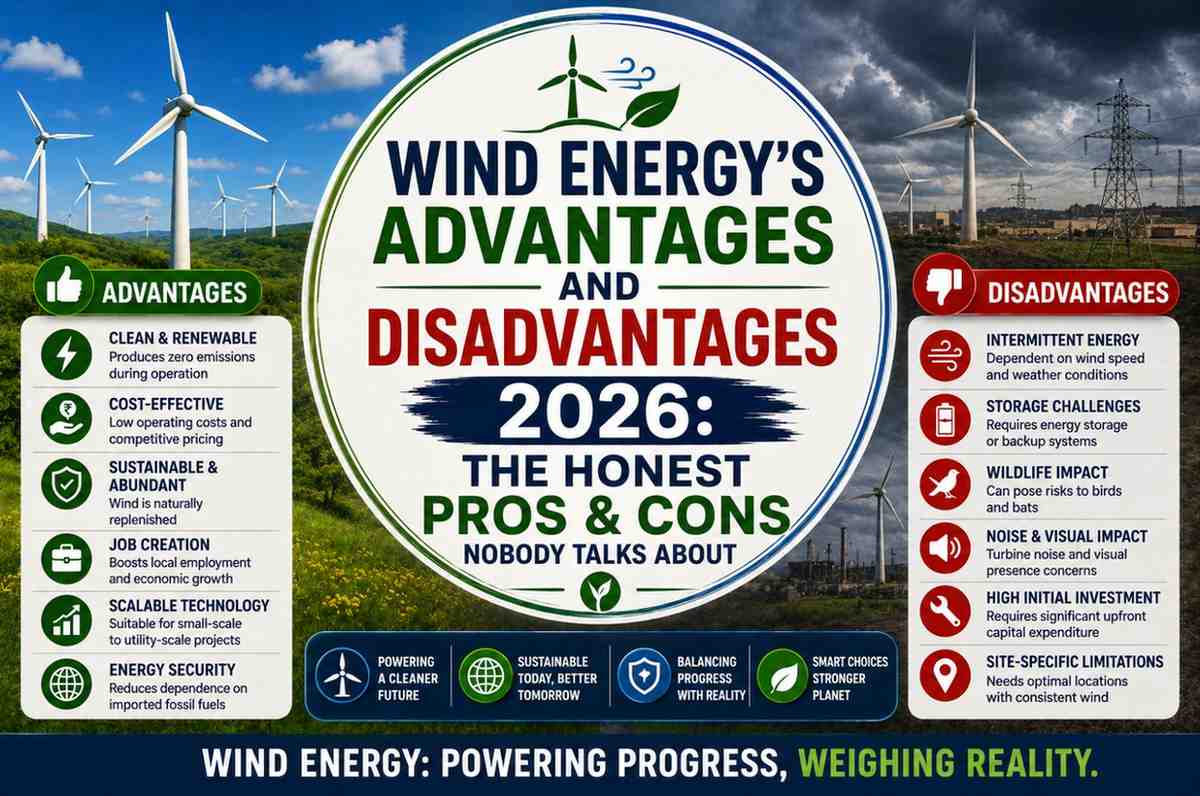
Wind energy’s advantages and disadvantages in 2026 are a topic that generates strong opinions—from clean energy advocates who see wind as a climate savior to critics who raise legitimate concerns about noise, wildlife, and landscape impact.
The truth, as always, sits between the extremes.
This is the most honest, comprehensive breakdown of wind energy’s advantages and disadvantages in 2026—covering the economics, the environment, the challenges, and where the technology is heading.
Wind Energy in 2026: A Quick Snapshot
Before diving into wind energy advantages and disadvantages in 2026, here’s the context:
- Global installed wind capacity: ~2,200 GW in 2026
- Wind provides ~8% of global electricity
- India has ~47 GW of installed wind capacity—the 4th largest in the world
- Offshore wind is growing at 35% annually
- Wind energy employs 1.4 million people globally
Wind is a major force in the global energy mix. Understanding its real advantages and disadvantages is essential for informed energy decision-making.
Wind Energy Advantages 2026
Advantage 1: Lowest Lifecycle Carbon Emissions of Any Energy Source
Wind energy produces 7–15 grams of CO₂ equivalent per kWh over its full lifecycle—including manufacturing, installation, and decommissioning.
This is lower than solar (20–50 g/kWh) and dramatically lower than coal (820–1,050 g/kWh). From a climate perspective, this is one of the most powerful wind energy advantages in 2026.
Advantage 2: Lowest Cost Electricity in History
Onshore wind in 2026 produces electricity at $28–$50/MWh in most markets—making it one of the cheapest electricity sources ever deployed at scale.
In India, onshore wind tariffs have fallen to ₹2.80–₹3.50/kWh at auction—genuinely competitive with coal-based power on pure cost.
Advantage 3: No Water Consumption
Thermal power plants — coal, gas, and nuclear — consume enormous amounts of water for cooling. Wind turbines consume virtually zero water in operation.
For water-stressed countries like India, this is a significant and underappreciated wind energy advantage in 2026.
Advantage 4: Dual Land Use
Wind turbines occupy only the physical footprint of their tower base. The surrounding land can continue to be used for farming, grazing, or forestry.
Research consistently shows that agricultural yields under wind farms are unaffected or marginally improved (the turbulence effect distributes CO₂ more evenly in crop canopies). Farmers often receive lease payments of ₹200,000–₹500,000 per turbine per year.
Advantage 5: Fuel Price Immunity
Unlike gas or coal plants, wind turbines have zero fuel cost. Once built, they generate electricity from free wind regardless of global commodity prices, supply disruptions, or geopolitical events.
This wind energy advantage — energy price stability — has become increasingly valued after the global fossil fuel price shocks of 2021–2023.
Advantage 6: Rapidly Improving Technology
Turbines in 2026 are dramatically more powerful than those of a decade ago. Modern onshore turbines have hub heights of 120–160 meters and rotor diameters of 130–175 meters, generating 4–6 MW each. Offshore turbines now reach 15–20 MW capacity.
Larger turbines mean more electricity per installation, further reducing the cost of wind energy over time.
Wind Energy Disadvantages 2026
Disadvantage 1: Variability — Wind Doesn’t Always Blow
The most fundamental wind energy’s disadvantage in 2026 remains its variability. Wind speed varies hourly, daily, and seasonally. Turbines generate power only when the wind blows within a specific speed range (typically 3–25 m/s).
Average capacity factors for onshore wind are 25–40%—meaning a 100 MW wind farm produces only 25–40 MW on average over a year. Grid management must accommodate this variability.
Battery storage, grid interconnection, and demand management help — but the challenge is real.
Disadvantage 2: Noise Pollution
Modern wind turbines produce 35–45 decibels of noise at a distance of 300–500 meters—roughly equivalent to a quiet library. This is not harmful to human health but is perceptible and can be irritating to residents living close to wind farms.
Most countries mandate minimum setback distances of 500–1,000 meters from residences. Community opposition to wind farm siting, often called “NIMBY” (Not In My Back Yard), remains a significant development challenge.
Disadvantage 3: Bird and Bat Mortality
Wind turbines do kill birds and bats—a genuine environmental concern among the wind energy disadvantages in 2026.
However, the scale matters. Studies consistently show that wind turbines kill far fewer birds per unit of energy than the following:
- Domestic cats (the largest bird killer in the US by far)
- Building glass collisions
- Fossil fuel pollution (which kills through habitat destruction, climate impacts, and air quality)
That said, poorly sited turbines near migration routes or raptor habitats cause disproportionate harm. Rigorous siting assessment is essential.
Disadvantage 4: Visual Impact and Landscape Concerns
Wind turbines are large and visible from significant distances. Many communities — especially in scenic rural or coastal areas — object to the visual impact of wind farms.
This wind energy’s disadvantage is genuinely subjective but politically powerful. Offshore wind helps by removing turbines from sensitive onshore landscapes, though at higher cost.
Disadvantage 5: Manufacturing and Disposal Challenges
Wind turbine blades—made from fiberglass composite—are currently difficult to recycle. Hundreds of thousands of blades will reach end-of-life over the next decade, raising waste management concerns.
Turbine nacelles contain rare earth metals (neodymium for permanent magnets) whose mining has environmental and supply chain implications.
These are wind energy disadvantages the industry is actively working to address—recyclable blade materials are in commercial development.
Disadvantage 6: High Upfront Infrastructure Cost
While the LCOE of wind is low, the upfront capital cost is high. A 100 MW wind farm requires hundreds of millions of dollars in capital investment — accessible mainly to large developers and utilities, not small investors or communities.
Related Article: Renewable Energy Growth Statistics 2026 — What the Numbers Really Mean
External Resources
FAQ: Wind Energy’s Advantages and Disadvantages 2026
Q1: What is the biggest advantage of wind energy in 2026? Zero carbon emissions during operation combined with record-low electricity costs make wind power one of the most compelling energy sources in the wind energy advantages and disadvantages 2026 analysis.
Q2: What is the biggest disadvantage of wind energy? Variability—wind doesn’t blow consistently—remains the most significant operational challenge for wind energy integration into electricity grids.
Q3: Do wind turbines harm birds? Yes, but far less per unit of energy than fossil fuel pollution or building glass collisions. Proper siting away from migration routes significantly reduces the impact.
Q4: How noisy are wind turbines in 2026? Modern turbines produce 35–45 dB at 300–500 meters—roughly equivalent to a quiet room. Minimum setback distances from homes are mandatory in most countries.
Q5: Can wind turbine blades be recycled? Current fiberglass blades are difficult to recycle. However, fully recyclable blade materials are in development and beginning commercial deployment in 2026.
Conclusion
The full picture of wind energy’s advantages and disadvantages in 2026 shows a technology that is genuinely transformative—cheap, clean, and increasingly essential—but not without real challenges in variability, siting, and waste management.
The advantages of wind energy in 2026 substantially outweigh the disadvantages for the purpose of electricity generation. The key is smart planning: rigorous siting, community engagement, storage integration, and honest acknowledgment of trade-offs.
Wind isn’t perfect. Nothing is. But as part of a diversified clean energy mix, it’s one of the most powerful tools humanity has for addressing the climate crisis.



 creator@ecometric.site