Introduction
How does climate change affect India in 2026 is not a question for future generations — it is a daily, lived reality for over a billion people right now.
India faces a uniquely severe combination of climate risks: extreme heat, intensifying monsoons, glacial melt, coastal flooding, agricultural disruption, and water scarcity — all simultaneously, and all worsening each year.
Understanding how does climate change affect India in 2026 matters not just for Indians, but for the world. India is home to 18% of humanity, produces food for hundreds of millions more, and its climate trajectory will shape global refugee patterns, food prices, and geopolitical stability for decades.
India’s Climate Baseline: Why It Is So Vulnerable
To understand how does climate change affects India in 2026, you must first understand what India starts with:
- Dependence on the monsoon: India’s agriculture — and thus its food security — depends on the June–September monsoon delivering approximately 80% of annual rainfall within 4 months
- High population density: Over 400 million people live in climate-vulnerable river plains and coastal zones
- Economic exposure: Approximately 40% of India’s workforce is employed in agriculture — directly exposed to climate variability
- Thermal stress baseline: Large parts of India already operate near the human tolerance limit for outdoor work during summer months (35–40°C wet bulb temperatures)
These pre-existing vulnerabilities determine how severely climate change affect India in 2026 compared to higher-latitude, wealthier nations.
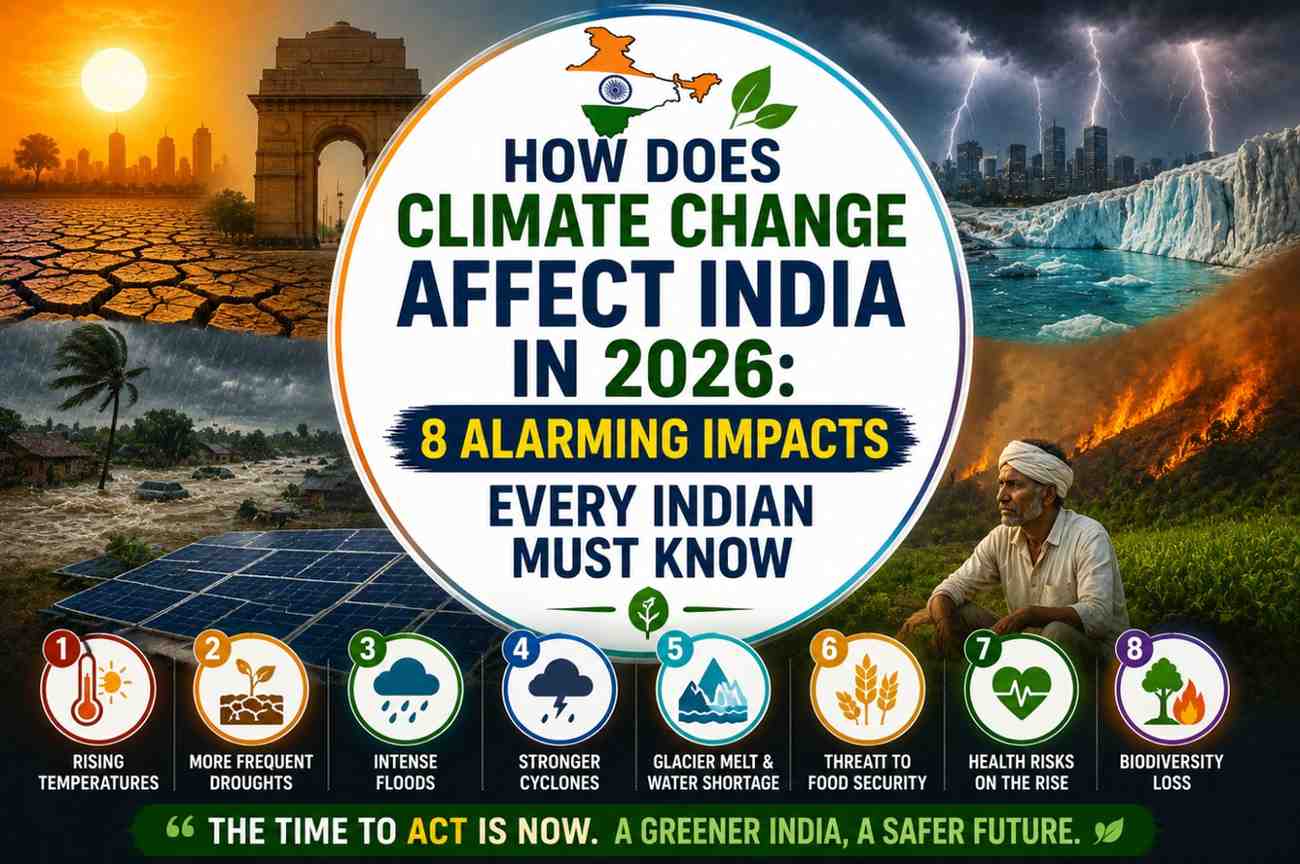
How Climate Change Affects India in 2026: 8 Critical Impacts
Impact 1: Lethal Heatwaves Are Becoming More Frequent
How does climate change affect India in 2026 is most immediately visible through heatwaves.
Pre-monsoon temperatures in northern and central India have increased by approximately 0.6°C per decade since 1950. This sounds modest — until you understand that India’s cities already operate near the human physiological heat tolerance limit.
Key facts:
- Heat action plans are active in over 100 Indian cities
- Delhi, Ahmedabad, Lucknow, and Nagpur have all recorded temperatures above 47–48°C in recent years
- India’s poorest workers — construction laborers, rickshaw drivers, farmers — have no option to avoid outdoor exposure
- The India Meteorological Department estimates climate change has made severe heatwave events 4–5x more likely than they were in 1960
Wet-bulb temperature (which combines heat and humidity) is the critical metric: above 35°C wet-bulb, the human body cannot cool itself even in shade. Parts of India’s Ganges plain and coastal Maharashtra already approach this threshold during heatwaves.
Impact 2: The Monsoon Is Becoming More Extreme and Less Predictable
The Indian monsoon is not disappearing — but how does climate change affects India’s monsoon in 2026 is deeply concerning.
The pattern is shifting from steady seasonal rainfall to more volatile extremes:
- More intense rainfall events — months of rain falling in days, causing flash floods
- Longer dry spells between rain events — causing drought-like conditions even in the monsoon season
- Later onset and earlier withdrawal — shortening the effective agricultural window
- More frequent “break” periods — weeks within the monsoon season with near-zero rainfall
The 2023 monsoon was a prime example: devastating floods in Himachal Pradesh, Uttarakhand, and Sikkim, while parts of Maharashtra and Karnataka suffered drought conditions in the same weeks.
Impact 3: Himalayan Glaciers Are Melting at Alarming Rates
India’s Himalayan glaciers feed major rivers including the Ganges, Brahmaputra, Indus, and their tributaries — providing water to approximately 800 million people.
How does climate change affect India’s water security in 2026 through glacial melt operates in two phases:
- Short-term (now–2040): More meltwater initially increases river flows — but causes glacial lake outburst floods (GLOFs) and unpredictable flooding
- Long-term (2040–2100): As glaciers shrink, dry-season river flows decrease significantly — threatening agriculture, drinking water, and hydropower for hundreds of millions
The Gangotri glacier (source of the Ganges) is retreating at approximately 22 metres per year. The Central Himalayan region has lost roughly 40% of glacier mass since 1960.
Impact 4: Coastal Flooding and Sea-Level Rise Threaten Millions
India has 7,517 km of coastline and approximately 170 million people living in low-lying coastal districts. How does climate change affect India’s coasts in 2026 is a compound problem:
- Sea level rise: The Indian Ocean is rising approximately 3.3mm per year (faster than the global average in some areas)
- Storm surge intensification: Cyclones in the Bay of Bengal and Arabian Sea are intensifying — more Category 4 and 5 storms hitting Indian coasts
- Erosion: Beaches and deltas are eroding; the Sundarbans (world’s largest mangrove forest, home to 4 million people) is losing approximately 7,500 hectares per decade
Mumbai, Chennai, Kolkata, Puri, and hundreds of smaller coastal towns face increasing flood risk. The Mumbai Metropolitan Region has a GDP of over $300 billion — one flood event can cost billions in damage.
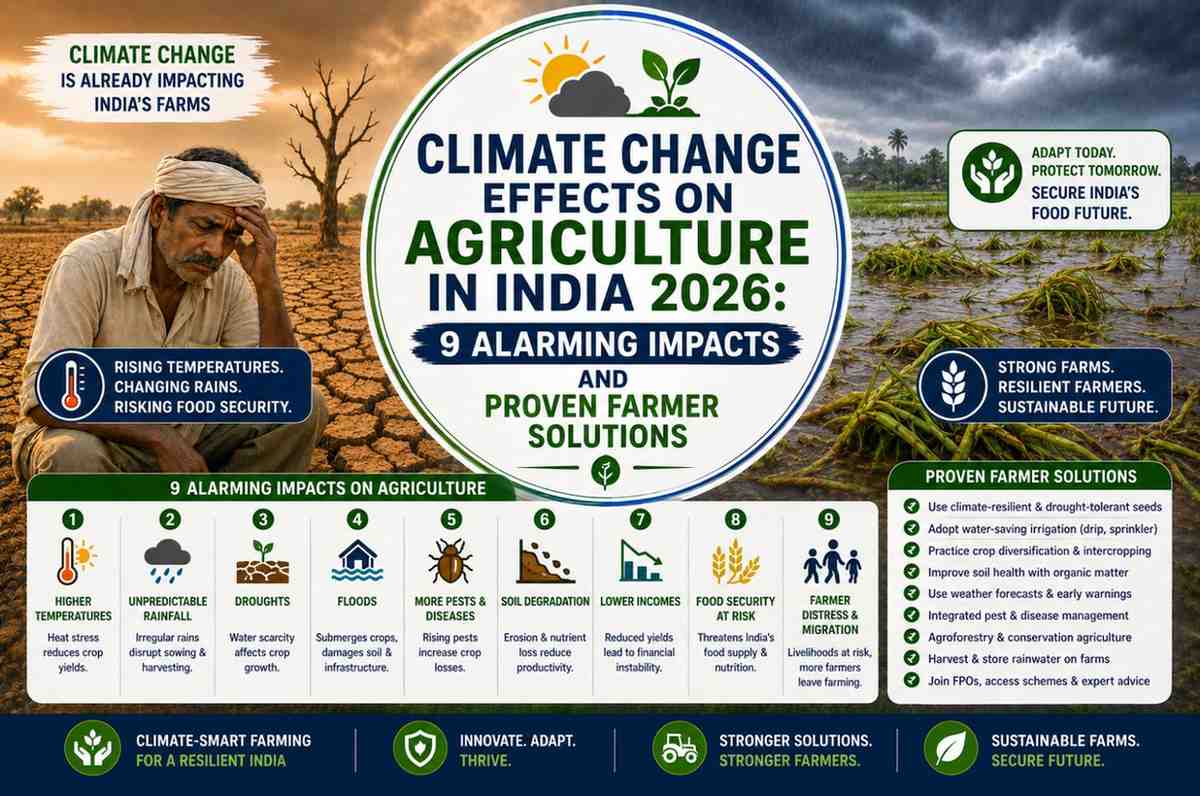
Impact 5: Food Security Is Directly Threatened
This is perhaps the most critical dimension of how does climate change affect India in 2026.
- Wheat: Higher temperatures during grain-filling reduce yields by 6–25% for each degree of warming above optimal temperatures. North Indian wheat yields are already showing stress
- Rice: Paddy crops are sensitive to nighttime temperatures — warming nights reduce grain quality and quantity
- Pulses: Lentils and chickpeas are highly heat-sensitive; production is increasingly variable
- Fruits and vegetables: Unseasonal rains, hailstorms, and heat stress damage horticultural crops, raising food prices
Impact 6: Water Stress Is Reaching Crisis Levels
India is already one of the world’s most water-stressed major nations. How does climate change affect India’s water in 2026 amplifies an existing crisis.
- India has 18% of the world’s population but only 4% of its freshwater
- Groundwater depletion is severe — the Indo-Gangetic Plain (India’s agricultural heartland) is seeing water tables dropping 1–3 metres per year in some areas
- Climate change reduces monsoon reliability while increasing evaporation — a double squeeze on freshwater availability
- By 2030, NITI Aayog projects that 21 major Indian cities (including Delhi, Bengaluru, Chennai) will exhaust their groundwater
Impact 7: Public Health Impacts Are Escalating
How does climate change affect India’s public health in 2026 is multidimensional:
- Heat-related illness: Thousands of Indians die annually from heat stroke; millions suffer heat exhaustion affecting productivity
- Vector-borne diseases: Malaria, dengue, and chikungunya are expanding their geographic range as warmer temperatures create new habitats for mosquito vectors
- Air quality: Climate change intensifies the conditions for air pollution formation; heatwaves trap particulate matter over Indian cities
- Water-borne disease: Flooding contaminates water supplies; droughts concentrate pollutants in remaining water sources
Impact 8: Climate Migration Is Already Underway
How does climate change is affecting India’s population distribution in 2026 through migration is increasingly documented.
- Drought-affected farmers in Maharashtra, Bundelkhand, and Vidarbha regions migrate to cities when crops fail
- Coastal communities in Odisha and Bengal are relocating inland from erosion and flooding
- The Sundarbans have already seen the permanent evacuation of some islands
The World Bank’s Groundswell report estimates climate change could create 40 million internal climate migrants in India by 2050 — equivalent to the current population of California.
India’s Climate Response: What Is Being Done
Understanding how does climate change affect India in 2026 is incomplete without examining India’s response:
Solar energy: India has become one of the world’s largest solar installers — over 70 GW installed by 2025, targeting 500 GW renewable capacity by 2030.
Heat Action Plans: Over 100 cities have adopted HAPs — providing cooling shelters, adjusting outdoor work hours, and issuing heat warnings.
National Adaptation Fund: The Government of India has established funding mechanisms for state-level climate adaptation, particularly for agriculture and coastal protection.
Atal Mission for Rejuvenation and Urban Transformation (AMRUT): Includes components for urban flood management and green infrastructure.
India’s challenge: ambitious adaptation needs intersect with developmental priorities. A country where millions still lack electricity cannot be asked to sacrifice development for climate action that its historical emissions barely contributed to creating.
Related: Carbon Emissions by Country 2026 Ranked — Who Pollutes the Most?
5 Frequently Asked Questions
Q1: How does climate change affect India differently from other countries? India’s unique combination of monsoon dependence, glacier-fed rivers, extreme heat baseline, massive agricultural workforce, and long coastline makes its climate vulnerability profile distinctively severe and multidimensional compared to most nations.
Q2: Which states in India are most affected by climate change in 2026? Rajasthan and Uttar Pradesh (extreme heat), Bihar and Assam (flooding), Uttarakhand and Himachal Pradesh (glacial melt and landslides), Odisha and Tamil Nadu (cyclones and coastal flooding), and Maharashtra and Telangana (drought and farmer distress) are consistently the most affected states.
Q3: Is India doing enough to address climate change? India has made significant progress on renewable energy but faces a complex equity challenge. Historically responsible for less than 5% of cumulative global emissions, India argues its development needs take priority. Its climate targets are among the more ambitious of major developing economies.
Q4: How does climate change affect India’s farmers specifically? Unpredictable monsoons, rising temperatures during cropping seasons, increased pest and disease pressure, groundwater depletion, and more frequent extreme events (floods, droughts, unseasonal rain) directly reduce farm incomes and increase food insecurity.
Q5: Will parts of India become uninhabitable due to climate change? Under high warming scenarios (3°C+), some regions — particularly the Gangetic Plain during summer months — could experience wet-bulb temperatures exceeding human physiological limits for days or weeks per year, making outdoor activity life-threatening. This is a risk for the second half of this century, not imminent — but it makes mitigation action now critically important.
Conclusion
How does climate change affect India in 2026 is a story of compounding crises: heatwaves that kill, monsoons that flood and fail simultaneously, glaciers that shrink, coastlines that disappear, and harvests that become more uncertain every year.
India did not create this crisis. Its historical contribution to greenhouse gas accumulation is small relative to its population. Yet it faces some of the world’s most severe consequences.
Understanding how does climate change affect India in 2026 is therefore both a matter of national urgency and global justice. India’s climate resilience — built through clean energy, smart agriculture, and community adaptation — will be one of the defining challenges and opportunities of the coming decades.
Explore our complete India climate coverage for state-by-state impact guides, agricultural solutions, and the stories of communities adapting on the frontlines.
External sources: Ministry of Earth Sciences India Climate Report | IPCC Regional Fact Sheet — Asia


 creator@ecometric.site