
Introduction
The climate change effects on agriculture in India in 2026 are not a distant threat — they are an immediate crisis affecting the livelihoods of 600 million people who depend on farming, directly or indirectly.
India is the world’s second-largest producer of wheat, rice, cotton, sugarcane, and dozens of other crops. Its food security — and that of its trading partners — depends on a climate system that is becoming increasingly unstable.
This article documents the climate change effects on agriculture in India in 2026 comprehensively: what’s failing, why it’s failing, which farmers are being hit hardest, and critically — which solutions are actually working on the ground.
Why Indian Agriculture Is Uniquely Vulnerable to Climate Change
The climate change effects on agriculture in India in 2026 are amplified by structural factors that make Indian farming more exposed than agriculture in most other major economies:
- Monsoon dependence: ~55% of India’s agricultural land is rain-fed (not irrigated). These farms depend almost entirely on the June–September monsoon — which is becoming less predictable every year
- Small landholdings: Over 86% of Indian farmers are smallholders (less than 2 hectares) — too small to absorb losses that larger commercial farms could weather
- Limited insurance penetration: Despite PM Fasal Bima Yojana, less than 30% of farmers are effectively covered by crop insurance
- High heat baseline: Most Indian cropping regions already experience temperatures near the optimal growing limit for key crops — any additional warming pushes yields over the thermal threshold
- Groundwater depletion: Decades of unsustainable irrigation have depleted aquifers across the Indo-Gangetic Plain — making crops more drought-vulnerable when rains fail
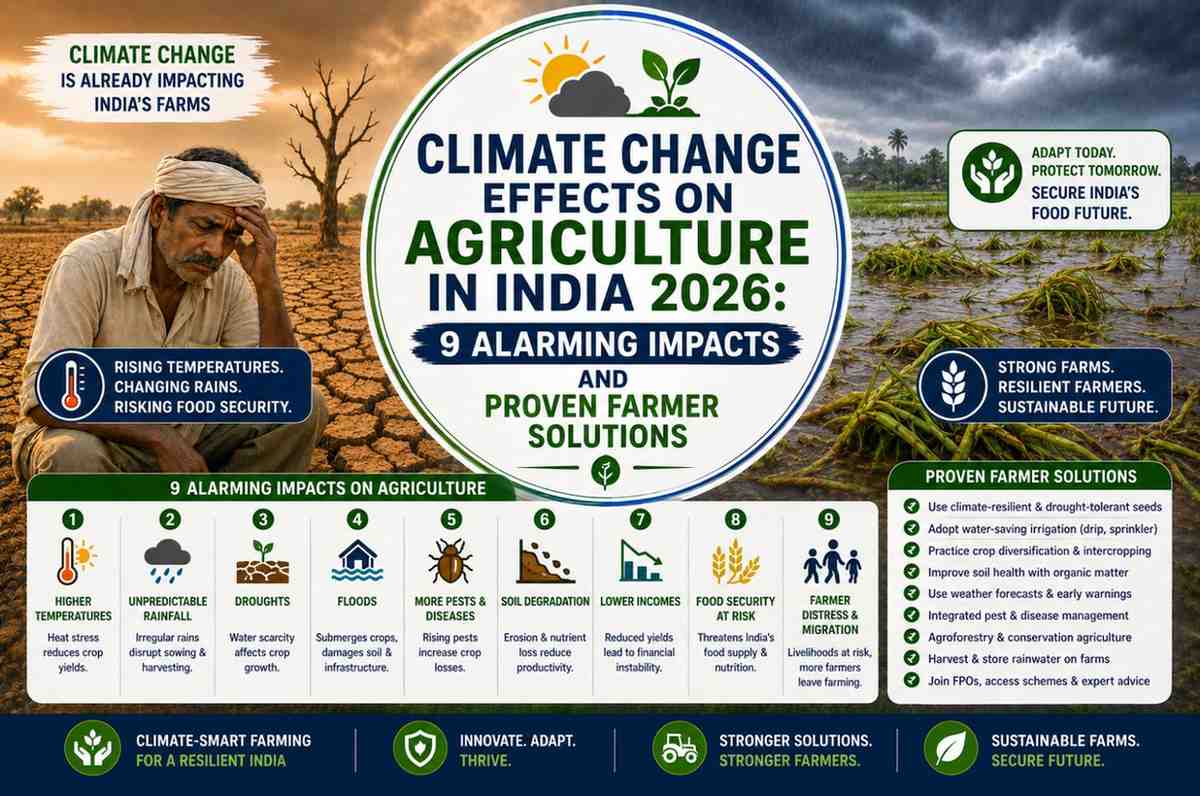
9 Critical Climate Change Effects on Agriculture in India 2026
Effect 1: Wheat Yield Decline from Terminal Heat Stress
Wheat is India’s second-most-important staple crop, primarily grown across Punjab, Haryana, Uttar Pradesh, and Madhya Pradesh during the Rabi (winter) season.
The climate change effect on wheat agriculture in India in 2026 is caused by “terminal heat stress” — when temperatures spike above 30°C during grain-filling (typically March–April). This causes grains to shrink and protein content to decline.
- Studies estimate a 5–8% yield reduction per 1°C warming above optimal temperatures during grain-filling
- Northern Indian wheat-growing regions have seen maximum temperatures in March increase by approximately 1.5°C over the last 30 years
- The 2022 spring heatwave — the worst in 122 years — caused wheat yield losses estimated at 3–5 million tonnes nationally
- India’s wheat production targets for 2026 face ongoing pressure from warming spring temperatures
Effect 2: Rice Production Disrupted by Monsoon Irregularity
Rice is India’s most important food crop — a staple for over 60% of the population. The climate change effects on rice agriculture in India in 2026 operate through multiple pathways:
- Monsoon delay and variability: Late or erratic monsoon onset means delayed transplanting, compressed growing seasons, and increased crop failure risk
- Flooding: Flash floods from intense monsoon rainfall can destroy paddy crops that have survived drought just weeks earlier — the same region can experience both in a single season
- Nighttime temperature warming: Rice grain quality and quantity decline significantly when nighttime temperatures remain above 22°C during flowering — a threshold now regularly exceeded in major rice-growing states
Research from IRRI (International Rice Research Institute) suggests Indian rice yields could decline 10–25% by 2050 under moderate climate scenarios without adaptation.
Effect 3: Groundwater Depletion and Irrigation Crisis
The climate change effects on agriculture in India’s water supply in 2026 compound an already critical groundwater crisis.
- The Indo-Gangetic Plain — India’s agricultural heartland, producing 50% of India’s food — has seen groundwater tables drop 0.3–1 metre per year in many districts (Punjab, Haryana, Western UP)
- Climate change is reducing monsoon reliability while increasing evapotranspiration (water lost from soil and plants in heat) — both increasing irrigation demand and reducing the rainfall that recharges aquifers
- NITI Aayog projects that groundwater resources could be depleted in 21 major Indian cities’ surrounding agricultural districts within the next decade under current trends
- When the groundwater runs out, rain-fed farming is all that remains — in a climate where rain is becoming less reliable
This water-agriculture nexus is one of the most severe climate change effects on agriculture in India in 2026.
Effect 4: Extreme Weather Events Destroying Harvests
Unseasonal weather events are increasingly destroying crops that survive the normal growing season.
- Hailstorms in spring (February–March) have devastated wheat and mustard crops in Rajasthan, Haryana, and Maharashtra in multiple recent years
- Unseasonal monsoon extension into October causes paddy crops left standing to spoil, or newly planted Rabi crops to rot
- Cyclones affect coastal agricultural states (Odisha, Andhra Pradesh, Tamil Nadu) with increasing frequency and intensity
- Flash floods in Himalayan states (Uttarakhand, Himachal Pradesh) destroy apple orchards and vegetable cultivation
A single extreme event can wipe out an entire year’s income for a smallholder farmer — with no buffer. This is the human face of climate change effects on agriculture in India in 2026.
Effect 5: Vegetable and Horticulture Losses
High-value vegetables and fruits are among the most heat-sensitive crops — and the most economically important for smallholder income.
- Tomatoes, onions, and potatoes all show significant yield decline above optimal temperatures
- Apple cultivation in Himachal Pradesh and Uttarakhand is under severe threat — warming temperatures are reducing the “chilling hours” that apple trees need during winter dormancy
- The apple belt is moving uphill as lower altitude orchards become thermally unsuitable — but there is only so much altitude available
- Mango flowering and fruit set are disrupted by abnormal temperatures and unseasonal rain during flowering
Effect 6: Pest and Disease Pressure Intensifying
Climate change effects on agriculture in India in 2026 include intensified pest and disease pressure — a less-discussed but devastating impact:
- Fall Armyworm (invasive pest) has spread across India since 2018, destroying maize crops; warmer temperatures accelerate its lifecycle and geographic expansion
- Fungal diseases (wheat blast, brown rust) are spreading northward as winter temperatures warm
- Desert Locusts — exacerbated by warming Indian Ocean generating the cyclone conditions that breed locust swarms — devastated crops in Rajasthan and Gujarat in 2019–2020, with ongoing risk
- Thrips and whiteflies on cotton and vegetables are more active and reproduce faster in warmer temperatures
Pesticide use has increased significantly, adding costs for already financially stressed farmers while raising health and environmental concerns.
Effect 7: Farmer Income Crisis and Debt
The climate change effects on agriculture in India’s farm economy in 2026 translate directly into income loss and debt:
- Crop failures from erratic monsoons, heat stress, or extreme events eliminate farm income in affected seasons
- Increased irrigation (pumping more groundwater) raises electricity/diesel costs
- Higher pesticide and input costs from intensified pest pressure
- Lower market prices when good years produce gluts, and supply shocks when bad years reduce supply erratically
India’s farmer suicide crisis — long linked to debt from crop failures — has a documented climate change component, particularly in Maharashtra’s Vidarbha region, Telangana, and Andhra Pradesh.
Effect 8: Pulses and Oilseeds — The Protein Crisis
India’s protein security depends on pulses (lentils, chickpeas, moong dal) — the primary protein source for hundreds of millions of vegetarians.
Pulses are highly sensitive to heat and moisture stress during flowering. The climate change effects on pulse agriculture in India in 2026 include:
- Yield decline in chickpeas (chana) — India’s most important pulse — from terminal heat stress
- Lentil (masoor) production declining in Madhya Pradesh and Uttar Pradesh from unpredictable late monsoon and winter warming
- Reduced pulse cultivation as farmers shift to less risky crops — concentrating food system risk
India is already the world’s largest importer of pulses. Climate change is worsening this dependency.
Effect 9: The Fisheries Dimension
While primarily land-focused, the climate change effects on agriculture in India in 2026 extend to inland and coastal fisheries — a critical protein and income source for millions:
- Warmer river and lake temperatures stress freshwater fish populations
- Cyclone and storm surge damage to coastal fishing infrastructure is increasing
- Changes in ocean temperature affect marine fish distribution, reducing catches for coastal fishing communities in Kerala, Tamil Nadu, and Odisha
Farmer Solutions That Are Actually Working
Despite the severity of climate change effects on agriculture in India in 2026, farmers, researchers, and government programs are developing and implementing effective adaptations:
Heat-Tolerant Crop Varieties
ICAR (Indian Council of Agricultural Research) and CIMMYT have developed wheat and rice varieties with significantly improved heat tolerance:
- HD 3385, DBW 187 — wheat varieties maintaining yields at higher temperatures
- DRR Dhan 42, Sahbhagi Dhan — drought-tolerant rice varieties
- Adoption is growing but needs dramatically faster scaling
System of Rice Intensification (SRI)
SRI uses less water, fewer seeds, and aerobic (non-flooded) conditions to produce equal or higher rice yields. This directly addresses the water crisis component of climate change effects on agriculture in India.
Natural Farming and Zero Budget Natural Farming (ZBNF)
Andhra Pradesh has scaled ZBNF to over 700,000 farmers — reducing input costs, improving soil water retention, and building long-term resilience to rainfall variability.
Micro-Irrigation (Drip and Sprinkler)
India’s PM Krishi Sinchayee Yojana is expanding drip irrigation — reducing water use by 30–50% while improving yields. Still reaching only a fraction of farmers who need it.
Crop Diversification
Moving away from water-intensive monocultures (paddy in Punjab) toward less water-intensive crops and crop mixes reduces vulnerability to the climate change effects on agriculture in India in 2026.
Weather-Based Crop Insurance Reform
Improved satellite-based crop assessment for PM Fasal Bima Yojana is reducing claim disputes and speeding payouts — making insurance more functional for climate-affected farmers.
Related: How Does Climate Change Affect India 2026 — Heatwaves, Floods & Food Security Explained
5 Frequently Asked Questions
Q1: Which Indian states are most affected by climate change effects on agriculture in 2026? Vidarbha (Maharashtra), Bundelkhand (MP/UP), Punjab (groundwater depletion), Rajasthan (drought and heat), Bihar and Assam (flooding), and Uttarakhand/Himachal Pradesh (glacial melt, hailstorms) are consistently the most severely affected regions.
Q2: How much could Indian crop yields decline by 2050? Depending on emissions trajectory and crop type, estimates range from 10–25% decline for rice and wheat by 2050 without adaptation, to smaller losses (5–10%) with successful variety adoption and irrigation efficiency. Adaptation is not optional — it’s survival.
Q3: Is organic farming a solution to climate change effects on Indian agriculture? Organic farming can improve soil carbon storage, water retention, and farmer resilience in some contexts. But a full transition without addressing climate change itself would also reduce yields in the short term, creating food security risks. It’s one part of a diversified solution, not a complete answer.
Q4: What is the government doing about climate change effects on agriculture in India? Key programs include National Mission for Sustainable Agriculture (NMSA), PM Fasal Bima Yojana (crop insurance), PM Krishi Sinchayee Yojana (irrigation), and National Innovation on Climate Resilient Agriculture (NICRA) program. Implementation speed and farmer reach remain the primary challenges.
Q5: Can Indian farmers adapt fast enough to keep up with climate change? With adequate support — better varieties, functional insurance, water-saving technology, and financial credit at fair rates — adaptation is possible at a scale that prevents catastrophe. Without that support, the speed of climate change will outpace the capacity of smallholder farmers to adapt on their own.
Conclusion
The climate change effects on agriculture in India in 2026 are real, severe, and worsening. But they are not a sealed fate.
Indian farmers have always adapted to adversity — that is the oldest and deepest tradition in Indian agriculture. What they face today is unprecedented in scale and speed. What they need is unprecedented in scale and speed too: better seeds, working insurance, efficient water use, and fair prices when harvests succeed.
The climate change effects on agriculture in India in 2026 are the intersection of a global crisis and a national urgency. Solving them requires both global emissions reduction (to slow the pace of change) and local investment in farmer resilience (to survive the change that’s already coming).
Explore our complete India climate and agriculture coverage — including state-by-state impact guides and the innovators building climate-resilient farming from the ground up.
External sources: ICAR Climate Smart Agriculture Programme | FAO India Food and Agriculture Report




 creator@ecometric.site