
Introduction
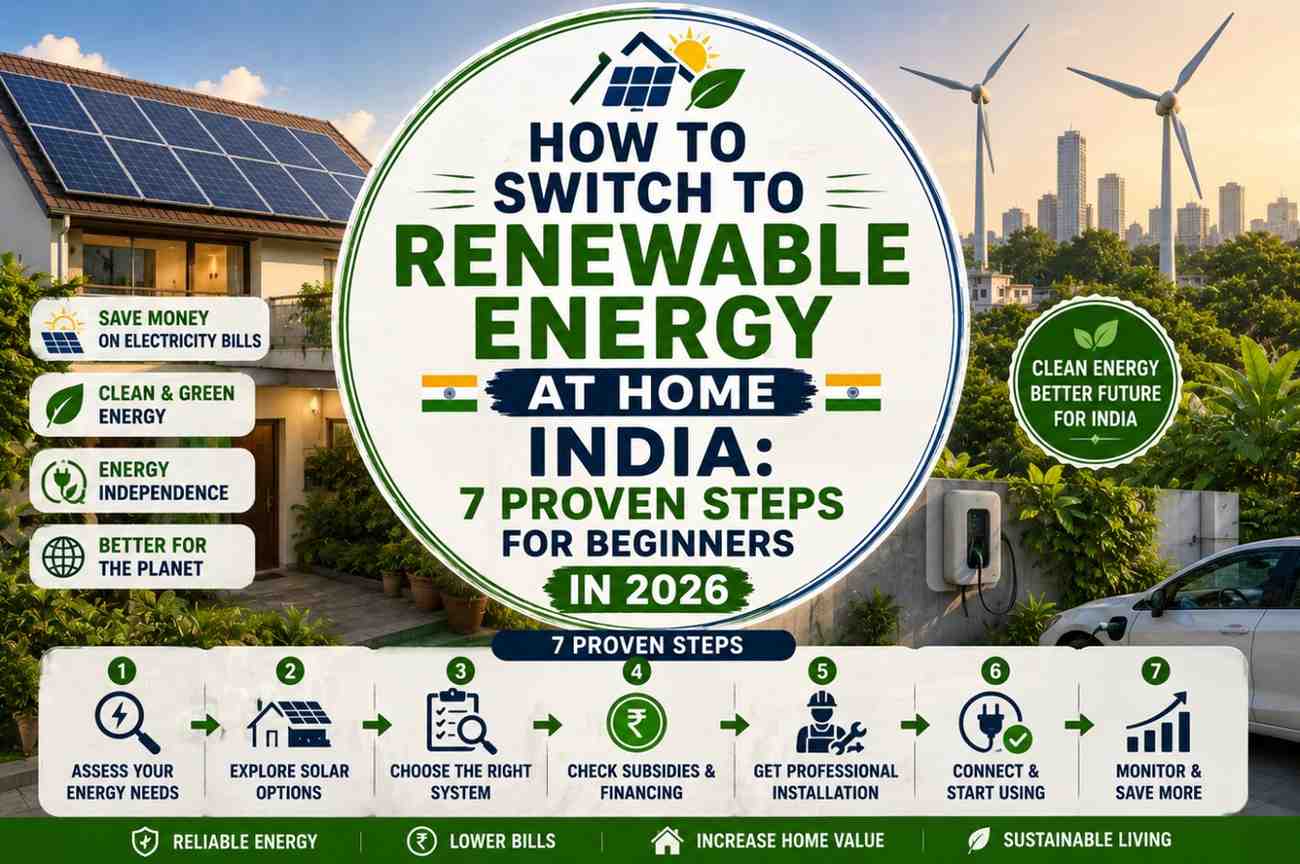
How to switch to renewable energy at home in India is a question more Indian families are asking in 2026 than ever before. With electricity bills rising, solar costs falling, and government subsidies at record levels, the timing has never been better.
But where do you actually start? What are the steps, the costs, the paperwork, and the options for different types of homes?
This complete beginner’s guide covers exactly how to switch to renewable energy at home in India in 2026—whether you own your home or rent, live in an apartment or a bungalow.
Step 1: Audit Your Current Energy Consumption
The first step in how to switch to renewable energy at home in India is understanding how much energy you currently use.
Look at your last 12 electricity bills and find:
- Your average monthly consumption in kWh (units)
- Peak consumption months (usually summer with AC use)
- Your current electricity tariff (₹/unit)
This baseline determines the size of the renewable system you need and the savings you can realistically expect.
Typical consumption by home size:
- 1 BHK without AC: 100–150 units/month
- 2 BHK with 1 AC: 200–300 units/month
- 3 BHK with 2 ACs: 350–500 units/month
- Large home/bungalow: 500–1,000+ units/month
Step 2: Assess Your Rooftop’s Solar Potential
For most Indian homeowners, how to switch to renewable energy at home in India primarily means rooftop solar. Before proceeding, assess your roof:
Ideal roof criteria:
- Orientation: South-facing is best; west-facing is good; east-facing is acceptable
- Shade-free: No shadow from trees, water tanks, or adjacent buildings between 9 AM and 4 PM
- Structural strength: Must support 15–20 kg/m² additional weight
- Available area: 1 kW system needs approximately 6–8 sq. metres of clear roof space
If your roof doesn’t meet these criteria, don’t worry — there are alternative options covered in later steps.
Step 3: Decide Which Type of Solar System You Need
When figuring out how to switch to renewable energy at home in India, you need to choose between three main solar system configurations:
Grid-Tied System (Recommended for Most)
- Connects to the electricity grid
- Uses net metering to export surplus and import when needed
- No battery required → lower cost
- Best for homes with reliable grid supply
- Cost: ₹120,000–₹250,000 for 2–3 kW (after subsidy)
Hybrid System (With Battery Backup)
- Grid-tied plus battery storage
- Provides power during grid outages
- Higher upfront cost; better for areas with frequent cuts
- Cost: ₹250,000–₹500,000 for 3–5 kW
Off-Grid System
- Completely independent of the grid
- Only viable for remote locations without grid access
- Not recommended for urban or suburban homes
Step 4: Apply for the PM Surya Ghar Subsidy
Before installing anything, apply for the PM Surya Ghar Muft Bijli Yojana subsidy—it’s a key part of understanding how to switch to renewable energy at home in India economically.
Subsidy amounts (2026):
- 1 kW: ₹30,000
- 2 kW: ₹60,000
- 3 kW and above: ₹78,000
How to apply:
- Visit pmsuryaghar.gov.in
- Register with your mobile number and electricity consumer number
- Apply for rooftop solar installation
- Get DISCOM feasibility approval
- Install from an empanelled vendor
- Apply for net metering
- Receive subsidy in your bank account within 30 days
This subsidy is available to all residential consumers across India. Don’t skip this step.
Step 5: Get Multiple Quotes and Choose a Quality Vendor
A critical step in how to switch to renewable energy at home in India is vendor selection. Don’t accept the first quote you receive.
Get at least 3 quotes from:
- Vendors empanelled on the PM Surya Ghar portal (mandatory for subsidy)
- Local vendors with verifiable installation reviews
- National brands like Tata Power Solar, Waaree, or Adani Solar
Questions to ask every vendor:
- Are your panels BIS-certified and ALMM-listed?
- What is the inverter brand and warranty?
- Do you handle the net metering application?
- What is the full installed price including all taxes?
- What is the post-installation AMC (Annual Maintenance Contract)?
Related Article: Best Solar Panels for Home India 2026 — Top Brands & Guide
Step 6: Switch to Energy-Efficient Appliances
How to switch to renewable energy at home in India isn’t only about generating clean power—it’s also about reducing consumption so your solar system can cover more of your needs.
Key switches to make:
- Replace incandescent/CFL bulbs with LEDs—reduces lighting load by 60–70%
- 5-star rated ACs — use 30–40% less power than 3-star models
- 5-star refrigerators — saves 150–200 units/year vs. old models
- Induction cooktops — more efficient than gas for some cooking styles
- Smart power strips — eliminate standby power waste
For many families, energy efficiency alone can reduce monthly bills by 15–25% before any solar installation.
Step 7: Consider EVs and Additional Renewable Upgrades
Once your solar system is operational, the next phase of how to switch to renewable energy at home in India is integrating an electric vehicle.
An EV charged from your rooftop solar system means you’re driving on clean, essentially free energy from your own roof. The economics are compelling:
- Petrol cost: approximately ₹8–₹10/km
- EV charged from solar: approximately ₹0.5–₹1/km
Over 15,000 km per year, this saves ₹100,000–₹140,000 annually in fuel alone—on top of your electricity savings.
Special Case: How to Switch to Renewable Energy in an Apartment
How to switch to renewable energy at home in India when you’re in an apartment is more challenging but not impossible:
- Group solar schemes: Many housing societies now install rooftop solar with shared benefits
- Green power tariffs: Some DISCOMs offer green tariff options where you pay slightly more for certified renewable energy
- Community solar projects: Emerging model where residents of apartments invest in off-site solar projects
- Energy efficiency focus: Apartments can still reduce consumption significantly through LED, 5-star appliances, and smart usage habits
External Resources
FAQ: How to Switch to Renewable Energy at Home India
Q1: What is the first step to switch to renewable energy at home in India? The first step is auditing your monthly electricity consumption from your recent bills to determine the right solar system size for your needs.
Q2: Can apartment residents switch to renewable energy at home in India? Yes—through housing society rooftop solar, green power tariffs from DISCOMs, or community solar projects, apartment residents can access renewable energy.
Q3: How long does it take to switch to solar at home in India? From application to full installation and net metering activation typically takes 4–8 weeks if using an empaneled PM Surya Ghar vendor.
Q4: Do I need battery storage when switching to renewable energy at home in India? Not necessarily. A grid-tied system with net metering is sufficient for most urban homes. Battery backup is worth considering only in areas with frequent power cuts.
Q5: What government support is available for switching to renewable energy at home in India in 2026? The PM Surya Ghar Muft Bijli Yojana provides subsidies up to ₹78,000 for rooftop solar systems, plus low-interest loans through nationalized banks.
Conclusion
How to switch to renewable energy at home in India in 2026 is more achievable than ever before. The steps are clear: audit your consumption, assess your roof, apply for the subsidy, choose quality equipment, and upgrade your appliances.
The financial case is compelling. The environmental benefits are real. And the process, while involving paperwork, is well-supported by government portals and empanelled vendors.
Start with Step 1 today — check your last three electricity bills and understand what you’re spending. The path to renewable energy at home in India begins with knowing exactly where you stand.




 creator@ecometric.site