
Introduction
AI and renewable energy 2026 have become one of the most powerful technology partnerships of the decade. Artificial intelligence is no longer a buzzword in the energy sector — it’s an operational reality transforming how solar farms predict output, how grids balance supply and demand, and how countries accelerate their clean energy transitions.
The convergence of AI and renewable energy is driving efficiency gains, cost reductions, and reliability improvements that would be impossible with conventional technology alone.
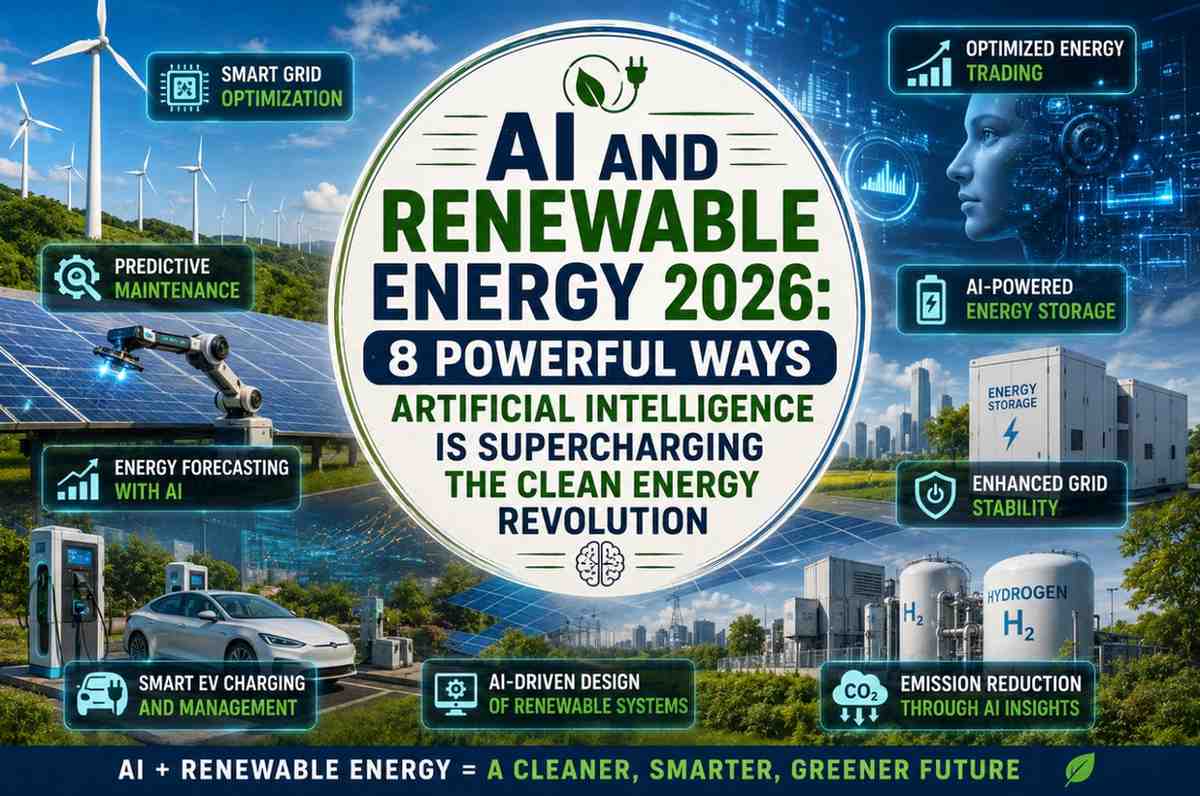
Here are 8 powerful ways AI is supercharging renewable energy in 2026 — and why this partnership will only deepen in the years ahead.
Why AI and Renewable Energy 2026 Are a Perfect Match
Before diving into specific applications, it helps to understand why AI and renewable energy are such natural partners.
Renewable energy has a fundamental challenge: variability. Solar panels don’t generate power at night. Wind turbines need wind. Managing a grid with large amounts of variable renewable generation requires processing vast amounts of data — weather forecasts, demand patterns, grid frequency, storage state — in real time.
This is exactly what AI excels at.
The combination of AI and renewable energy 2026 is essentially intelligence solving variability — turning the biggest weakness of clean energy into a manageable engineering challenge.
8 Ways AI Is Transforming Renewable Energy in 2026
1. Solar Generation Forecasting
One of the most mature applications of AI and renewable energy 2026 is solar output forecasting. Traditional meteorological models could predict solar irradiance 24–48 hours ahead with moderate accuracy.
AI models — particularly deep learning systems trained on years of satellite data, weather patterns, and real plant performance — now forecast solar generation 4–7 days ahead with 90%+ accuracy.
This transforms grid management. When operators know exactly how much solar power will be available on Thursday afternoon, they can plan backup generation, storage dispatch, and demand response with precision rather than guesswork.
2. Wind Power Prediction
Wind forecasting is even more technically challenging than solar — wind speed and direction are highly localized and turbulent. AI and renewable energy 2026 applications in wind include:
- LiDAR-integrated neural networks that model wind behaviour at turbine height
- Wake effect modelling — predicting how one turbine’s output affects others downwind
- Extreme weather detection — identifying potential storm damage windows for preemptive turbine protection
Google’s DeepMind applied AI to a wind farm in the US and increased the predictability of output by 25%, making the wind power worth approximately 20% more on the grid because it could be committed in advance.
3. Smart Grid Balancing and Demand Response
Perhaps the most critical application of AI and renewable energy 2026 is real-time grid management. AI systems now continuously monitor:
- Generation output from thousands of solar and wind installations
- Real-time electricity demand across millions of connected meters
- Battery storage levels and optimal charge/discharge timing
- Cross-border electricity flows and price signals
- Weather patterns affecting both supply and demand
These systems make thousands of micro-adjustments per hour — routing power, activating storage, signalling demand response programs — in ways that maintain grid stability with high renewable penetration.
India’s national grid (operated by POSOCO) is increasingly deploying AI and renewable energy management tools as the share of variable renewables crosses 20% of capacity.
4. Predictive Maintenance for Solar and Wind
Unexpected equipment failures are expensive in renewable energy — both in lost generation and repair costs. AI and renewable energy 2026 applications in predictive maintenance include:
- Drone-based thermal imaging AI that identifies failing solar cells before they degrade output
- Acoustic AI that detects abnormal bearing wear in wind turbines months before failure
- Power curve deviation detection — AI flags when a turbine’s output deviates from its expected curve, indicating blade fouling, yaw misalignment, or gearbox issues
- Inverter health monitoring — early detection of DC/AC conversion efficiency losses
These tools are reducing unplanned downtime by 30–40% at large solar and wind farms — a meaningful improvement to LCOE and investor returns.
5. Battery Storage Optimization
Battery storage is becoming the critical enabler of high-renewable grids. AI and renewable energy 2026 are transforming how batteries are managed:
- AI-optimized charge/discharge cycles extend battery lifespan by 15–20% versus simple rule-based management
- Electricity price arbitrage — AI buys cheap excess solar and sells during peak demand
- Grid frequency regulation — batteries managed by AI respond in milliseconds to frequency deviations
- Thermal management — AI manages battery temperature to maximize both performance and longevity
The combination of falling battery costs and AI-optimized management is making grid-scale storage economically compelling at a scale that changes the fundamental reliability calculus of renewable energy.
6. Site Selection and Resource Assessment
Before a single panel is installed or turbine erected, AI and renewable energy 2026 are transforming how developers identify optimal project locations.
Traditional site assessment required months of on-site measurement. AI now processes:
- 20+ years of satellite-derived solar irradiance data
- LiDAR terrain mapping for wind resource modelling
- Land use and ownership databases
- Grid connection capacity and proximity data
- Environmental sensitivity mapping
AI can identify the globally optimal location for a 100 MW solar plant within a search area of thousands of square kilometres — in hours rather than years.
7. Energy Market Trading and Price Forecasting
Renewable energy generators increasingly participate in competitive electricity markets. AI and renewable energy 2026 applications in trading include:
- Day-ahead electricity price forecasting with 85%+ accuracy
- Optimal bidding strategies that maximize revenue within regulatory constraints
- Real-time balancing market participation — responding to price signals in minutes
- Long-term power purchase agreement (PPA) pricing models — helping developers and offtakers negotiate fair long-term prices
This AI-driven market intelligence reduces the revenue risk of renewable projects — improving financing terms and accelerating deployment.
8. AI-Powered Virtual Power Plants
Perhaps the most transformative application of AI and renewable energy 2026 is the virtual power plant (VPP).
A VPP uses AI to aggregate thousands of distributed energy resources — rooftop solar panels, home batteries, EV chargers, smart appliances — and coordinate them as a single flexible power resource.
In 2026, VPPs are operational across Australia, Germany, the US, and increasingly India. A large VPP can:
- Provide the same grid services as a conventional peaking power plant
- Do so at much lower cost
- Use zero-emission distributed resources
- Respond in seconds, not minutes
AI is the essential intelligence layer that makes VPPs possible — without it, coordinating millions of small devices in real time is computationally impossible.
The AI Energy Consumption Challenge
An honest look at AI and renewable energy 2026 must acknowledge a complication: AI itself is an enormous and rapidly growing energy consumer.
Training large AI models consumes megawatt-hours of electricity. Data centres running AI applications consumed approximately 400–500 TWh globally in 2025 — roughly equivalent to the entire electricity consumption of Germany.
The critical question is whether AI’s energy consumption is offset by the efficiency gains it delivers to the clean energy system. The evidence in 2026 suggests the answer is yes — but the industry must ensure that AI infrastructure is itself powered by renewables to avoid a counterproductive circular dynamic.
Related Article: Renewable Energy Growth Statistics 2026 — Record Numbers Explained
AI and Renewable Energy 2026 in India
For India specifically, AI and renewable energy 2026 are beginning to intersect in important ways:
- SECI (Solar Energy Corporation of India) is piloting AI-based grid forecasting
- POSOCO uses machine learning for real-time grid management
- Adani Green and Greenko have deployed AI predictive maintenance on large solar farms
- Indian Space Research Organisation (ISRO) satellite data feeds AI solar resource models for PM Surya Ghar planning
India’s scale of renewable deployment — the world’s third-largest market — makes AI tools both necessary and high-impact.
External Resources
FAQ: AI and Renewable Energy 2026
Q1: How is AI used in renewable energy in 2026? Key applications of AI and renewable energy 2026 include solar/wind forecasting, grid balancing, predictive maintenance, battery optimization, site selection, and virtual power plant coordination.
Q2: Does AI help make renewable energy more reliable? Yes — AI forecasting and grid management tools significantly improve the predictability and reliability of variable solar and wind generation, addressing the core reliability challenge.
Q3: What is a virtual power plant and how does AI enable it? A virtual power plant aggregates thousands of distributed solar panels, batteries, and smart devices. AI coordinates them in real time to act as a single flexible power resource for the grid.
Q4: Is AI increasing renewable energy costs or reducing them? AI reduces renewable energy costs by improving efficiency, extending equipment life, optimizing market participation, and enabling smarter grid management — the savings substantially exceed AI’s operating costs.
Q5: How is India using AI in its renewable energy sector in 2026? India is deploying AI in grid forecasting (POSOCO), solar resource assessment (PM Surya Ghar planning), predictive maintenance on large solar farms, and smart grid management as renewable penetration increases.
Conclusion
AI and renewable energy 2026 are not separate trends — they are deeply intertwined pillars of the clean energy transition. AI makes renewable energy more predictable, more reliable, more efficient, and more economically competitive.
From forecasting solar output with near-perfect accuracy to coordinating millions of home batteries as a virtual power plant, artificial intelligence is supercharging renewable energy in ways that were science fiction just a decade ago.
The partnership between AI and renewable energy will only deepen as both technologies mature. Countries and companies that master this combination will lead the clean energy economy of the 21st century.




 creator@ecometric.site