
Introduction
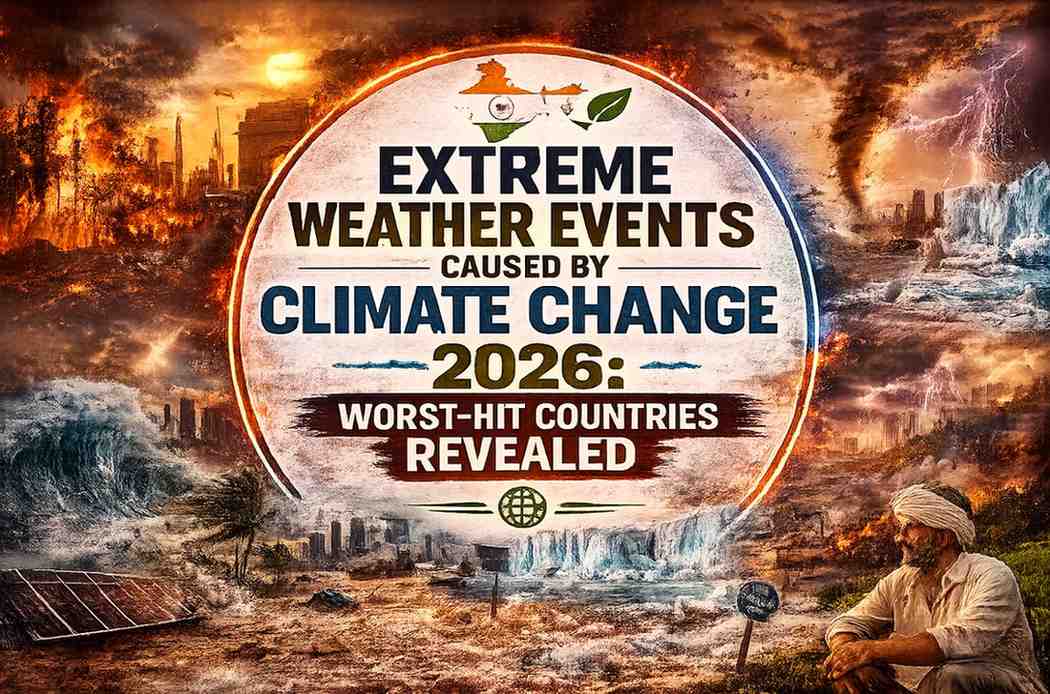
Extreme weather events caused by climate change in 2026 are no longer aberrations. They are the new normal — striking every continent, every season, with increasing frequency and ferocity.
The scientific link between greenhouse gas emissions and intensified extreme weather is now one of the most well-established fields in climate science, called attribution science. Researchers can now calculate, within weeks of a disaster, exactly how much more likely or intense it was made by climate change.
This guide covers the major extreme weather events caused by climate change in 2026, organized by region, with the science that connects them to a warming planet.
How Climate Change Makes Extreme Weather Worse
Before the country-by-country breakdown, here’s the physics behind extreme weather events caused by climate change in 2026:
Heatwaves: A warmer baseline makes extreme heat more frequent and more intense. A heatwave that would have occurred once per 50 years in a pre-industrial climate now occurs every 5–10 years at 1.5°C warming.
Flooding: Warmer air holds more moisture (7% more per degree Celsius). This means when storms occur, they dump more water. Extreme rainfall events caused by climate change are significantly more intense than before.
Droughts: Higher temperatures increase evaporation from soil and vegetation. Regions that were already dry become drier faster. Wet regions can also experience “flash droughts” — rapid soil moisture loss between rain events.
Tropical Cyclones: While climate change may not increase the total number of hurricanes and typhoons, it makes the strongest ones stronger by providing more fuel (warm ocean water) and more moisture for heavier rainfall.
Wildfires: Hotter temperatures, earlier snowmelt, and prolonged droughts create the dry, hot conditions that turn sparks into catastrophic fires.
Asia — Frontline of Extreme Weather Events Caused by Climate Change 2026
India: Extreme Heat and Flooding Simultaneously
India in 2026 continues to experience some of the world’s most severe extreme weather events caused by climate change. The cruel paradox: the same monsoon-dependent country faces both deadly heatwaves and catastrophic floods.
- Pre-monsoon heatwaves in March–May across North India, Rajasthan, and Uttar Pradesh regularly exceed 45°C — temperatures that cause rapid heat stroke and kill outdoor laborers and the elderly
- Flooding in Bihar, Assam, and Kerala during monsoon season caused by intensified rainfall events that deposit a month’s rain in days
- Cyclones in the Bay of Bengal have intensified — Category 4 and 5 storms now more frequent than historical averages
Attribution science confirms that the probability of India’s most severe recent heatwaves has been made 30x more likely by human-caused climate change.
Related: How Does Climate Change Affect India 2026 — Heatwaves, Floods & Food Security Explained
Pakistan: Catastrophic Floods and Glacial Lake Outbursts
Pakistan’s 2022 floods — which submerged one-third of the country and affected 33 million people — were a defining extreme weather event caused by climate change. That disaster has not been a one-off.
Pakistan has more glaciers than any region outside the polar ice caps. As they melt due to warming, Glacial Lake Outburst Floods (GLOFs) become more frequent and devastating — sending walls of water down mountain valleys into densely populated areas.
China: Unprecedented Flooding and Heatwaves
China experienced devastating floods along the Yangtze River basin, and heat events in eastern cities routinely broke records through 2024–2025. The summer of 2023 saw Shanghai record its longest heatwave since measurement began.
Extreme weather events caused by climate change in 2026 continue this pattern across China’s diverse climate zones.
Philippines and Bangladesh: Typhoons and Sea-Level Rise
The Philippines faces the world’s highest exposure to tropical cyclones. Super Typhoon Hainan (2013) changed global understanding of what extreme weather events caused by climate change could look like — Category 5 storms hitting vulnerable coastlines.
Bangladesh, despite contributing less than 0.3% of global emissions, loses land to sea-level rise while also facing intensified monsoon flooding and cyclone storm surges.
Europe — Unexpected Extreme Weather Events Caused by Climate Change 2026
Europe was once considered largely insulated from the worst extreme weather events caused by climate change. That assumption has been shattered.
Heat: The 2022 Benchmark and Beyond
The European heatwave of 2022 killed approximately 61,000 people across the continent — the deadliest weather disaster in Europe in decades. A 2023 attribution study found this event was made virtually impossible without human-caused climate change.
In 2026, southern Europe (Spain, Portugal, Italy, Greece) continues to experience summer temperatures that regularly exceed 45°C — previously unheard of in a continent not designed for tropical heat.
Wildfires: Mediterranean Forests Burning
Greece burned approximately 96,000 hectares in its record 2023 fire season. Southern France, Spain, and Portugal have all experienced record fire years driven by the combination of higher temperatures, drought, and earlier vegetation drying that are classic extreme weather events caused by climate change.
Flooding in Northern and Western Europe
Paradoxically, while the south bakes, the north floods. Germany and Belgium experienced catastrophic flooding in July 2021 — over 200 dead — from extreme rainfall events that attribution science linked directly to climate change intensification.
This “simultaneous flood and drought” pattern across Europe is itself a signature of extreme weather events caused by climate change 2026 disrupting historical climate patterns.
Africa — Unequal Impacts of Extreme Weather Events Caused by Climate Change 2026
Africa is the continent least responsible for climate change (contributes ~4% of historical cumulative emissions) and most severely impacted by extreme weather events caused by climate change 2026.
East Africa: Drought Then Flood
The Horn of Africa (Somalia, Ethiopia, Kenya) endured its worst drought in 40 years during 2022–2023 — five consecutive failed rainy seasons affecting 36 million people. Then in late 2023 and 2024, the El Niño reversal brought catastrophic flooding to the same regions.
This “whiplash” pattern — drought followed rapidly by extreme flooding — is a hallmark of extreme weather events caused by climate change in East Africa.
Southern Africa: Cyclones
Cyclone Idai (2019) and subsequent storms hitting Mozambique, Zimbabwe, and Madagascar established a pattern of increasingly intense Indian Ocean cyclones affecting southern Africa. Attribution studies confirmed these storms were made significantly more intense by warmer sea surface temperatures.
Sahel: Expanding Desertification
The Sahara Desert is expanding southward — a process driven by reduced and less predictable rainfall combined with higher temperatures. The Sahel region (Burkina Faso, Mali, Chad, Niger) faces acute food insecurity as pastoral and agricultural lands become unviable.
The Americas — Record Events Every Season
United States: Billion-Dollar Disaster Economy
The United States experienced 28 separate billion-dollar weather disasters in 2023 alone — a new record. Extreme weather events caused by climate change in 2026 continue this trend:
- Hurricane seasons producing more Category 4–5 storms in the Gulf of Mexico and Atlantic
- Western wildfires (California, Oregon, Washington, Colorado) that now burn year-round rather than seasonally
- Flooding along the Mississippi and Ohio river systems from atmospheric river events
- Record winter storms caused by disrupted polar vortex patterns linked to Arctic warming
Canada: Record Wildfire Season
Canada’s 2023 wildfire season burned approximately 18 million hectares — the worst in recorded history, more than double any previous year. The smoke blanketed US cities for weeks. Attribution science directly links the severity to extreme weather events caused by climate change in Canada’s boreal forests.
Central America and Caribbean: Hurricane Intensity
The Caribbean and Central America face increasingly intense Atlantic hurricane seasons. Countries like Honduras, Guatemala, and Haiti — with limited infrastructure and resources — suffer catastrophic damage from storms that wealthier nations recover from in months.
Oceania: Australia and Pacific Islands on the Frontline
Australia: Fire, Flood, and Reef Death
Australia’s “Black Summer” (2019–2020) burned over 18 million hectares, killed an estimated 3 billion animals, and blanketed major cities in smoke for months. Attribution science established this was made at least 30% more likely by human-caused climate change.
In 2022, eastern Australia then suffered catastrophic flooding — the same regions that burned now inundated. This alternation between extreme drought/fire and extreme flooding is one of the definitive extreme weather events caused by climate change 2026 patterns in southeastern Australia.
Pacific Island Nations: Existential Threat
For nations like Tuvalu, Kiribati, and the Marshall Islands, extreme weather events caused by climate change aren’t just economic disasters — they threaten national existence. Storm surges now regularly overwash entire low-lying atolls. Some islands have been evacuated permanently.
Tuvalu has signed an agreement with New Zealand for potential relocation of its entire population — the first “climate refugee” agreement between sovereign nations.
The Economic Cost of Extreme Weather Events Caused by Climate Change 2026
The financial toll of extreme weather events caused by climate change is staggering and growing:
- Global economic losses from natural disasters: approximately $250–300 billion per year (2020–2025 average)
- Climate-related losses are rising at ~7% per year
- By 2050, climate-related economic damages could reach $1–5 trillion per year under moderate warming scenarios (Swiss Re, Lloyd’s of London projections)
- Insurance markets in high-risk areas (Florida, California, Queensland) are withdrawing — making extreme weather events economically devastating even for insured homeowners
Related: Carbon Emissions by Country 2026 Ranked — Who Pollutes the Most?
5 Frequently Asked Questions
Q1: Are extreme weather events caused by climate change getting worse every year? Not uniformly year to year — natural variability means some years are worse than others. But the trend over decades is clearly upward in frequency, intensity, and cost. El Niño years like 2023–2024 amplify the background warming signal.
Q2: Can scientists prove that a specific weather event was caused by climate change? Attribution science can calculate how much more likely or intense a specific event was made by human-caused warming — not whether it “would have happened” without climate change. The distinction is important but the practical answer is: yes, we can quantify the climate contribution.
Q3: Which type of extreme weather is most directly linked to climate change? Heatwaves have the clearest and strongest attributable link to climate change. Extreme rainfall events are second. Tropical cyclone intensification and wildfire severity are also strongly attributed.
Q4: Which countries are most vulnerable to extreme weather events caused by climate change in 2026? The most vulnerable countries combine high climate exposure with low adaptive capacity: Bangladesh, Pakistan, Philippines, Mozambique, Haiti, Somalia, and Pacific Island nations.
Q5: Is extreme weather happening more in poor countries than rich countries? Both are experiencing more extreme weather. But poor countries suffer disproportionately because they have less infrastructure to withstand events, less insurance coverage, less emergency response capacity, and slower economic recovery.
Conclusion
Extreme weather events caused by climate change in 2026 are the most visible and human consequence of a warming planet. From wildfires in Canada to floods in Pakistan to heatwaves across Europe, no continent is immune.
The country-by-country picture reveals a profound injustice: the nations and communities contributing least to greenhouse gas emissions are suffering the most severe consequences.
Every tonne of CO₂ not emitted reduces future risk. Every fraction of a degree of warming prevented saves lives. The extreme weather events caused by climate change we see in 2026 are the result of decisions made decades ago — but the extreme weather of 2040 will be determined by decisions made right now.
Follow our climate coverage for ongoing updates on extreme weather attribution science, regional impacts, and climate solutions.
External sources: World Meteorological Organization Climate Reports | IPCC AR6 Impacts, Adaptation and Vulnerability


 creator@ecometric.site