Introduction
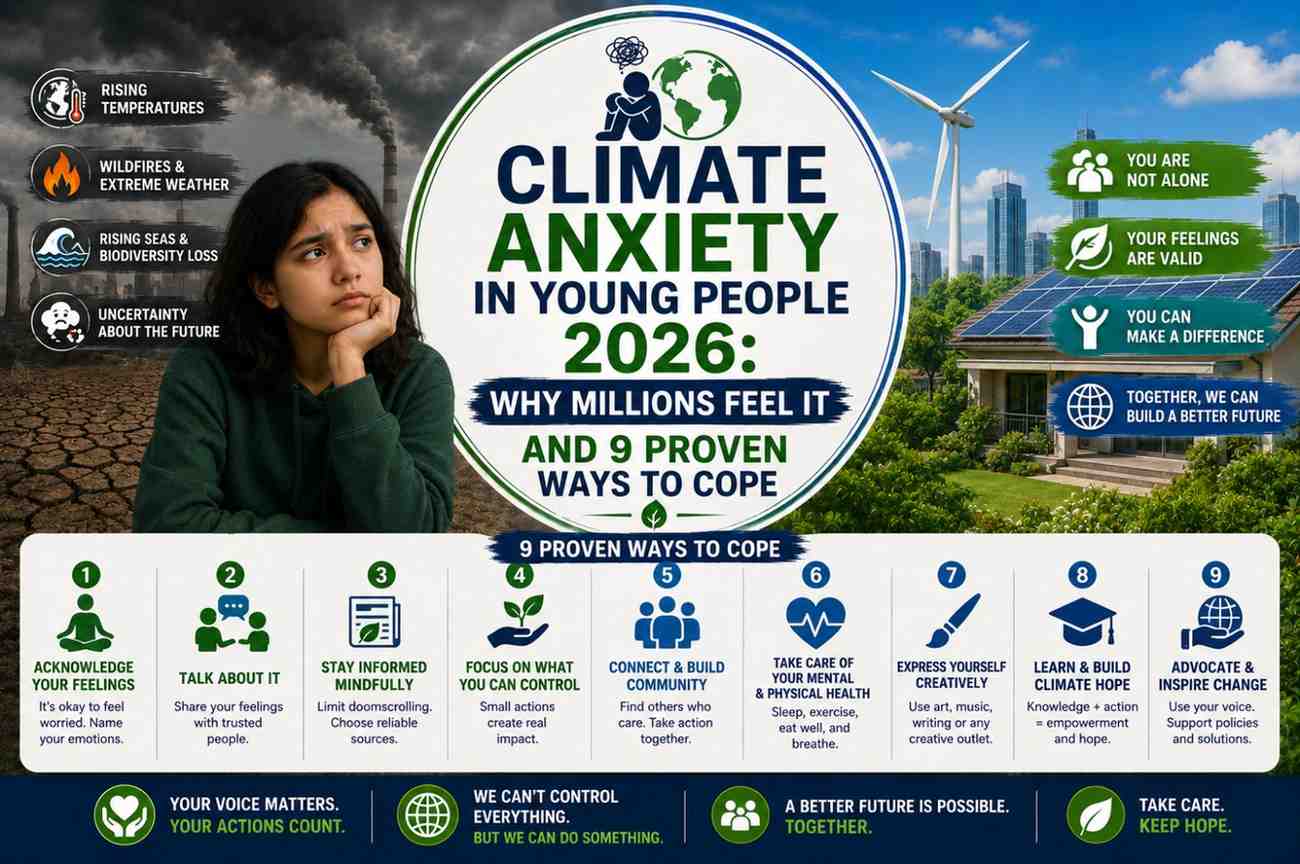
Climate anxiety in young people in 2026 is one of the most significant — and most underreported — mental health challenges of our time.
It has a formal name: eco-anxiety or climate anxiety — defined by the American Psychological Association as a “chronic fear of environmental doom.” It is not a diagnosable disorder. It is a rational psychological response to a genuinely threatening situation.
And it is widespread. Studies consistently find that climate anxiety in young people is more prevalent, more intense, and more life-affecting than in older generations. Understanding why — and how to respond in psychologically healthy ways — is the subject of this guide.
How Widespread Is Climate Anxiety in Young People in 2026?
The data on climate anxiety in young people in 2026 is striking:
- A landmark 2021 global study published in The Lancet Planetary Health, surveying 10,000 young people aged 16–25 across 10 countries, found:
- 59% were very or extremely worried about climate change
- 45% said climate anxiety affected their daily lives and functioning
- 56% believed “humanity is doomed” due to climate change
- 75% found the future frightening
- Young people in lower-income countries (India, Nigeria, Philippines) reported higher anxiety than those in higher-income countries
- A 2023 survey by Gallup found climate change is the top concern of 18–29 year olds globally — ahead of economic anxiety, war, and political instability.
- American Psychological Association surveys consistently show Gen Z (born 1996–2012) and Gen Alpha (born 2013+) report significantly higher rates of climate anxiety than Millennials, Gen X, or Boomers — not because they are less resilient, but because they are more informed and more exposed to climate impacts.
Climate anxiety in young people in 2026 is not a niche phenomenon or a product of “doomscrolling.” It is a mass psychological response to a real existential challenge.
Why Is Climate Anxiety So Much Worse in Young People?
Understanding climate anxiety in young people in 2026 requires understanding what’s different about being young in this era.
They Have the Most at Stake
Young people today will live through the most consequential decades of climate change. A 15-year-old in 2026 will be 59 in 2070 — well within the high-impact climate projections of IPCC models.
The anxiety is proportional to the exposure. When scientists say “impacts will be severe by 2050,” older generations hear “not in my lifetime.” Young people hear “in the middle of my life.”
They Inherited a Problem They Didn’t Create
One of the most psychologically damaging dimensions of climate anxiety in young people in 2026 is the deep sense of injustice:
- Current young people contributed negligibly to the historical emissions causing climate change
- The decisions that created the crisis were made by generations before them
- The political and economic power to fix it largely remains with older generations
- Young people feel the consequences most severely while having the least agency
This combination — responsibility without agency — is a classic driver of anxiety and helplessness.
They Grew Up With Climate in the News
Millennials and Gen Z grew up with climate change as a constant background fact of their informational world. Climate disasters are not occasional news events — they are a continuous feed of wildfires, floods, heatwaves, and extinction reports.
The psychological concept of chronic stress versus acute stress is relevant here: climate anxiety in young people in 2026 operates as a form of chronic, background-level threat that never fully resolves — unlike a single frightening event that passes.
They Are Witnessing Inadequate Adult Response
Young people observing international climate negotiations — 30+ years of conferences with inadequate outcomes — develop a rational sense that the adults who caused the problem are not solving it fast enough.
Greta Thunberg’s famous phrase “How dare you” captured a sentiment felt by tens of millions of young people: the anger of a generation watching its future bargained away in conference rooms.
The Spectrum: When Is Climate Anxiety in Young People 2026 Healthy vs. Harmful?
Climate anxiety in young people exists on a spectrum:
Healthy Eco-Anxiety
- Motivates action and engagement
- Produces appropriate grief for real losses without becoming debilitating
- Maintains connection to the world and other people
- Drives political participation and lifestyle changes
- Can be held alongside realistic hope and moments of joy
Harmful Eco-Anxiety / Eco-Grief
- Paralyzes rather than motivates
- Interferes with relationships, school, work, and daily function
- Involves catastrophic thinking that eliminates all hope or agency
- Is accompanied by depression, panic attacks, or dissociation
- Leads to isolation or withdrawal from the world
The difference isn’t the intensity of the feeling — it’s the functional outcome. Climate anxiety in young people in 2026 becomes a clinical concern when it consistently impairs daily functioning over weeks or months.
9 Proven Ways to Cope With Climate Anxiety in 2026
These strategies are grounded in both psychological research and the specific nature of climate anxiety:
1. Acknowledge the Anxiety Without Amplifying It
The first step with climate anxiety in young people in 2026 is validation: this feeling is appropriate. Climate change is genuinely threatening. Pretending otherwise is psychologically worse than acknowledging the fear.
But there’s a difference between acknowledging anxiety and feeding it with constant doom-scrolling, catastrophic news consumption, or apocalyptic social media.
Practical step: Set intentional limits on news and climate content consumption. Informed is not the same as perpetually immersed.
2. Distinguish Between What You Can and Cannot Control
The classic source of anxiety is focusing on uncontrollable threats. With climate anxiety in young people in 2026, a key coping mechanism is narrowing focus to the sphere of personal and collective influence:
Cannot control: Global emission trajectories; political decisions of foreign governments; past emissions already in the atmosphere.
Can influence: Your own choices; local political participation; collective community action; the companies you support; conversations that change minds.
Psychologists call this a locus of control exercise — and it reliably reduces anxiety while increasing productive engagement.
3. Take Action — Any Action
The most effective intervention for climate anxiety in young people in 2026 in psychological research is action.
Action restores agency — the antidote to helplessness. Action doesn’t have to be grand. It can be:
- Voting (or registering to vote)
- Joining a local environmental group
- Writing to an elected official
- Participating in a climate march
- Making more sustainable consumer choices
- Having one conversation about climate that you wouldn’t have had before
A 2021 study in the journal Global Environmental Psychology found that even small climate-related actions significantly reduced anxiety and increased wellbeing among young people — the mechanism being restored sense of agency.
4. Connect With Others Who Feel the Same Way
Isolation amplifies climate anxiety in young people in 2026. Connection reduces it.
Finding communities of young people who share climate concern — and who channel it into action rather than paralysis — is one of the most protective factors identified in climate psychology research.
This can be:
- School or college environmental groups
- Youth climate organizations (Fridays for Future, Sunrise Movement, local equivalents)
- Online communities with a focus on solutions and mutual support
- Informal friend groups where climate is openly discussed
The shared nature of the concern matters. Knowing you’re not alone — that millions feel the same way — is itself therapeutic.
5. Engage With Solutions, Not Just Problems
The media narrative around climate anxiety in young people in 2026 is dominated by problems. A deliberate rebalancing toward solutions — which are extensive and real — is psychologically restorative.
Real solutions that are working:
- Renewable energy is the fastest-growing sector in the global economy
- Electric vehicle adoption is accelerating exponentially
- Global deforestation rates are declining in several major regions
- Youth activism has materially changed corporate and government climate policy in documented cases
Staying informed about climate solutions is not denial. It’s accurate information about a complex situation that has both alarming and encouraging dimensions.
6. Spend Time in Nature
Research consistently shows that time in nature reduces anxiety, improves mood, and — relevant to climate anxiety in young people in 2026 — rebuilds the sense of connection to the natural world that makes climate action feel meaningful rather than abstract.
This can seem paradoxical: spending time in a nature that is threatened. But grief for nature is healthier from a place of connection than from abstract fear.
7. Seek Professional Support When Needed
If climate anxiety in young people in 2026 is interfering with daily function — sleep, relationships, work, school — professional support is appropriate and available.
Therapists specializing in eco-anxiety and climate-aware counseling are an emerging specialty. The Climate Psychology Alliance and similar organizations maintain directories of therapists with climate expertise.
School counselors and university mental health services are increasingly trained to address eco-anxiety specifically.
Accessing support is not weakness — it is responsible self-care in response to a genuinely difficult psychological situation.
8. Practice Climate Grief as a Community
Some researchers and therapists now lead “climate grief circles” — structured group sessions where participants acknowledge loss (of landscapes, species, climate stability) and process it collectively.
This approach, drawing on traditions of communal mourning and mindfulness, has shown promise in reducing the isolation and shame that sometimes accompanies climate anxiety in young people in 2026.
9. Maintain Perspective on the Full Arc of the Story
Climate change is a genuinely serious crisis. It is not, based on current science, the end of humanity or all life on Earth.
The IPCC’s most alarming scenarios require sustained, deliberate inaction over decades. Even under current policies, billions of people will adapt and survive — with enormous suffering, but not extinction.
Maintaining psychological perspective doesn’t mean minimizing the crisis. It means resisting catastrophic all-or-nothing thinking — the cognitive distortion where “this is very bad” becomes “everything is irreversibly destroyed.”
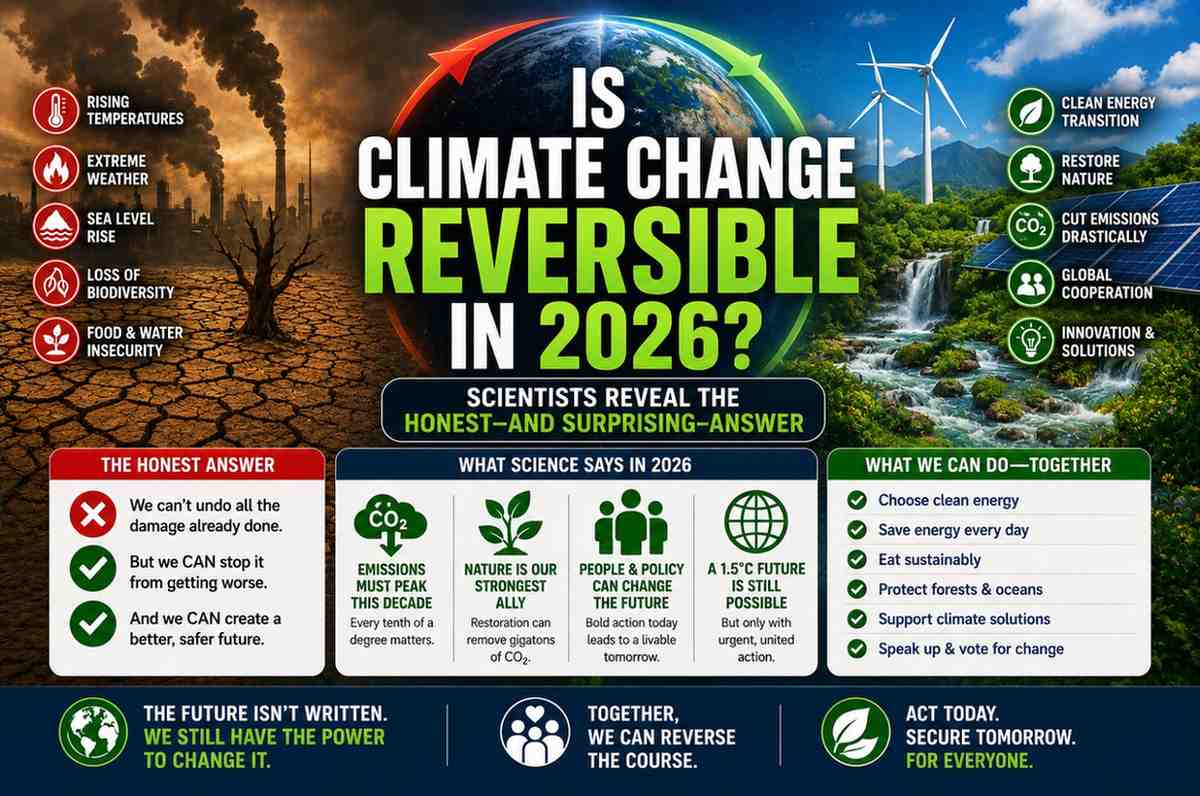
Related: Is Climate Change Reversible 2026? What Scientists Actually Say
The Difference Between Climate Anxiety and Climate Defeatism
One of the most important distinctions in climate anxiety in young people in 2026 is between anxiety and defeatism.
Anxiety: A heightened emotional response to real threat. Can motivate or paralyze. Workable with the strategies above.
Defeatism: A cognitive belief that the situation is hopeless and action is pointless. More dangerous than anxiety because it eliminates motivation entirely.
Defeatism is not supported by the evidence. The difference between the climate we get at 2°C and at 3°C is not trivial — it represents hundreds of millions of lives, vast amounts of suffering, and the survival or collapse of entire ecosystems.
The fight matters. That’s not toxic positivity — it’s an accurate reading of the science of what’s at stake.
Related: Climate Change Facts for Students 2026 — 15 Shocking Truths Every Young Person Must Know
5 Frequently Asked Questions
Q1: Is climate anxiety in young people a mental health disorder? No — eco-anxiety is not a diagnosable disorder. It is a normal psychological response to a real threat. It becomes a clinical concern when it significantly impairs daily functioning over extended periods, at which point professional support is appropriate.
Q2: Why do young people feel more climate anxiety than older people? Young people have more years of climate-vulnerable life ahead, grew up with constant climate news, inherited a problem they didn’t cause, and often feel their generation has been failed by those with power. All of these factors rationally amplify anxiety.
Q3: Does taking climate action actually reduce climate anxiety? Yes — this is one of the most consistent findings in climate psychology research. Even small actions restore a sense of agency and reduce helplessness, which is the primary driver of anxiety becoming debilitating.
Q4: Should parents shield children from climate change information to prevent anxiety? Research suggests age-appropriate, honest engagement with climate topics — paired with action and discussion of solutions — is healthier than avoidance. Children who feel informed and empowered show less anxiety than those who sense something is being hidden.
Q5: Where can young people in India access support for climate anxiety? NIMHANS (National Institute of Mental Health and Neurosciences), iCall (iCare helpline), Vandrevala Foundation, and platforms like YourDOST offer mental health support. While climate-specific counseling is less established in India than the West, general anxiety support applies directly.
Conclusion
Climate anxiety in young people in 2026 is a rational, widespread, and largely unaddressed psychological phenomenon that deserves the same attention we give to other mental health challenges of youth.
The anxiety is not a symptom of weakness. It is a symptom of paying attention to the most consequential challenge humanity faces.
The answer is not to feel less. The answer is to feel the weight of this moment honestly — and then channel that weight into something that matters. Action, connection, community, and hope grounded in what’s actually true about what’s still possible.
The world is in genuine trouble. It is not without hope. And the generation experiencing climate anxiety most intensely is also the generation most motivated to change the outcome.
That combination — anxiety and agency together — is not despair. It is exactly what the world needs.
Explore our full climate and mental health coverage, share this article with someone who’s struggling, and find your community of people who refuse to look away.
External sources: The Lancet Planetary Health — Young People’s Climate Anxiety Study | American Psychological Association — Eco-Anxiety Report


 creator@ecometric.site