Introduction
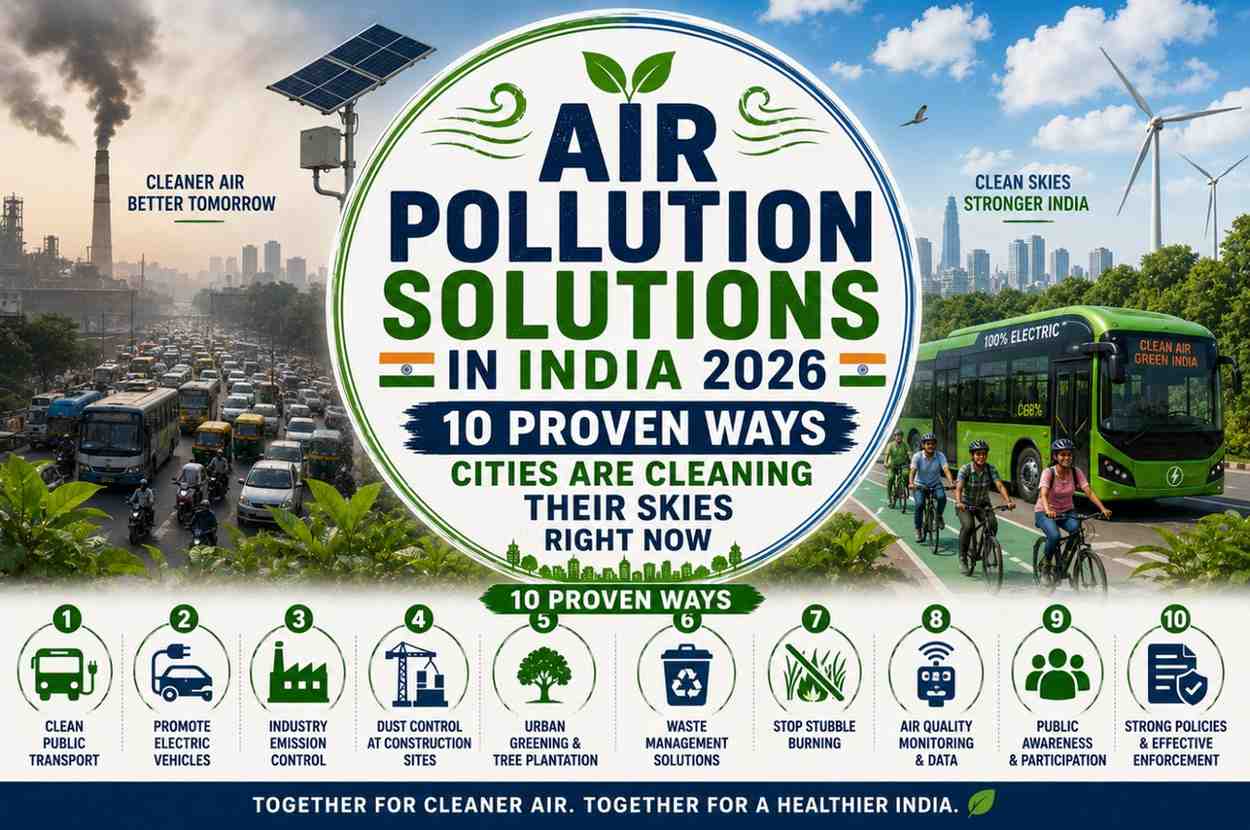
Air pollution solutions in India 2026 have moved from policy papers to real streets. India is home to some of the most polluted cities on Earth — yet 2026 is proving to be a turning point. From Delhi’s smog emergency response systems to Pune’s green transit revolution, Indian cities are deploying a remarkable range of strategies to fight air pollution.
The problem is enormous. But so is the response. Here are 10 proven air pollution solutions in India 2026 that are making a measurable difference right now.
Why Air Pollution Solutions in India 2026 Are Urgent
India’s air quality crisis is a public health emergency. According to the World Health Organization, 14 of the world’s 20 most polluted cities are in India.
The health toll is staggering:
- Particulate matter (PM2.5) causes approximately 1.6 million premature deaths per year in India
- Children in polluted cities show measurably lower lung capacity
- Air pollution costs India an estimated 1.4% of GDP annually in health and productivity losses
The good news: air pollution solutions in India 2026 are beginning to show results in AQI data across multiple cities.
Solution 1 — Electric Bus Fleet Expansion Across Major Cities
One of the most impactful air pollution solutions in India 2026 is the rapid scaling of electric bus fleets under the PM e-Bus Sewa scheme.
Over 10,000 electric buses have been deployed or ordered across Delhi, Mumbai, Bangalore, Hyderabad, and Pune.
Impact on Air Quality
Diesel buses are among the worst contributors to urban PM2.5 and NOx levels. Replacing even a fraction of the fleet produces measurable AQI improvements on major transport corridors.
Delhi’s electric bus corridors have shown 15–22% reduction in roadside NOx concentrations compared to 2022 diesel baselines.
Solution 2 — Real-Time Air Quality Monitoring Networks
You can’t fix what you can’t measure. The expansion of real-time AQI monitoring is a foundational air pollution solution in India 2026.
The Central Pollution Control Board (CPCB) has expanded its Continuous Ambient Air Quality Monitoring Stations (CAAQMS) network to over 800 stations across 250+ cities.
How This Data Is Being Used
- Mobile apps like SAMEER give citizens real-time AQI readings by locality
- Municipal corporations trigger pollution emergency protocols at specific AQI thresholds
- Construction and industrial activities are automatically restricted during high-pollution events
- Data feeds directly into the National Clean Air Programme (NCAP) performance tracking
Related Article: Delhi Air Pollution Solutions 2026
Solution 3 — Stubble Burning Alternatives in Punjab and Haryana
Crop residue burning in Punjab and Haryana contributes 25–40% of Delhi’s winter air pollution. Solving this is one of the most critical air pollution solutions in India 2026.
The 2026 approach combines:
- Subsidized Happy Seeder machines that plant directly through crop residue without burning
- Biogas plants converting stubble to compressed biogas (CBG)
- Biomass pellet plants creating commercial value for residue
- Satellite monitoring and farmer compensation for verified non-burning
Punjab reported a 35% reduction in fire counts in the 2025 season compared to 2021. The trend continues in 2026.
Solution 4 — Industrial Stack Emission Controls
Industrial emissions — from brick kilns, cement plants, and thermal power stations — are major contributors to ambient air pollution.
Among the key air pollution solutions in India 2026 is mandatory real-time stack emission monitoring (CEMS) for all large industries.
The Online Monitoring Mandate
All industries in the 17 heavily polluting categories must now transmit emissions data continuously to CPCB’s server. Non-compliant stacks trigger automatic regulatory action.
In the Indo-Gangetic Plain — India’s most polluted airshed — brick kiln conversions to zigzag technology have reduced PM emissions by up to 70% per kiln.
Solution 5 — Anti-Smog Guns and Dust Suppression Systems
Construction dust is one of the largest contributors to urban PM10 levels. Air pollution solutions in India 2026 targeting construction include anti-smog guns — water atomization systems that suppress airborne dust particles.
Delhi’s PWD and NDMC now deploy over 150 mobile anti-smog guns daily at major construction sites, road works, and waste processing areas.
Smog tower installations — large-scale air filtration units at high-traffic intersections — continue as experimental interventions, though their effectiveness at city scale remains debated among scientists.
Solution 6 — Green Belt Development and Urban Forestry
Trees absorb CO₂, filter PM2.5, and reduce the urban heat island effect that worsens smog conditions.
Urban forestry is one of the longer-term air pollution solutions in India 2026 — with cities like Hyderabad, Bangalore, and Chandigarh planting millions of trees along highways, rail corridors, and industrial buffer zones.
The Miyawaki Forest Method
The Miyawaki dense-planting technique is gaining popularity in Indian cities. These micro-forests reach maturity 10× faster than conventional plantations and provide 30× more ecological services per square meter.
Mumbai, Delhi, and Pune have collectively planted over 200 Miyawaki forests in the past three years.
Related Article: Best Air Purifier Plants for Home India
Solution 7 — CNG and Ethanol Blended Fuel Transition
Transitioning commercial vehicles from diesel to Compressed Natural Gas (CNG) and petrol vehicles to ethanol-blended fuel is a proven air pollution solution in India 2026.
Delhi’s auto-rickshaw fleet — over 90,000 vehicles — is now 100% CNG. The city’s entire bus fleet is either CNG or electric.
E20 (20% ethanol-blended petrol) rollout across India reduces vehicular PM and hydrocarbon emissions by approximately 20% compared to standard petrol.
Solution 8 — Waste-to-Energy Plants Replacing Open Burning
Open waste burning — at landfill sites, roadside dumps, and construction debris piles — is one of the most toxic sources of PM2.5 and dioxins in Indian cities.
Waste-to-energy plants that incinerate municipal solid waste under controlled, high-temperature conditions with emission scrubbers represent a significant air pollution solution in India 2026.
Delhi’s Okhla and Ghazipur waste-to-energy plants process over 4,000 tonnes per day — material that previously burned openly at landfills.
For the latest CPCB data and pollution guidelines, see Central Pollution Control Board India and National Clean Air Programme.
Solution 9 — Odd-Even Vehicle Rationing During Pollution Emergencies
Delhi’s odd-even vehicle rationing scheme — where private vehicles with odd or even number plates alternate daily operation — remains one of the most visible air pollution solutions in India 2026 during smog season emergencies.
While not a permanent solution, odd-even reduces vehicle density on roads by 10–15% during peak periods.
Combined with construction bans, firecracker restrictions, and diesel generator shutdowns, emergency response packages can bring AQI down 20–30 points within 48–72 hours.
Solution 10 — National Clean Air Programme (NCAP) Targets
The overarching policy framework for air pollution solutions in India 2026 is the National Clean Air Programme — India’s first national framework with city-specific PM2.5 reduction targets.
The 2026 milestone targets:
- 40% reduction in PM10 and PM2.5 concentrations by 2026 (from 2017 baseline) in 131 non-attainment cities
- Action plans for each city tailored to their specific pollution source profile
- Annual city rankings creating accountability and competitive improvement pressure
Early data shows 95 of 131 cities have achieved measurable improvements. 47 cities have hit or exceeded 30% reduction targets.
5 Short FAQs
Q1: Which Indian city has improved air quality the most in 2026? Cities like Varanasi, Agra, and Lucknow have shown significant AQI improvements under NCAP. Varanasi recorded over 40% PM10 reduction since 2017 through riverfront cleaning, vehicle fleet upgrades, and brick kiln conversions.
Q2: What is India’s NCAP and is it working? The National Clean Air Programme (NCAP) sets PM2.5 and PM10 reduction targets for 131 Indian cities. As of 2026, the majority of target cities show measurable improvement, though Delhi and several NCR cities remain significantly above WHO safe limits.
Q3: Is Delhi’s air getting cleaner in 2026? Delhi shows slow but measurable improvement in annual average AQI over a 5-year trend, primarily from EV adoption, CNG fleet transition, and stubble fire reductions. However, winter smog events remain severe due to geography and regional agricultural burning.
Q4: What is India’s biggest source of air pollution? India’s air pollution sources vary by region. In northern India, the dominant sources are vehicles, crop burning, industry, and construction dust. In cities, vehicular emissions and road dust typically contribute the largest shares.
Q5: What can ordinary citizens do about air pollution in India? Switch to public transport or EVs, avoid burning waste or leaves, use air purifier plants indoors, support local clean air initiatives, and check AQI daily via the SAMEER app before outdoor exercise.
Conclusion
Air pollution solutions in India 2026 are no longer theoretical. Electric buses are running. Smog guns are spraying. Satellite systems are catching stubble fires before they spread. Thousands of monitoring stations are providing the data cities need to act decisively.
The challenge remains enormous — but so does India’s capacity to respond.
Start breathing better. Share this article, explore our full pollution coverage, and join the movement that is cleaning India’s skies one city at a time.


 creator@ecometric.site