Introduction
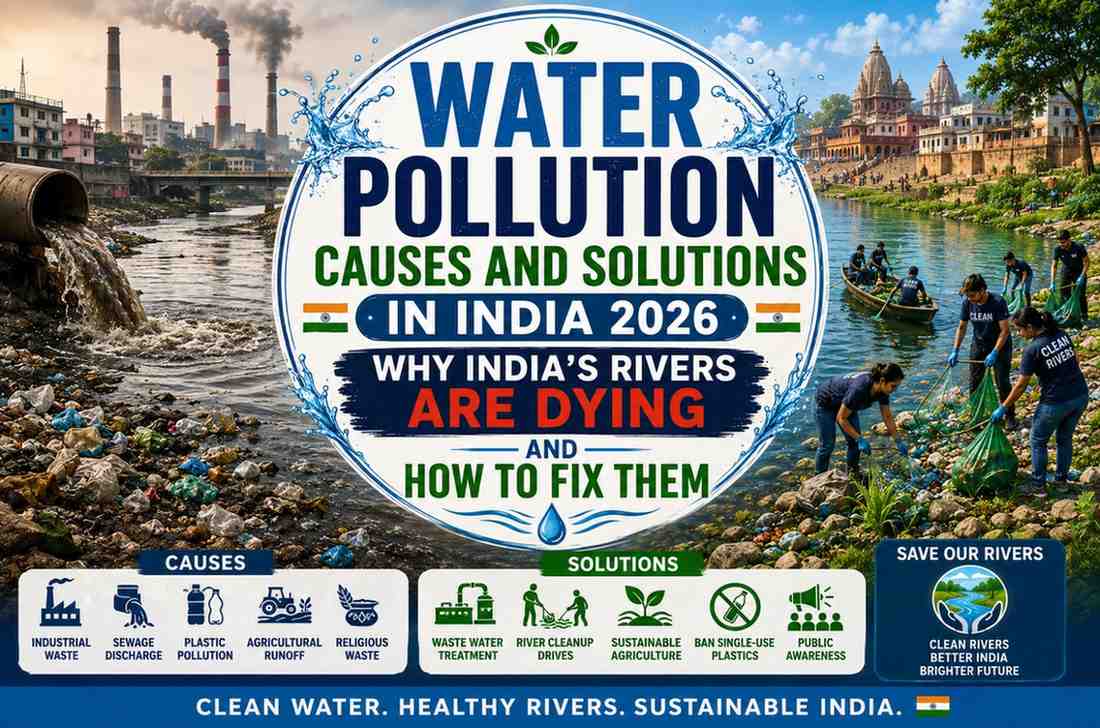
Water pollution causes and solutions in India, 2026, form one of the most urgent environmental stories of our time. India’s rivers—the Ganga, Yamuna, Godavari, Krishna, and Sabarmati—are cultural lifelines and biological ecosystems that are dying from pollution pressure they were never designed to absorb.
Understanding water pollution causes and solutions in India in 2026 is essential for every Indian citizen—because the water crisis is already affecting drinking water safety, agriculture, fisheries, and public health across the country.
Here is the complete picture: why rivers are dying, and the proven approaches that are beginning to reverse the damage.
The Scale of Water Pollution in India 2026
The statistics are stark:
- Only 50% of India’s sewage is treated before discharge into water bodies
- Over 600 rivers across India are classified as polluted by CPCB
- The Yamuna receives 58% of Delhi’s wastewater but contains only 2% of Delhi’s river length
- Heavy metal contamination affects groundwater in 23 of India’s 36 states
Water pollution causes and solutions in India in 2026 must be understood against this backdrop of decades of accumulated damage meeting urgent new intervention.
The 5 Main Water Pollution Causes in India
Cause 1 — Untreated Sewage Discharge
Municipal sewage is India’s single largest water pollutant. India generates approximately 72,000 million liters per day (MLD) of sewage—but treatment capacity exists for only about 40,000 MLD, and actual treatment is even lower due to operational failures.
Raw sewage carrying biological contaminants, pharmaceuticals, and heavy metals flows directly into rivers.
Cause 2 — Industrial Effluents
Textile dyeing units in Tiruppur, tanneries in Kanpur, pharmaceutical plants in Hyderabad, and paper mills across the country discharge partially or untreated effluents into rivers and groundwater.
The Ganga’s coliform bacteria levels downstream of Kanpur’s tannery district are thousands of times above safe limits.
Cause 3 — Agricultural Runoff
India uses approximately 1.6 million tonnes of chemical fertilizers annually. Nitrogen and phosphorus runoff from fields causes eutrophication — algal blooms that deplete oxygen and kill aquatic life in rivers and lakes.
Pesticide runoff — including endosulfan, chlorpyrifos, and organophosphates — contaminates both surface and groundwater.
Cause 4 — Solid Waste Dumped in or Near Water Bodies
Municipal solid waste — including plastic — is routinely dumped on riverbanks, in drains, and directly in water bodies. During monsoon, this material is washed into rivers, creating both physical and chemical pollution.
Cause 5 — Religious and Ritual Waste
Idol immersion during festivals (Ganesh Chaturthi, Durga Puja) introduces non-biodegradable plastic decorations, chemical paints containing lead and mercury, and organic materials in concentrated bursts.
8 Proven Water Pollution Solutions in India 2026
Solution 1 — Sewage Treatment Plant Expansion and Modernization
The Namami Gange program has been the most significant investment in water pollution causes and solutions in India by 2026. Over ₹37,000 crore have been committed to:
- Building 180+ new Sewage Treatment Plants (STPs) along the Ganga basin
- Upgrading existing non-functional STPs
- Laying new sewer networks in Ganga towns
Treatment capacity along the Ganga has increased from 1,500 MLD in 2015 to over 4,800 MLD in 2026. This is measurable progress — though the gap remains large.
Solution 2 — Real-Time Effluent Monitoring for Industries
CPCB now mandates real-time effluent flow monitoring (EFM) for all major industrial units near water bodies. Data transmits continuously to CPCB servers—enabling immediate regulatory action when discharge limits are exceeded.
This has been a significant water pollution solution in India in 2026—reducing industrial effluent violations in monitored zones by over 40%.
Related Article: Air Pollution Solutions in India 2026
Solution 3 — Natural Treatment Wetlands and Phytoremediation
Constructed wetlands — engineered ecosystems using water-filtering plants like vetiver, water hyacinth, and reed beds — treat sewage and agricultural runoff naturally at a fraction of the cost of conventional STPs.
Several Ganga towns, including Haridwar and Rishikesh, now use constructed wetlands as secondary or tertiary treatment stages. Water hyacinth, despite being an invasive species, absorbs heavy metals and nitrogen with extraordinary efficiency.
Solution 4 — River Continuous Monitoring Stations
India now operates over 500 river water quality monitoring stations with real-time data transmission. Parameters monitored include:
- Dissolved oxygen (key indicator of river health)
- pH and conductivity
- Biological oxygen demand (BOD)
- Heavy metals including lead, arsenic, and chromium
- Coliform bacteria counts
This data is publicly available and drives enforcement action and policy decisions.
Solution 5 — Faecal Sludge Management (FSM) in Smaller Cities
Most attention focuses on sewage from large cities. But millions of septic tanks and pit latrines in smaller towns overflow or are emptied directly into drains.
Faecal sludge management—collecting, transporting, and treating sludge from decentralized systems—is a critical water pollution solution in India 2026 for Tier 2 and Tier 3 cities.
For detailed government data, see Namami Gange Programme and Central Pollution Control Board Water Monitoring.
Solution 6 — Zero Liquid Discharge Mandate for Textile and Tannery Industries
The Zero Liquid Discharge (ZLD) mandate requires that highly polluting industries—textiles, tanneries, distilleries—treat and recycle all process water with zero discharge to public water bodies.
Implementation has been challenging but is accelerating in 2026, particularly in Tiruppur and Kanpur, where river pollution from these industries is most severe.
Solution 7 — River Rejuvenation Through Biodiversity Restoration
The Ganges’ dolphin population—a bioindicator of river health—is slowly recovering as water quality improves in some stretches. Forest cover on river banks is being restored to reduce erosion and runoff.
Biodiversity restoration doesn’t just heal ecosystems—it creates natural water purification services worth more than any engineered system.
Solution 8 — Community Participation and River Parliaments
Gram sabhas (village councils) along major rivers are increasingly forming “River “Parliaments”—community oversight bodies that monitor local pollution sources and report violations.
Community-led monitoring has proven more effective than government inspection alone for detecting illegal factory discharge and agricultural runoff events in real time.
Related Article: Soil Pollution Causes, Effects, and Solutions in India
5 Short FAQs
Q1: Which is India’s most polluted river in 2026? The Yamuna remains India’s most critically polluted river. The 22-km stretch through Delhi—where it receives the bulk of the city’s sewage—is biologically dead for most of the year despite decades of cleanup programs.
Q2: Is the Ganga getting cleaner under Namami Gange? Measurable improvement has been recorded in several Ganga stretches, particularly upstream near Haridwar and Rishikesh. However, downstream stretches near industrial cities like Kanpur remain severely polluted.
Q3: What is BOD, and why does it matter for river health? BOD (Biological Oxygen Demand) measures how much oxygen bacteria need to break down organic matter in water. High BOD means low dissolved oxygen, which kills fish and aquatic life. Clean rivers have BOD below 3 mg/l; the Yamuna through Delhi regularly exceeds 30 mg/l.
Q4: How does agricultural runoff affect drinking water? Nitrates from fertilizers leach into groundwater — the source of drinking water for 60% of India’s rural population. High nitrate drinking water causes methemoglobinemia (blue baby syndrome) in infants and is linked to cancer risk in adults.
Q5: What can individuals do about water pollution in India? Avoid dumping oil, paint, or medicines in drains. Report illegal effluent discharge to CPCB. Use organic fertilizers and pesticides in gardens. Participate in river cleanup drives. Pressure local representatives for STP construction and maintenance funding.
Conclusion
Water pollution causes and solutions in India 2026 tell a difficult but not hopeless story. The causes—inadequate sewage treatment, industrial discharge, and agricultural runoff—are well understood. The solutions are proven. The missing ingredient is consistent implementation, adequate funding, and civic pressure.
India’s rivers can be saved. The evidence from improving Ganga stretches and recovering dolphin populations proves it.
Join the river restoration movement. Share this article, participate in local river cleanup efforts, and demand accountability from those responsible for implementing India’s water pollution solutions.

 creator@ecometric.site