
Introduction
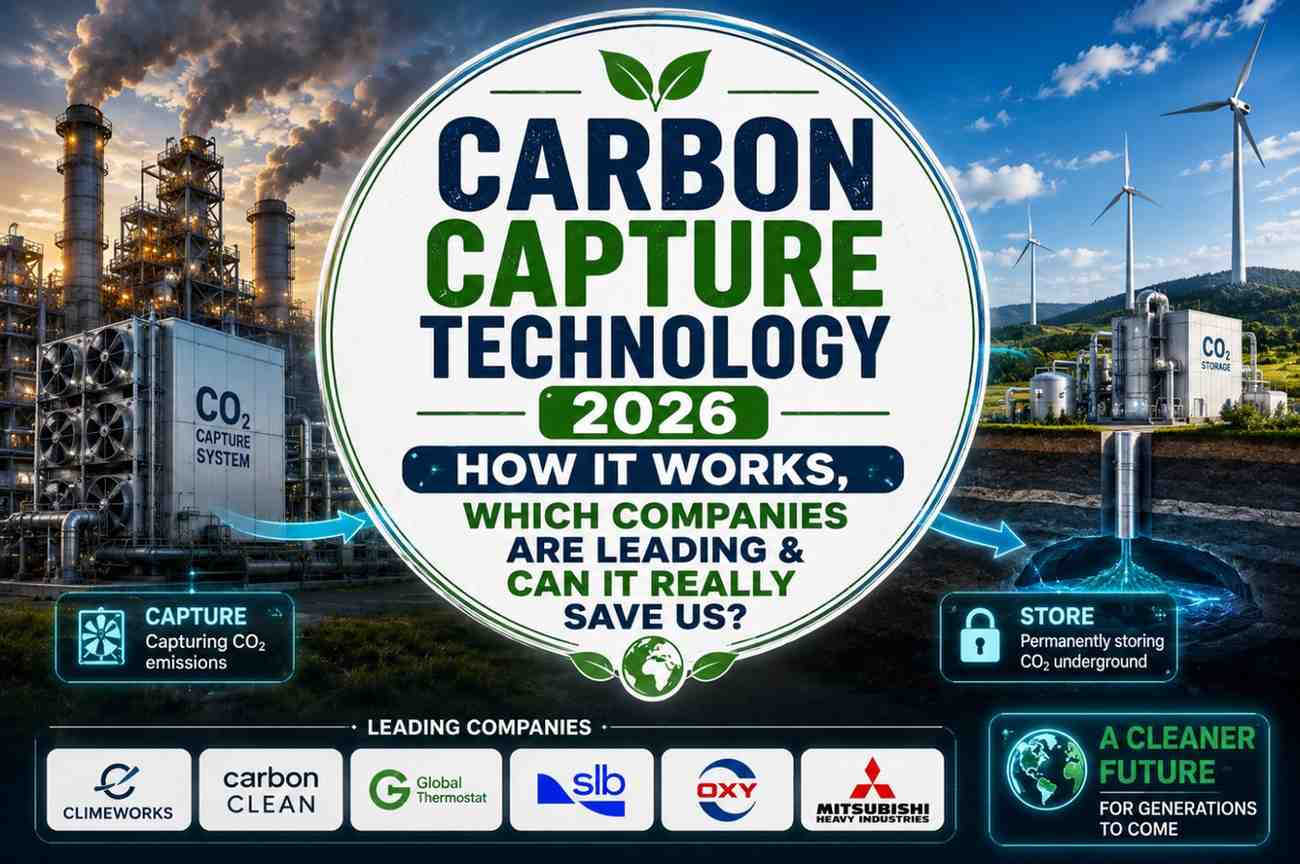
Carbon capture technology in 2026 is at an inflection point. Once dismissed as a fringe idea or a fossil fuel industry talking point, direct air capture and carbon storage are now receiving billions in government and private investment—and deploying at unprecedented scale.
But the question haunting every serious climate conversation remains: can carbon capture technology in 2026 actually contribute meaningfully to solving the climate crisis? Or is it an expensive distraction from the real work of cutting emissions?
Here is the complete, honest answer — how it works, who’s leading, the real costs, and what scientists actually say.
What Is Carbon Capture Technology 2026?
Carbon capture technology in 2026 encompasses several distinct approaches to removing CO₂ from the atmosphere or preventing it from entering it.
The main categories:
Point-source capture: Capturing CO₂ at its emission source—power plants, cement factories, steel mills—before it enters the atmosphere.
Direct Air Capture (DAC): Machines that pull CO₂ directly from ambient air, regardless of where the emissions occurred.
Bioenergy with Carbon Capture and Storage (BECCS): Growing biomass that absorbs CO₂, burning it for energy, and then capturing and storing the emissions—potentially achieving net negative emissions.
Nature-based solutions: Forests, wetlands, seagrass, and enhanced rock weathering that absorb CO₂ through biological and geological processes.
Each approach has different economics, scalability, energy requirements, and permanence.
How Does Carbon Capture Technology 2026 Actually Work?
Direct Air Capture (DAC)
The leading carbon capture technology 2026 approach for removing historical emissions works like this:
- Large fans draw ambient air across chemical sorbent materials (either liquid solvents or solid sorbents)
- The sorbent selectively binds CO₂ molecules from the ~420 ppm concentration in air
- The captured CO₂ is released by applying heat
- Purified CO₂ is compressed and either stored permanently underground in geological formations or used in industrial applications
The Energy Challenge
DAC requires significant energy — currently 1.5–2.5 GJ per tonne of CO₂ captured. Running this on fossil fuel energy would be counterproductive. The technology only makes climate sense powered by renewable energy.
Which Companies Are Leading Carbon Capture Technology 2026?
Climeworks (Switzerland)
Climeworks operates the world’s largest DAC facility—Mammoth—in Iceland, operational since 2024. It captures approximately 36,000 tonnes of CO₂ per year, storing it permanently in basalt rock formations.
Carbon capture technology in 2026 at Climeworks costs approximately $300–400 per tonne. The company is scaling toward cost reduction through next-generation plant designs.
Carbon Engineering / 1PointFive (USA/Canada)
Acquired by Occidental Petroleum, Carbon Engineering’s technology underpins Stratos — the world’s first commercial-scale DAC facility in Texas, designed to capture 500,000 tonnes per year at full capacity.
Heirloom Carbon (USA)
Heirloom uses enhanced mineral weathering—accelerating the natural process by which limestone (CaCO₃) absorbs CO₂—at far lower energy cost than chemical DAC.
Indian Context
India’s carbon capture technology 2026 landscape includes early-stage research at IITs and CSIR institutions on low-cost sorbent materials and pilot projects at coal power stations under the National Thermal Power Corporation. India’s cement and steel sectors are high-priority targets for point-source capture.
Related Article: Air Pollution Solutions in India 2026
The Cost Problem: Is Carbon Capture Technology 2026 Affordable?
This is the central challenge of carbon capture technology in 2026:
| Technology | Current cost/tonne CO₂ | 2030 target |
|---|---|---|
| DAC (Climeworks) | $300–600 | $100–150 |
| DAC (Carbon Engineering) | $200–350 | $100 |
| Point-source industrial | $50–120 | $30–60 |
| Afforestation | $5–50 | Stable |
| Enhanced weathering | $50–200 | $30–50 |
At $300+/tonne, DAC is too expensive for the scale required. The IPCC estimates we need to remove 5–15 billion tonnes of CO₂ annually by 2050 to limit warming to 1.5°C.
At $200 per tonne × 10 billion tonnes = $2 trillion per year. That’s roughly 2% of global GDP — possible but politically extraordinary.
The race is on to reduce costs through scale, learning curves, and novel sorbent materials.
What the Science Says: Can Carbon Capture Technology 2026? Save Us?
The honest scientific assessment of carbon capture technology in 2026 from the IPCC:
- All credible 1.5°C pathways include some carbon removal—it is not optional
- Carbon capture cannot substitute for rapid emissions reductions—it supplements them
- Current deployment is orders of magnitude below what models require
- Nature-based solutions (forests, wetlands) are immediately deployable at lower cost but limited in permanence
What this means: Carbon capture is necessary but insufficient. It buys time for the energy transition — it doesn’t replace it.
For the scientific consensus, see IPCC Sixth Assessment Report on Carbon Dioxide Removal and International Energy Agency Carbon Capture Analysis.
Carbon Utilization: Turning CO₂ Into Products
One promising dimension of carbon capture technology in 2026 is using captured CO₂ as a raw material rather than just burying it.
Applications include:
- Synthetic fuels (e-fuels): CO₂ + green hydrogen → methanol, jet fuel, diesel
- Building materials: CO₂ mineralized into concrete aggregate (CarbonCure technology)
- Plastics: CO₂ as a feedstock replacing petroleum in polymer production
- Greenhouses: Piped CO₂ accelerates crop growth
Carbon utilization creates revenue streams that could reduce net capture costs—potentially making carbon capture technology commercially self-sustaining in certain applications by 2026.
The Risk: Carbon Capture as a Delay Tactic
The most serious criticism of carbon capture technology in 2026 is that it provides political cover for continued fossil fuel extraction.
If governments and corporations believe that carbon capture will “fix it later,” they may avoid the politically difficult decisions—phasing out coal, ending fossil fuel subsidies, restricting new oil exploration—that immediate climate action requires.
Multiple climate scientists and economists argue that carbon capture investment, while necessary, must not come at the expense of mitigation ambition.
Related Article: Ocean Plastic Pollution Solutions 2026
5 Short FAQs
Q1: Does carbon capture technology actually work? Yes — it demonstrably removes CO₂ from air or point sources. Climeworks’ Iceland facility and Occidental’s Texas plant are operational proof of concept. The challenge is cost and scale, not fundamental feasibility.
Q2: How much does carbon capture cost in 2026? Direct air capture currently costs $200–600 per tonne of CO₂ depending on the technology and energy source. Point-source industrial capture is cheaper at $50–120 per tonne. Costs are falling rapidly with scale.
Q3: Is carbon capture better than planting trees? Both are needed. Trees are cheaper and provide additional ecosystem benefits but are vulnerable to fire, drought, and logging. DAC provides permanent, verifiable storage but at a much higher cost. They complement rather than replace each other.
Q4: Does India have carbon capture projects in 2026? India has pilot projects at coal power plants and cement factories and significant research underway. Commercial-scale deployment is still early-stage in India, but the country’s large industrial emissions make it a major potential market.
Q5: Can carbon capture stop climate change on its own? No. The IPCC is unequivocal: carbon removal must accompany deep, rapid emissions cuts—not replace them. At current costs and deployment rates, carbon capture is a necessary supplement to, not a substitute for, transitioning away from fossil fuels.
Conclusion
Carbon capture technology in 2026 is real, operational, and scaling. It is also expensive, energy-intensive, and insufficient on its own. The honest answer to whether it can save us is yes—but only as part of a package that prioritizes ending new emissions first.
The technology works. The question is whether we’ll deploy it fast enough, at sufficient scale, powered by clean energy, while simultaneously eliminating fossil fuels.
Stay informed on climate solutions. Follow our full environment coverage to track carbon capture deployment, costs, policy developments, and the technologies that give humanity its best chance at a livable climate.



 creator@ecometric.site