
Introduction
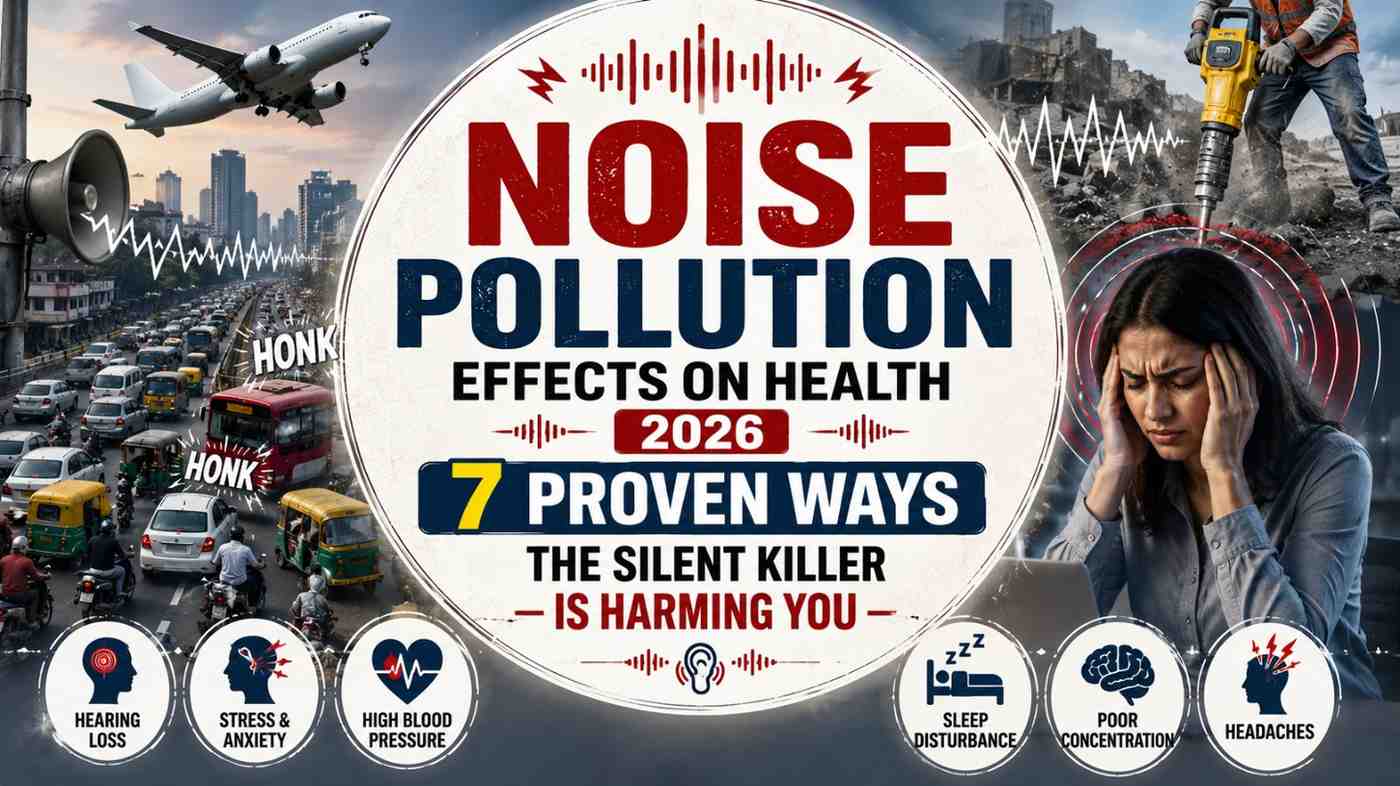
The noise pollution effects on health, 2026 research reveals, are no longer surprising to scientists—but they continue to shock the public. Noise is not merely annoying. It is a physiological stressor that raises blood pressure, disrupts sleep, impairs cognition, and increases mortality risk.
The noise pollution effects on health 2026 studies confirm what the WHO has been warning for years: environmental noise is the second-largest environmental health hazard in Europe and a growing crisis in Asia’s rapidly urbanizing cities—including every major Indian metro.
The silent killer isn’t silent at all. It’s honking outside your window right now.
What Is Noise Pollution and How Loud Is Too Loud?
Before examining noise pollution effects on health in 2026 specifically, we need to understand the scale.
The WHO recommends:
- Outdoor daytime noise: below 53 dB(A)
- Nighttime outdoor noise: below 45 dB(A)
- Indoor sleeping environment: below 35 dB(A)
Reality in Indian cities:
- Delhi roads: 80–90 dB(A) during peak traffic
- Mumbai construction zones: 85–100 dB(A)
- Typical Indian market area: 70–80 dB(A)
Prolonged exposure to noise above 65 dB(A) begins triggering measurable physiological stress responses—regardless of whether you consciously perceive it as disturbing.
Effect 1 — Cardiovascular Disease: The Deadliest Noise Pollution Effect on Health
The most serious of all noise pollution effects on health, 2026 research confirms, is cardiovascular disease.
The WHO’s 2018 Environmental Noise Guidelines for the European Region estimated that
- 48,000 new cases of ischaemic heart disease per year in Europe are attributable to road traffic noise
- 12,000 premature deaths annually linked to noise-induced cardiovascular disease
The Physiological Mechanism
Noise triggers the body’s stress response even during sleep. Cortisol and adrenaline release elevate blood pressure, heart rate, and blood glucose. Chronic activation of this response—night after night—leads to:
- Hypertension (high blood pressure)
- Arterial stiffness
- Increased risk of heart attack and stroke
A landmark study in the European Heart Journal found that each 10 dB increase in road traffic noise was associated with a 7% increase in heart attack risk.
Effect 2 — Sleep Disruption and Its Cascading Health Consequences
Noise pollution effects on health: 2026 research increasingly focuses on sleep disruption as the primary mechanism connecting noise exposure to multiple health outcomes.
Even noise that doesn’t wake you causes the following:
- Micro-arousals (brief wakings below conscious awareness)
- Suppression of slow-wave (deep) sleep stages
- Reduced REM sleep duration
- Elevated nocturnal blood pressure
The WHO identifies 40 dB(A) as the nighttime threshold above which sleep disruption begins—a threshold routinely exceeded in every major Indian city even with windows closed.
The Sleep Deprivation Cascade
Chronic sleep disruption from noise pollution effects on health 2026 feeds into the following:
- Obesity (disrupted leptin/ghrelin hormones)
- Type 2 diabetes (impaired glucose metabolism)
- Depression and anxiety
- Impaired immune function
- Accelerated cognitive decline
Related Article: Air Pollution Solutions in India 2026
Effect 3 — Hearing Loss: The Most Direct Noise Pollution Health Effect
Occupational and environmental noise-induced hearing loss is the most obvious of all noise pollution effects on health 2026 outcomes — and among the most common.
The WHO estimates 1.1 billion young people worldwide are at risk of noise-induced hearing loss from recreational noise alone.
In India:
- Traffic noise routinely exceeds 85 dB(A)—the threshold for occupational hearing damage at prolonged exposure
- Street vendors, traffic police, and construction workers face continuous extreme exposures
- Diwali firecracker noise routinely exceeds 120 dB(A)—the pain threshold
Hearing loss is irreversible. Once noise-damaged auditory hair cells are destroyed, they do not regenerate.
Effect 4 — Cognitive Impairment in Children
Children are particularly vulnerable to noise pollution effects on health in 2026. A series of studies on schoolchildren near airports, highways, and railway lines consistently shows the following:
- Reduced reading comprehension
- Lower memory performance
- Impaired attention and concentration
- Higher rates of hyperactivity
- Slower language development in younger children
The landmark RANCH (Road traffic and Aircraft Noise exposure and children’s Cognition and Health) study across multiple European countries found that aircraft noise exposure was associated with a 6-month delay in reading age.
Indian children in high-noise urban environments face comparable or worse exposures with little research and minimal mitigation.
Effect 5 — Mental Health: Anxiety, Depression, and Noise Annoyance
The noise pollution effects on health 2026 mental health research paints a consistent picture: chronic noise exposure is significantly associated with anxiety, depression, and psychological distress.
Noise annoyance — a specific psychological response to unwanted sound — activates the same stress pathways as physical danger, but without resolution.
Key findings:
- People living in high road-traffic-noise areas have 25% higher risk of depression
- Noise annoyance is a stronger predictor of stress-related illness than the actual decibel level
- Urban dwellers with access to quiet green spaces show significantly lower stress biomarkers despite similar noise exposure
Effect 6 — Dementia Risk
Among the most alarming recent noise pollution effects on health, 2026 findings show evidence linking chronic noise exposure to increased dementia risk.
A large Danish cohort study published in The Lancet Regional Health found that every 10 dB increase in road traffic noise above 45 dB(A) was associated with a 27% increase in Alzheimer’s disease risk.
The Proposed Mechanisms
- Chronic sleep disruption impairs glymphatic clearance of amyloid beta plaques from the brain
- Noise-induced cardiovascular damage reduces cerebral blood flow
- Chronic stress accelerates neuroinflammation
Noise may be silently degrading brain health over decades — with dementia as a late-stage consequence.
Effect 7 — Reduced Quality of Life and Economic Productivity
Noise pollution effects on health in 2026 extend beyond clinical disease to quality of life and economic output.
WHO estimates noise costs Europe €30–40 billion annually in lost productivity, medical costs, and reduced property values.
In India, where noise levels are generally higher and regulations weaker, the economic toll is likely proportionally greater—affecting worker productivity, student academic performance, and healthcare costs.
For comprehensive WHO noise health guidelines, see WHO Environmental Noise Guidelines for the European Region and Central Pollution Control Board Noise Standards in India.
What You Can Do: Protecting Yourself From Noise Pollution
Understanding noise pollution effects on health in 2026 is only useful if it drives protective action:
- Use earplugs or quality noise-cancelling headphones in high-noise environments
- Create a quiet sleep sanctuary—dense curtains, white noise machines, earplugs for sleeping
- Advocate for local noise ordinances and report chronic violations to local authorities
- Choose housing away from major roads where financially possible—a 50-meter setback cuts road noise by 6–8 dB
- Plant trees and hedges—vegetation reduces noise transmission by 5–10 dB per 10 meters
- Support public transport—fewer private vehicles dramatically reduce urban noise
Related Article: Best Air Purifier Plants for Home India
5 Short FAQs
Q1: What is a safe noise level for daily living? The WHO recommends outdoor daytime noise below 53 dB(A) and nighttime noise below 45 dB(A) to prevent health effects. Most Indian cities routinely exceed both limits by 20–40 dB.
Q2: Can noise pollution cause permanent damage? Yes. Noise-induced hearing loss is permanent and irreversible. Cardiovascular effects of chronic noise exposure also cause lasting arterial damage that doesn’t fully reverse when noise exposure ends.
Q3: Are children more vulnerable to noise pollution than adults? Yes. Children’s developing brains and auditory systems are more susceptible to noise damage. Cognitive impairment, reading delays, and attention deficits are documented outcomes for children in chronically noisy environments.
Q4: What are India’s noise pollution standards? India’s Noise Pollution (Regulation and Control) Rules 2000 set limits of 55 dB(A) daytime and 45 dB(A) nighttime in residential areas—limits routinely exceeded in most urban areas with limited enforcement.
Q5: Does noise pollution affect animals and wildlife? Yes, significantly. Noise pollution disrupts bird communication and breeding, disturbs marine mammals that rely on sonar, and drives wildlife away from otherwise suitable habitats near human settlements.
Conclusion
The noise pollution effects on health 2026 research makes one thing undeniably clear: noise is not a minor inconvenience. It is a measurable, documented cause of heart disease, sleep deprivation, cognitive decline, hearing loss, mental illness, and possibly dementia.
India’s cities are among the noisiest on Earth. The health cost of this is enormous—and largely invisible in public health discussions.
Your health depends on quiet. Share this article, advocate for noise regulations in your community, and take practical steps to protect your sleep, heart, and mind from the silent killer hiding in plain sound.



 creator@ecometric.site