Introduction
Ocean plastic pollution solutions for 2026 have never been more urgent—or more innovative. Over 11 million tonnes of plastic enter the world’s oceans every year, with projections suggesting this could triple by 2040 without decisive action.
The crisis is real: microplastics are now found in the deepest ocean trenches, in Arctic sea ice, in fish tissue, and in human blood. But the 2026 ocean plastic pollution solutions being deployed by scientists, engineers, and ocean organizations are also more powerful than ever.
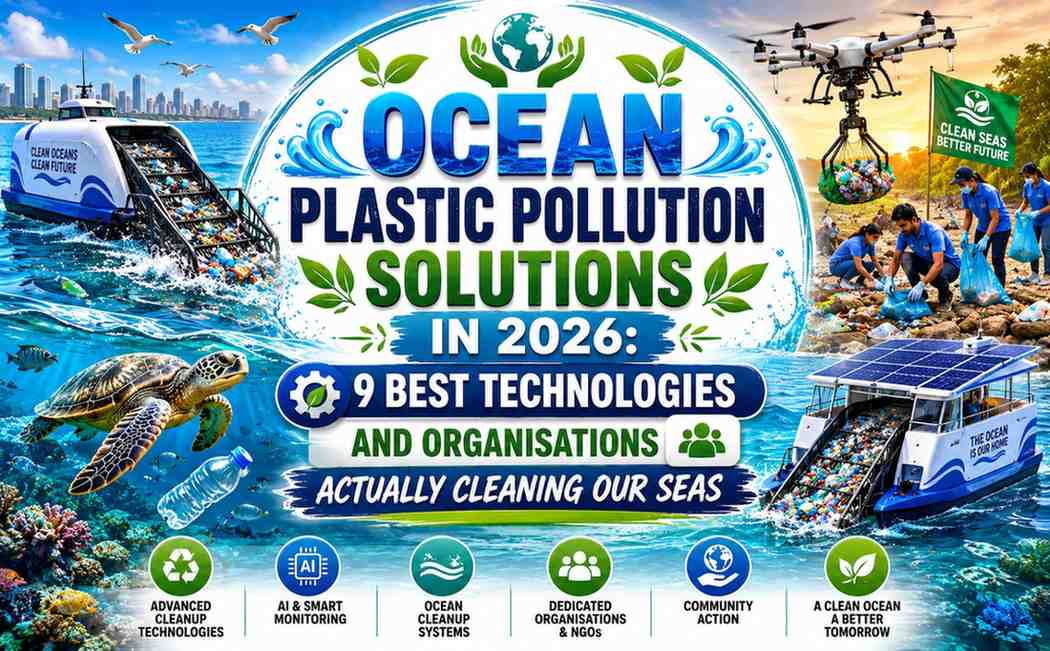
Here are 9 technologies and organizations that are actually making a measurable difference.
The Scale of the Ocean Plastic Crisis in 2026
The numbers tell a sobering story:
- 8–12 million tonnes of plastic enter oceans annually
- The Great Pacific Garbage Patch covers 1.6 million km²—twice the size of Texas
- 700 marine species are affected by ocean plastic
- Microplastics have been detected in 114 aquatic species consumed by humans
- India is among the top contributors to ocean plastic via the Ganges and coastal rivers
Understanding ocean plastic pollution solutions in 2026 requires understanding that both cleanup AND prevention are essential—ocean cleanup alone cannot outpace current input rates.
Solution 1 — The Ocean Cleanup’s System 03
The Ocean Cleanup (founded by Boyan Slat) is the most visible of all ocean plastic pollution solutions in 2026, and System 03 is its most powerful cleanup vessel yet.
System 03 is a U-shaped barrier spanning 2.6 km that captures plastic carried by ocean currents. It operates in the Great Pacific Garbage Patch and has captured over 10 million kilograms of plastic since the program began.
What Happens to the Collected Plastic
The Ocean Cleanup processes captured plastic into recycled products—initially sunglasses, now expanding to broader consumer goods. Revenue funds continued operations.
System 03 aims to clean 90% of ocean plastic by 2040 — an ambitious but scientifically grounded target.
Solution 2 — River Plastic Interception: Interceptor Systems
Stopping plastic at the river mouth before it enters the ocean is one of the most efficient ocean plastic pollution solutions in 2026. The Ocean Cleanup’s Interceptor systems do exactly this.
Interceptors are solar-powered, autonomous barges deployed in rivers—collecting plastic carried by river currents before it reaches the sea.
Interceptors are now operating or in deployment in:
- Indonesia, Malaysia, Vietnam (Southeast Asia’s highest-output rivers)
- Dominican Republic, Jamaica
- India: Planned or in early deployment stages on Ganga tributaries
India, contributing an estimated 126,500 tonnes of ocean plastic annually, is a critical deployment priority.
Related Article: Water Pollution Causes and Solutions India 2026
Solution 3 — Seabin Technology for Harbours and Marinas
Seabins are floating trash collection devices that sit in harbors, marinas, and calm coastal waters—pumping water and filtering out plastic debris, microplastics, and oil.
Each Seabin collects approximately 1.4 tonnes of debris per year—small by ocean standards but highly effective in concentrated coastal areas where plastic density is highest.
Over 1,000 Seabins are now deployed worldwide as part of ocean plastic pollution solutions 2026 in Europe, Australia, and increasingly in Asia.
Solution 4 — Manta Systems: Catamaran Microplastic Collectors
Microplastics—particles below 5 mm—are invisible to most ocean cleanup systems. The Manta vessel by the Plastic Odyssey project specifically targets microplastic collection using fine mesh trawling.
Why Microplastics Are the Hardest Problem
By volume, microplastics may outnumber macro-plastic by 100:1 in ocean water. They enter fish tissue, accumulate up food chains, and are functionally impossible to separate from seawater at large scale with current technology.
The most effective ocean plastic pollution solutions for microplastics in 2026 are prevention-focused: stopping microplastic sources at origin (synthetic textiles, tire dust, and plastic pellets).
Solution 5 — Enzymatic Plastic Degradation
Scientists have discovered and engineered enzymes capable of breaking down PET plastic (the most common ocean plastic) into its constituent monomers—which can then be used to create new virgin-quality plastic.
The FAST-PETase enzyme, developed at the University of Texas, can degrade PET in days rather than the 400 years it takes naturally.
This is one of the most exciting biological ocean plastic pollution solutions for 2026—potentially enabling enzymatic treatment of plastic-concentrated ocean zones or coastal collection sites.
Solution 6 — Extended Producer Responsibility (EPR) Legislation
The most impactful long-term ocean plastic pollution solution for 2026 is legal: making plastic producers financially responsible for the end-of-life management of their packaging.
India’s Plastic Waste Management Amendment Rules 2022 introduced EPR obligations requiring producers, importers, and brand owners to collect and process plastic waste equivalent to their production volume.
How EPR Changes Incentives
When companies pay for plastic waste management, they suddenly have financial motivation to:
- Reduce packaging weight and complexity
- Switch to recyclable or compostable materials
- Design for disassembly and reuse
- Fund collection infrastructure in markets where they sell
For an international perspective, see UNEP Global Plastic Treaty Progress 2026 and The Ocean Cleanup Progress Reports.
Solution 7 — Beach and Coastal Cleanup Networks
Organized beach cleanups seem modest compared to ocean-scale solutions — but they prevent plastic already on shore from re-entering the sea and engage millions of people in ocean stewardship.
Major networks active in India 2026:
- ICC (International Coastal Cleanup) by Ocean Conservancy — India’s largest annual coastal cleanup event
- Afroz Shah’s Versova Beach Cleanup — the world’s largest beach cleanup project, ongoing since 2015
- Surfrider Foundation India — protecting coastal ecosystems through cleanup and advocacy
Versova Beach has removed over 20 million kilograms of waste since 2015 — a powerful demonstration of what organized citizen action achieves.
Related Article: How to Reduce Plastic Pollution at Home
Solution 8 — Seaweed and Mycelium-Based Packaging Alternatives
Reducing ocean plastic requires replacing single-use plastics with genuinely biodegradable alternatives that break down harmlessly in marine environments.
Leading ocean plastic pollution solutions in 2026 in materials science include the following:
- Seaweed-based packaging: Notpla (UK) creates seaweed film sachets and coatings that dissolve in water within weeks—used at London Marathon for water sachets
- Mycelium packaging: Ecovative’s mushroom-root foam replaces expanded polystyrene with material that composts in soil within 30–45 days
- Cassava-based bags: Indonesian startup Avani produces bags from cassava starch that dissolve in water—relevant to Asian markets
Solution 9 — The UN Global Plastics Treaty
The most consequential ocean plastic pollution solution in development for 2026 is the UN Global Plastics Treaty—a legally binding international agreement to end plastic pollution.
Negotiations, which began in 2022, target a framework that would:
- Set mandatory reduction targets for plastic production
- Establish global standards for recyclability and compostability
- Create financing for developing nations to build waste management infrastructure
- Harmonize EPR requirements across jurisdictions
The treaty, expected to be finalized in 2025–2026, would be the most significant environmental agreement since the Paris Climate Accord.
5 Short FAQs
Q1: How much plastic is currently in the ocean? Estimates suggest 150–200 million tonnes of plastic have accumulated in the world’s oceans to date, with 8–12 million more tonnes added every year. The Great Pacific Garbage Patch alone contains approximately 80,000 tonnes.
Q2: Can ocean cleanup technology remove all ocean plastic? No — not at current rates of plastic entry. Even The Ocean Cleanup’s most optimistic projections require a simultaneous dramatic reduction in plastic input. Cleanup alone cannot outpace a tap still running.
Q3: How does plastic harm ocean animals? Marine animals ingest plastic, mistaking it for food, leading to starvation. They become entangled in plastic debris, causing injury and drowning. Microplastics bioaccumulate up the food chain, delivering toxic chemicals to apex predators, including humans.
Q4: What is India doing about ocean plastic pollution? India’s Plastic Waste Management Rules 2022 introduced EPR requirements, banned single-use plastics, and set up plastic waste processing infrastructure. Coastal cleanup drives involve millions of volunteers annually.
Q5: What can I do to reduce ocean plastic pollution? Refuse single-use plastics, particularly bags, straws, and bottles. Properly dispose of all plastic waste. Support brands with EPR commitments. Participate in local beach and river cleanup events. Advocate for extended producer responsibility legislation.
Conclusion
Ocean plastic pollution solutions in 2026 combine engineering brilliance, biological innovation, citizen action, and international law. None of these alone is sufficient. All of them together—plus fundamental reduction in plastic production—represent humanity’s best chance to restore ocean health.
The plastic is there. The solutions exist. The only missing ingredient is sufficient urgency and will.
Protect the oceans that protect us. Share this article, join a coastal cleanup, and choose plastic-free options in your daily life. Every piece of plastic prevented from entering the ocean is a victory.

 creator@ecometric.site