
Introduction
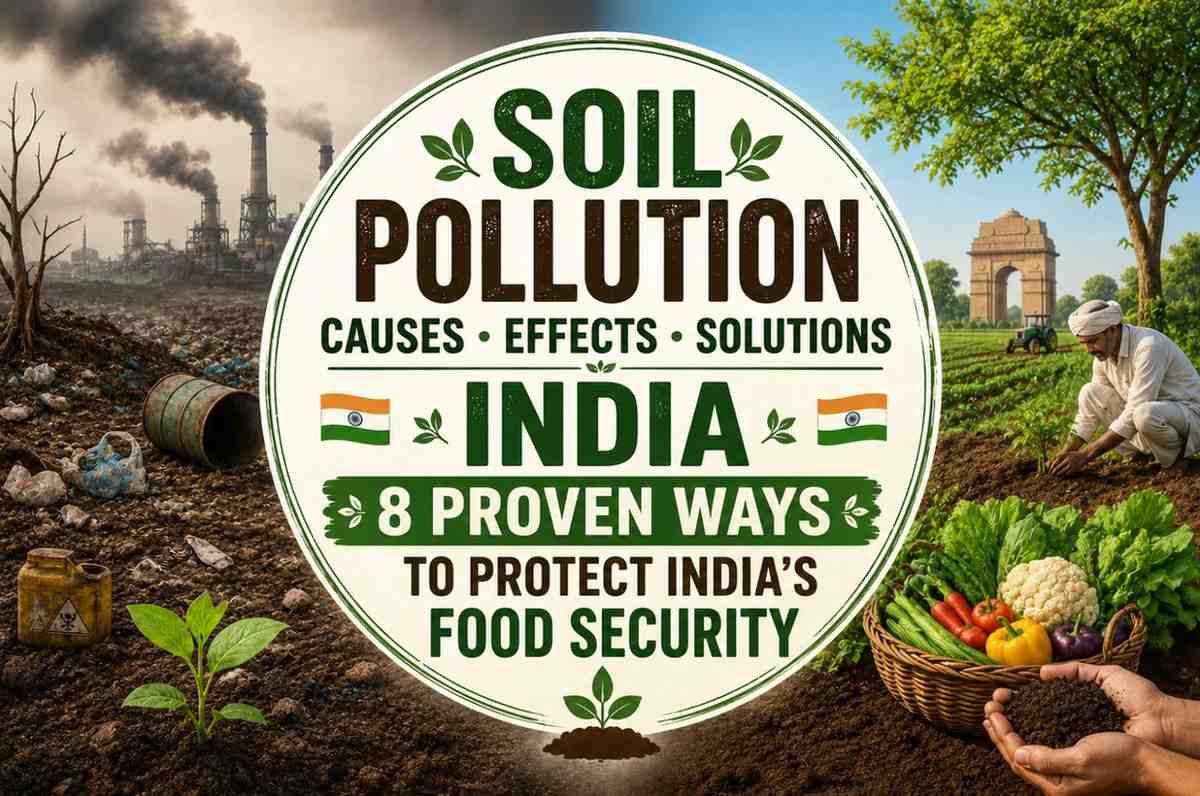
Soil pollution causes effects solutions India — this trio of concerns forms one of the country’s most underreported environmental crises. While air and water pollution command headlines, the degradation of India’s agricultural soil is a slow-motion emergency threatening the food security of 1.4 billion people.
India has approximately 297 million hectares of land, of which roughly 120 million are agricultural. Soil pollution causes effects and solutions in India affect this land directly — reducing crop yields, contaminating food, poisoning groundwater, and systematically destroying the biological foundation of farming.
Here is the complete picture — and 8 proven solutions that can reverse the damage.
The Scale of Soil Pollution in India 2026
The statistics reveal the depth of the crisis:
- Over 147 million hectares of Indian land is degraded in some form
- 5,723 potentially contaminated sites have been identified by CPCB — the real number is likely far higher
- Punjab’s soil, once the breadbasket of India, shows heavy metal concentrations 2–10 times above safe limits in multiple districts
- Microplastic contamination of agricultural soil is now documented in every Indian state studied
Understanding soil pollution causes effects solutions India begins with identifying where the contamination originates.
The Main Soil Pollution Causes in India
Cause 1 — Chemical Fertilizer Overuse
India uses approximately 166 kg of fertilizer per hectare of cropland — well above the global average. Chronic nitrogen and phosphorus fertilizer overuse:
- Acidifies soil, destroying beneficial microbial communities
- Causes nitrogen runoff contaminating groundwater
- Creates nutrient imbalances that reduce long-term crop productivity
- Generates nitrous oxide emissions (a potent greenhouse gas)
Cause 2 — Pesticide and Insecticide Accumulation
India uses over 50,000 tonnes of pesticides annually. Many organochlorine pesticides — including DDT, which India finally phased out from agriculture in 2008 — persist in soil for decades.
Newer organophosphate pesticides degrade faster but create acute toxicity risks for soil organisms, earthworms, and beneficial insects including pollinators.
Cause 3 — Industrial Waste Disposal
Soil pollution causes effects solutions India researchers consistently identify industrial waste as the most severe contamination source. Industries generating hazardous soil pollution include:
- Tanneries (chromium contamination in Kanpur and Unnao)
- Battery recycling units (lead contamination)
- Mining operations (arsenic, cadmium, mercury)
- Textile dyeing units (azo dyes and heavy metals)
- Electronic waste dismantling (in Delhi NCR and Mumbai periphery)
Cause 4 — Municipal Solid Waste Dumping
Open landfills and illegal dumping sites leach heavy metals, organic chemicals, and pathogens into surrounding soil. India’s 3,159 urban local bodies collectively generate over 150,000 tonnes of municipal solid waste daily — much of which ends up in open dumping grounds rather than managed landfills.
Cause 5 — Wastewater Irrigation
Many farmers, particularly around cities, irrigate with untreated or partially treated sewage water — attracted by its nitrogen content. This introduces heavy metals, pharmaceuticals, and pathogens directly into food-growing soil.
The Main Soil Pollution Effects in India
Effect 1 — Reduced Crop Yield and Quality
Soil contamination directly reduces agricultural productivity. Heavy metals inhibit plant enzyme function and nutrient absorption. Pesticide accumulation destroys mycorrhizal fungi networks that help roots absorb phosphorus and water.
Punjab, which pioneered India’s Green Revolution, now faces declining soil health — with paddy yields stagnating and farmers reporting increased input requirements to maintain output.
Effect 2 — Food Contamination and Human Health
Soil pollution causes effects solutions India research shows crops grown in contaminated soil absorb heavy metals — particularly cadmium, lead, and arsenic — into edible parts.
Studies of rice, wheat, and vegetables grown near tanneries, mining areas, and sewage-irrigated farms in India have found heavy metal levels exceeding safe limits.
Heavy metal food contamination causes:
- Kidney damage (cadmium)
- Neurological impairment, particularly in children (lead)
- Cancer risk (arsenic, cadmium, chromium VI)
Effect 3 — Groundwater Contamination
Pollutants leaching through contaminated soil enter groundwater — the drinking water source for 60% of India’s rural population. Fluoride, arsenic, nitrates, and heavy metals are already present at unsafe levels in groundwater across multiple Indian states.
Effect 4 — Loss of Soil Biodiversity
Healthy agricultural soil contains more organisms per teaspoon than humans on Earth. Pesticides, heavy metals, and chemical fertilizers devastate this underground ecosystem — destroying the biological services (nutrient cycling, disease suppression, water retention) that make soil productive without purchased inputs.
8 Proven Soil Pollution Solutions for India
Solution 1 — Soil Health Cards and Precision Fertilization
The Government of India’s Soil Health Card scheme has tested over 22 crore soil samples — providing farmers with crop-specific fertilizer recommendations based on actual soil nutrient status.
This prevents over-fertilization — addressing one of the primary soil pollution causes in India at its source.
Solution 2 — Organic Farming Transition Support
Converting from chemical-intensive to organic farming eliminates pesticide and chemical fertilizer input while building soil organic matter. India already has 2.8 million certified organic farmers — the world’s largest count — but organic area remains a small fraction of total cropland.
State programs in Sikkim (100% organic) and Andhra Pradesh (natural farming movement with 700,000 farmers) demonstrate that transition at scale is possible.
Solution 3 — Phytoremediation: Plants That Clean Soil
Certain plants accumulate heavy metals from contaminated soil into their tissue — a process called phytoremediation. Indian research institutions have identified several effective phytoremediators for local conditions:
- Sunflower: Absorbs lead and radioactive cesium
- Indian mustard (Brassica juncea): Absorbs lead, cadmium, zinc, copper
- Vetiver grass: Stabilizes contaminated soil, absorbs heavy metals
- Hemp (Cannabis sativa): Efficient heavy metal accumulator
Multiple cycles of phytoremediator planting and harvesting can progressively reduce soil heavy metal levels.
Related Article: Water Pollution Causes and Solutions India 2026
Solution 4 — Bioremediation Using Indigenous Microorganisms
Soil pollution causes effects solutions India research at IIT Bombay, IIT Delhi, and CSIR institutions has identified soil bacteria and fungi capable of degrading petroleum hydrocarbons, pesticides, and organic pollutants.
Bioaugmentation — introducing remediation microorganisms to contaminated sites — and biostimulation — enhancing existing microbial communities with nutrients and oxygen — are cost-effective solutions for organic soil contaminants.
Solution 5 — Hazardous Waste Site Remediation Program
CPCB’s contaminated site remediation program targets the most severe industrial contamination hotspots. Priority sites include:
- Kanpur tannery belt (chromium)
- Sukinda chromite mines, Odisha
- Jadugora uranium mining area, Jharkhand
- Various battery recycling clusters in NCR
Full remediation of these sites would immediately remove sources of ongoing groundwater and soil contamination affecting millions of people.
For technical guidelines, see CPCB Contaminated Site Remediation and Ministry of Agriculture Soil Health Programme.
Solution 6 — Natural Farming and Vermicomposting
Andhra Pradesh’s Community Managed Natural Farming (APCNF) program has demonstrated dramatic soil health recovery through:
- Complete elimination of chemical inputs
- Jeevamruta (fermented cow dung and urine preparation) as soil inoculant
- Mulching to protect soil microbial communities
- Crop rotation and intercropping to restore nutrient balance
Participating farms show increased earthworm counts, improved water retention, and recovering yields — despite initially lower productivity during transition.
Solution 7 — Stricter Industrial Effluent Control Near Farmland
Buffer zones around agricultural land — preventing industrial effluent disposal within specified distances — are a fundamental regulatory soil pollution solution in India.
State Pollution Control Boards are mandated to enforce these buffers, though ground-level compliance remains inconsistent.
Solution 8 — Plastic Mulch Film Recovery Programs
Plastic mulch films used in agriculture are a growing source of microplastic soil contamination. Films fragment in sunlight and tillage, releasing microplastics that persist indefinitely.
Mandatory plastic film recovery programs — requiring farmers to collect and return used film for recycling — are being piloted in Gujarat and Rajasthan.
Related Article: Zero Waste Lifestyle Tips for Beginners India
5 Short FAQs
Q1: Is India’s agricultural soil getting more polluted over time? Overall, yes. Chemical input intensity has increased steadily. Industrial contamination of agricultural soil continues in many regions. However, pockets of improvement exist — particularly where organic and natural farming transitions have occurred.
Q2: Which Indian states have the worst soil pollution? Punjab (heavy metals from industrial and agricultural chemicals), Uttar Pradesh (tannery and industrial waste), Odisha and Jharkhand (mining contamination), and urban agricultural belts around Delhi and Mumbai (sewage irrigation) face the most severe documented soil pollution.
Q3: Can contaminated soil be restored to fertility? Yes — but it takes time. Mild contamination can recover within 3–10 years of pollution removal and organic management. Severe heavy metal contamination may require active remediation (phyto or bioremediation) for 10–30 years before agricultural use is advisable.
Q4: Are organic vegetables from India actually free of soil pollution? Not necessarily. Certified organic farming avoids adding pesticides and chemical fertilizers, but if soil was previously contaminated, or if irrigation water is polluted, organic certification doesn’t guarantee heavy-metal-free produce. Soil testing before and during organic transition is essential.
Q5: What is the Soil Health Card scheme and is it helping? India’s Soil Health Card scheme tests farmer soil samples and provides crop-specific nutrient recommendations. Over 22 crore cards have been issued. Where followed, the scheme reduces over-fertilization and improves soil health. Adoption and compliance remain the key challenges.
Conclusion
Soil pollution causes effects solutions India describe a crisis that is slower and less visible than air or water pollution — but potentially more consequential. India’s food security depends on healthy agricultural soil. Its contamination threatens not just crop yields but the health of hundreds of millions of Indians through food and water.
The solutions — organic farming, phytoremediation, bioremediation, industrial controls, precision agriculture — are available, proven, and increasingly deployed. What’s needed is greater urgency, funding, and enforcement.
India’s food security begins in the soil. Share this article, support organic farming initiatives, and demand that industrial contamination of agricultural land is treated as the national security issue it truly is.



 creator@ecometric.site