
ntroduction
Zero waste lifestyle tips for beginners in India are more relevant — and more achievable — than ever before. India generates over 62 million tonnes of municipal solid waste annually, with only 22–28% properly processed. The rest ends up in landfills, open dumps, and eventually in waterways and soil.
The good news for Indian households: zero waste lifestyle tips for beginners India practitioners discover that this path actually saves money, reconnects you with traditional Indian practices, and significantly reduces your environmental footprint.
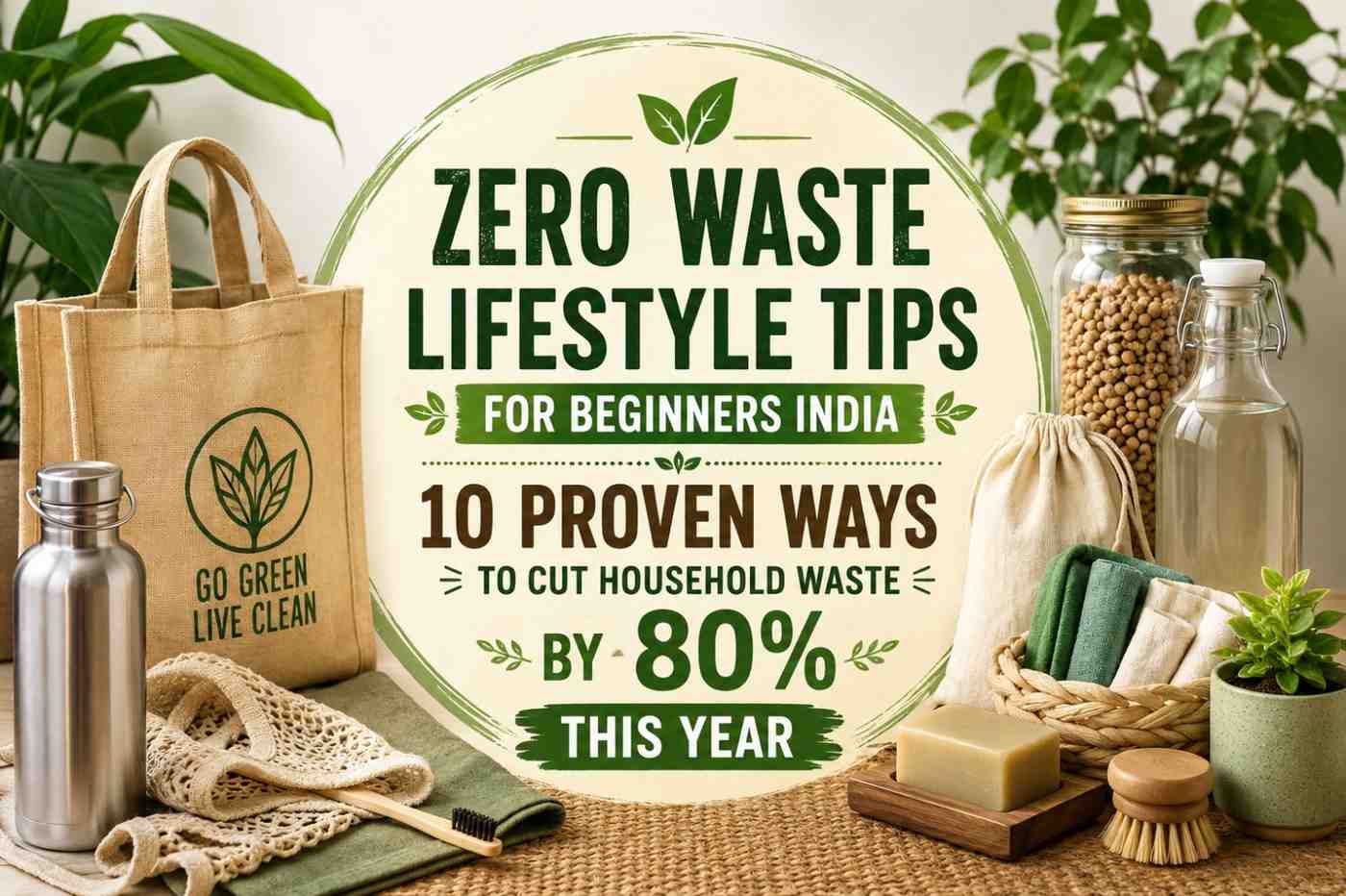
You don’t need to be perfect. You need to start. Here are 10 proven steps to cut your household waste by 80% this year.
What Is a Zero Waste Lifestyle for Indian Households?
Zero waste lifestyle tips for beginners India guides typically define zero waste not as literally producing zero trash — but as dramatically minimizing waste through refusing, reducing, reusing, recycling, and composting (the “5 Rs”).
The goal is to produce so little non-recyclable, non-compostable waste that your landfill contribution approaches zero.
For Indian households, this is particularly achievable because:
- Indian culture traditionally produces far less packaging waste
- Composting of organic waste (60–70% of Indian household waste by weight) is straightforward
- Cloth bags, steel containers, and bulk purchasing from kirana stores are already culturally embedded
- Traditional practices like using banana leaves, clay pots, and newspaper wrapping are inherently zero-waste
Step 1 — Conduct a Waste Audit First
The first of all zero waste lifestyle tips for beginners India practitioners recommend: before changing anything, examine what you’re actually throwing away.
Spend one week collecting and categorizing your household waste:
- Organic/food waste (fruit peels, vegetable scraps, cooked food waste)
- Plastic packaging (sachets, wrappers, bags, bottles)
- Paper and cardboard
- Glass
- Metal (tins, foils)
- Other/mixed waste
Most Indian households find that 60–70% is organic waste (directly compostable), 15–20% is plastic packaging, and 10–15% is paper. This immediately reveals where to focus effort first.
Step 2 — Start Composting: The Highest-Impact Zero Waste Step
Since organic waste is the dominant fraction of Indian household waste, composting is the single most impactful of all zero waste lifestyle tips for beginners India guides recommend.
Easy Composting Methods for Indian Apartments
Khamba pot composting: Traditional terracotta pot composting using earthworms (vermicomposting). Compact, odour-free, and produces excellent fertilizer for plants. Kits available from ₹1,000–3,000.
Two-pot system: Two plastic buckets with holes alternated — fill one, let it mature, use the compost on plants and start again.
Bokashi composting: Japanese-origin fermentation system using Bokashi bran. Works for cooked food, meat, and dairy — which traditional composting can’t handle. No odour, very compact. Bokashi bran available in Indian eco-stores.
A household generating 500g–1kg of food waste daily can produce high-quality garden compost within 6–8 weeks. This single step eliminates 60–70% of landfill-bound waste.
Step 3 — Eliminate Single-Use Plastic Systematically
Plastic packaging is the second-largest waste stream for most Indian households. Zero waste lifestyle tips for beginners India guides consistently recommend a systematic elimination approach:
Month 1: Cloth bags for all shopping (eliminates carry bags)
Month 2: Steel water bottle everywhere (eliminates purchased plastic bottles)
Month 3: Loose grain, spice, and pulse purchasing from kirana (eliminates plastic pouches)
Month 4: Bar soap, shampoo bars, refill-based cleaning products (eliminates bathroom plastic)
Month 5: Seasonal fruit and vegetable purchasing from vendors (eliminates supermarket plastic trays)
By month 6, most households following these zero waste lifestyle tips for beginners in India find their plastic waste reduced by 80–90%.
Related Article: How to Reduce Plastic Pollution at Home
Step 4 — Master the Art of Refusing
The most powerful word in zero waste lifestyle tips for beginners India practice is “no.”
Refusing unwanted items prevents waste before it enters your home:
- “No straw, please” at restaurants
- “No plastic bag” (carry your own)
- “No receipt, please” (or ask for digital receipt)
- “No promotional flyer, please” at events
- “No single-use cup” (carry your own steel or bamboo cup)
Refusing requires only habit change — no additional purchases. It is the most cost-free of all zero waste lifestyle practices.
Step 5 — Adopt Traditional Indian Practices That Were Always Zero Waste
A profound insight in authentic zero waste lifestyle tips for beginners India content: India didn’t need to “discover” zero waste. Traditional Indian life was already zero waste.
Traditional zero-waste practices to revive:
- Banana leaf plates instead of thermocol or plastic disposables
- Clay cups (kulhad) for chai — biodegradable and enriches soil
- Cloth diapers (langots) instead of disposable nappies
- Brass and copper vessels instead of plastic containers
- Newspaper wrapping for fresh produce instead of plastic bags
- Repairing rather than replacing — the traditional Indian mochi (cobbler) and darzi (tailor) model
These practices weren’t “sustainable” as a conscious philosophy — they were just economically logical. Reviving them reduces waste while saving money.
Step 6 — Build a Zero Waste Kitchen
The kitchen generates most household waste. Zero waste lifestyle tips for beginners India for the kitchen:
Meal planning: Reduce food waste by planning meals and buying only what you’ll actually use. Food waste in Indian households is estimated at 50–70 kg per person per year.
Root-to-stem cooking: Use every part of vegetables — pumpkin seeds (roast and eat), cauliflower leaves (sabzi), banana peels (thoran), watermelon rind (pickle). Traditional Indian cuisine already does this brilliantly.
Proper storage: Vegetables stored correctly last 2–3 times longer. Leafy greens stay fresh for a week in a damp cloth in the fridge. Root vegetables keep for weeks in a cool, dark, well-ventilated basket.
Lacto-fermentation: Traditional pickles (achar), kanji, and fermented foods extend seasonal produce far beyond harvest — a zero-waste food preservation technique India mastered centuries ago.
Step 7 — Choose Package-Free and Bulk Purchasing
Zero waste lifestyle tips for beginners India consistently point to bulk purchasing and package-free shopping as transformative.
Most Indian cities still have:
- Kirana stores selling rice, flour, pulses, sugar, spices loose by weight
- Sabzi mandis where fresh produce is sold without packaging
- Mobile vegetable vendors from whom produce needs no plastic bag
- Oil dispensing shops that refill your container
Bring your own containers. The shopkeeper saves on packaging. You get fresher product, save money, and eliminate plastic entirely.
Step 8 — Create a Zero Waste Bathroom
The bathroom is the second most plastic-intensive zone. Zero waste lifestyle tips for beginners India for the bathroom:
- Bar soap in paper packaging replaces 2–3 liquid soap plastic bottles per year
- Bamboo toothbrush replaces plastic toothbrush (change every 3 months)
- Shampoo bars replace plastic shampoo bottles
- Menstrual cups or cloth pads replace years of disposable sanitary product plastic
- Safety razor replaces lifetime of plastic disposable razors
- Coconut oil or aloe vera gel replaces multiple single-function moisturizer plastic tubes
A zero-waste bathroom transition typically saves ₹3,000–8,000 per year compared to conventional product purchasing.
Step 9 — Repair, Donate, and Swap Instead of Disposing
Zero waste lifestyle tips for beginners India practitioners eliminate a major waste stream by changing their relationship with possessions.
Before discarding anything:
- Can it be repaired? Cobblers, tailors, electronics repair shops, furniture carpenters — India’s repair economy is still alive and affordable
- Can it be donated? Goonj, iSPRAT, DanMart, and local NGOs accept quality used clothing, books, toys, and household items
- Can it be sold? OLXIndia, Facebook Marketplace, neighbourhood WhatsApp groups
- Can it be swapped? Local swap events and online swap communities are growing in Indian cities
Only when all four options are exhausted should disposal be considered.
For India-specific zero waste resources, see Centre for Science and Environment Zero Waste India and Sustainability India Community.
Step 10 — Build Community and Normalize Zero Waste Around You
The deepest of all zero waste lifestyle tips for beginners India veteran practitioners share: individual change multiplied by community adoption is exponentially more powerful.
Practical community zero waste actions:
- Organize a neighbourhood composting collective (shared Khamba system)
- Start a building-level segregation and recycling system
- Create a RWA swap library for books, tools, and occasionally used items
- Introduce zero-waste birthday party norms in your circle (no plastic decorations, cloth bags as return gifts, home-cooked food)
- Share this article and your own journey with family WhatsApp groups
The most contagious thing about zero waste lifestyle tips for beginners India success stories: they inspire the people who see them in action.
Related Article: Soil Pollution Causes Effects Solutions India
What 80% Waste Reduction Actually Looks Like
A typical Indian family of four currently generates approximately 2–4 kg of waste per day.
Following these zero waste lifestyle tips for beginners India through to implementation:
- Composting (60–70% reduction): 1.2–2.8 kg/day diverted from landfill
- Plastic elimination (15–20% reduction): 300–800g/day
- Paper reduction (10% reduction): 200–400g/day
Remaining non-compostable, non-recyclable waste: less than 400g per day — a reduction of 70–80% from baseline.
Within one year, households consistently following this guide produce waste that fits in a small jar per month — the “Mason jar goal” of the zero waste movement.
5 Short FAQs
Q1: Is zero waste lifestyle affordable in India? Yes — and it typically saves money. Bulk purchasing, fewer packaged products, reusable items replacing disposables, and reduced food waste all cut household expenditure. Most families save ₹3,000–10,000 per year within the first year of zero waste practice.
Q2: How do I handle wet waste or food scraps in an apartment without a garden? Khamba pot composting (terracotta pot vermicomposting) works perfectly in apartments with no outdoor space. It is odour-free, compact (fits in a kitchen corner or balcony), and produces excellent compost for potted plants. Bokashi fermentation is another excellent apartment option.
Q3: What do I do with plastic waste that I can’t avoid? Collect unavoidable plastics, clean and dry them, and give them to your kabadiwala (scrap dealer), or drop at ITC’s WoW (Wellbeing Out of Waste) collection points, Tetra Pak recycling bins, or local NGO recycling drives. These divert plastic from landfill even when elimination isn’t possible.
Q4: How do I get my family to adopt zero waste practices? Start with the swaps that benefit them directly — fresher food, cost savings, better health. Don’t lecture; demonstrate. Cook from scratch, bring your own bags, start a balcony garden with compost. Visible success is far more persuasive than information.
Q5: What is the first step someone should take toward zero waste in India? Start composting food waste. It’s the highest-impact single action (eliminates 60–70% of household landfill waste), is completely free to start, produces valuable fertilizer for plants, and makes all subsequent zero waste steps feel easier by building the habit of intentional waste awareness.
Conclusion
Zero waste lifestyle tips for beginners India point toward a way of living that is not only environmentally responsible but deeply connected to the best of India’s traditional culture — thrift, resourcefulness, community, and respect for the material world.
Cutting your household waste by 80% in one year is not an extreme goal. It’s an achievable, money-saving, health-improving lifestyle upgrade that thousands of Indian families have already made.
Start today. Pick one step from this guide — just one — and implement it this week. Then add another. Within a year, your home will be transformed, your conscience will be lighter, and your contribution to India’s waste crisis will have turned from part of the problem to part of the solution.



 creator@ecometric.site